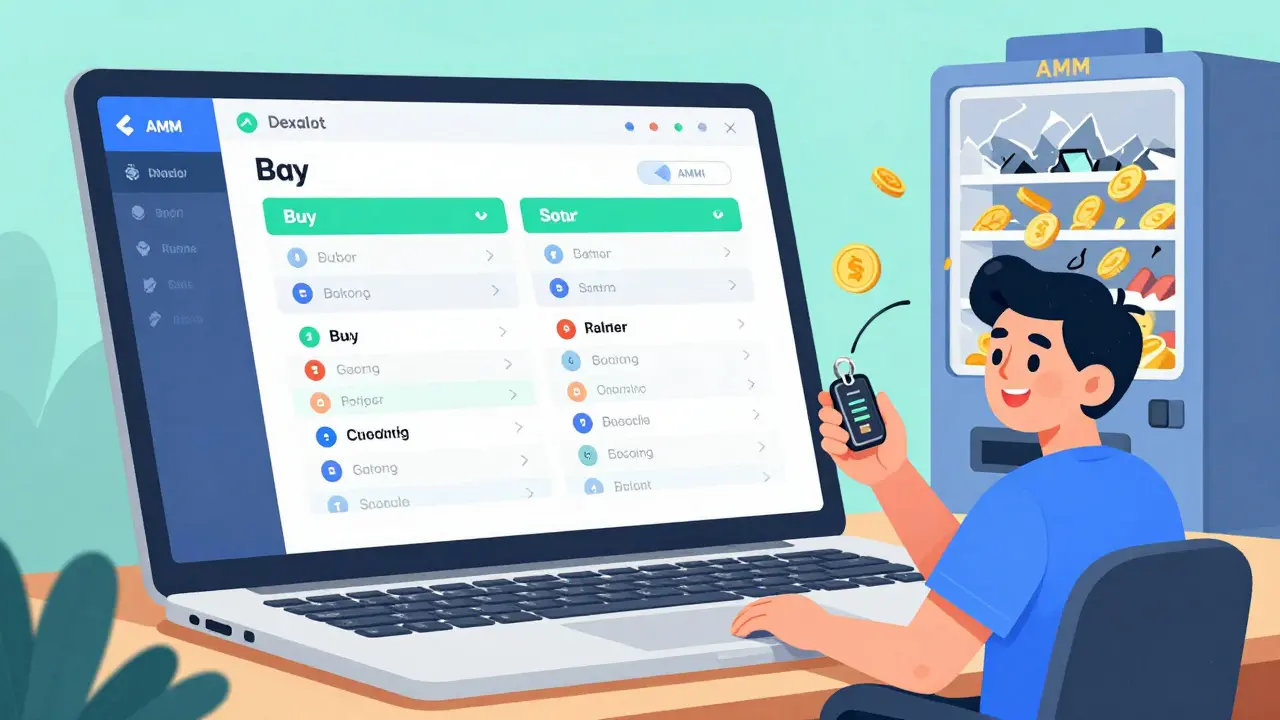
Most decentralized exchanges (DEXs) feel like stepping back in time. You get stuck with confusing interfaces, massive slippage on big trades, and the constant headache of calculating gas fees for every single click. Dexalot promises to fix this by bringing the familiar look and feel of a centralized exchange-like Binance or Coinbase-into the decentralized world. But does it actually deliver, or is it just another project chasing hype?
In this Dexalot review, we’re cutting through the marketing fluff. We’ll look at how their unique order-book system works, whether the ALOT token is worth your attention, and if the platform’s security holds up against the giants like Uniswap. If you are tired of automated market makers (AMMs) eating your profits on large orders, keep reading.
What Exactly Is Dexalot?
Dexalot is a non-custodial, omni-chain decentralized exchange that uses an on-chain Central Limit Order Book (CLOB) rather than an Automated Market Maker model. It was built from the ground up to be fully on-chain, meaning no central server controls your funds or matches your trades behind the scenes.
The biggest differentiator here is the technology stack. While most DEXs sit on Ethereum and suffer from its slow speeds and high costs, Dexalot is built primarily on Avalanche C-Chain. This network offers 100% compatibility with Ethereum Virtual Machine (EVM) technology but delivers transaction finality in just 1-2 seconds. They have also expanded to Arbitrum and Base, allowing for cross-chain liquidity without needing wrapped assets.
Think of it this way: Uniswap is like buying stocks from a vending machine-you pay whatever price the machine sets based on the ratio of coins inside. Dexalot is like walking onto the floor of the New York Stock Exchange. You see every buy and sell order, and you trade directly with other people. This results in much better prices for larger trades.
User Experience: The Centralized Feel Without the Risk
If you have traded on a centralized exchange (CEX) before, Dexalot will feel instantly familiar. The interface mimics traditional platforms, featuring real-time charts, depth-of-market graphs, and a standard order entry form. This lowers the barrier to entry significantly. You don’t need to understand complex liquidity pool ratios to make a trade.
Here is what makes the experience smooth:
- Gasless Transactions: Through integrations like D’CENT Wallet’s GasPass technology, many swaps and transfers on supported chains cost zero gas fees. This is a huge win for small traders who usually lose money on network fees alone.
- Web3 Integration: You connect via MetaMask or similar wallets. Your private keys never leave your device, ensuring true self-custody.
- Cross-Chain Simplicity: Their SimpleSwap feature lets you move liquidity between Avalanche, Arbitrum, and Base seamlessly. You aren't locked into one ecosystem.
However, there is a catch. Because it is a newer platform compared to industry leaders, the mobile app is still "coming soon" as of late 2024 updates. For now, you are mostly relying on the web interface, which works fine on desktops but can be clunky on smaller screens.
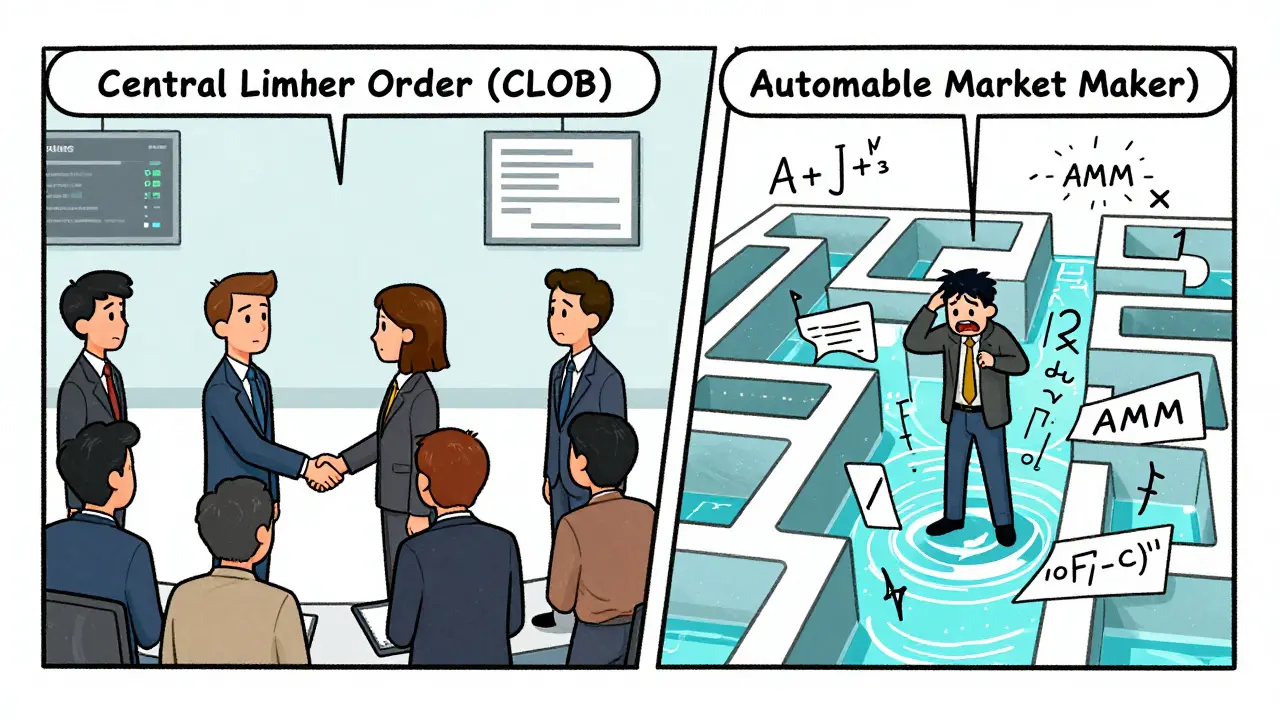
Trading Mechanics: CLOB vs. AMM
To understand why Dexalot matters, you need to understand the difference between their model and the competition.
| Feature | Dexalot (CLOB) | Uniswap/Raydium (AMM) |
|---|---|---|
| Price Discovery | Driven by actual buyer/seller orders | Driven by mathematical formulas and pool ratios |
| Slippage | Low for large orders (if liquidity exists) | High for large orders due to curve impact |
| Capital Efficiency | High; liquidity providers earn fees without impermanent loss risk in some models | Lower; liquidity providers face significant impermanent loss |
| Complexity | Requires understanding order books (Limit/Market orders) | Simpler "swap" interface, but hidden complexities in pools |
The Central Limit Order Book (CLOB) allows for precise execution. If you want to buy Bitcoin when it hits $60,000 exactly, you place a limit order. On an AMM, you might get filled at $59,800 or $60,200 depending on the pool's state. For professional traders, this precision is non-negotiable.
Security and Trust: Who Holds Your Keys?
Security is the main reason people flock to DEXs. With Dexalot, you are dealing with a non-custodial platform. This means Dexalot never holds your funds. When you trade, the smart contract executes the swap instantly on the blockchain. If the website goes down tomorrow, your assets are still safe in your wallet.
Their architecture includes a PostgreSQL database that acts as a mirror for transactions, ensuring transparency, while the immutable records live on the Avalanche C-Chain. They claim to use "industry best practices in traditional finance combined with top-tier crypto audits." However, specific audit firm names and dates are often buried in technical docs rather than front-and-center on the homepage, which is a slight red flag for new users who should always verify these details independently.
Unlike hybrid solutions that store user data off-chain for speed, Dexalot states they "never consider hybrid solutions," sticking to pure decentralization. This is a philosophical stance that prioritizes security over potential marginal speed gains, appealing to purists but potentially limiting scalability optimizations seen in competitors.
The ALOT Token: Utility or Speculation?
Every exchange has a native token, and Dexalot’s is ALOT. As of late 2025 data, the token has faced significant market pressure. Here are the hard numbers:
- Current Price: ~$0.17 USD
- Market Cap: ~$15.69 million
- 24h Volume: ~$27.36 million
- Total Supply: 100 million tokens
- Circulating Supply: 57 million tokens
The price history tells a cautionary tale. From a 1-year high of $3.21, the token dropped roughly 83% to its current levels. This volatility suggests that while the platform is building utility, the market sentiment remains cautious. The ALOT token is designed for governance participation and potential fee discounts, but the exact economic mechanics were only partially detailed in founder interviews.
Be aware: A low market cap ($15m) means the token is highly susceptible to manipulation and large swings. It is not yet a "blue chip" asset. Treat any investment in ALOT as high-risk speculation until the platform achieves mass adoption comparable to Uniswap or PancakeSwap.
Pros and Cons: The Honest Verdict
No platform is perfect. Before you connect your wallet, weigh these factors carefully.
Why You Might Like Dexalot:
- Speed: 1-2 second finality on Avalanche is incredibly fast for a DEX.
- Cost: Gasless transactions remove friction for small trades.
- Interface: Familiar order-book UI reduces the learning curve for ex-CEX traders.
- Decentralization: True non-custodial trading with no central point of failure.
Why You Should Be Careful:
- Liquidity Depth: Compared to Uniswap’s billions in daily volume, Dexalot’s volume is tiny. Large institutional-sized orders might still struggle to find enough counter-parties.
- Token Volatility: The ALOT token has crashed significantly, indicating weak holder confidence so far.
- Ecosystem Size: Fewer integrated DeFi apps mean less "stickiness" compared to Ethereum or Solana ecosystems.
- Mobile Access: Lack of a robust native mobile app limits on-the-go trading.
Who Is Dexalot For?
Dexalot isn’t for everyone. If you are a casual user who just wants to swap ETH for USDT quickly and doesn’t care about slippage, stick with Uniswap or a centralized exchange. The convenience outweighs the minor price differences for small amounts.
However, Dexalot shines for:
- Active Traders: Those who use limit orders and stop-losses to manage risk precisely.
- Large Volume Traders: Individuals moving significant sums who want to avoid the heavy slippage penalties of AMMs.
- Privacy Advocates: Users who refuse to KYC (Know Your Customer) and want full anonymity.
- Avalanche Ecosystem Fans: People already holding AVAX who want deep liquidity options within that network.
Final Thoughts
Dexalot represents a compelling middle ground in the crypto space. It attempts to solve the two biggest complaints about DEXs: poor user experience and high costs. By leveraging Avalanche’s speed and implementing a traditional order book, they have created a tool that feels modern and efficient.
But remember, technology alone doesn’t drive value. Liquidity does. Until Dexalot attracts more users and deeper liquidity pools, it remains a niche player. Use it for its strengths-speed and precision-but keep an eye on the broader market trends. Always do your own research (DYOR), start with small amounts, and never invest more than you can afford to lose.
Is Dexalot safe to use?
Yes, Dexalot is considered safe because it is non-custodial. You retain control of your private keys, and trades are executed via smart contracts on public blockchains like Avalanche and Arbitrum. However, always verify contract addresses and ensure you are using the official website to avoid phishing scams.
Does Dexalot require KYC?
No. As a decentralized exchange (DEX), Dexalot does not require identity verification (KYC). You simply connect your Web3 wallet (like MetaMask) to start trading. This preserves your privacy but also means there is no customer support to recover lost funds if you make a mistake.
What is the ALOT token used for?
The ALOT token serves as the native utility token for the Dexalot ecosystem. Its primary functions include governance voting rights for protocol changes and potential fee discounts for traders. It may also be used in future incentive programs like the DIP Incentives mentioned by the team.
Can I trade on Dexalot with my phone?
Currently, Dexalot is primarily a web-based platform. While the website is responsive, there is no dedicated native mobile app available yet. The team has indicated that a mobile app is in development, but for now, you must use a mobile browser connected to your wallet.
How does Dexalot compare to Uniswap?
Uniswap uses an Automated Market Maker (AMM) model, which is simpler but can result in high slippage for large trades. Dexalot uses a Central Limit Order Book (CLOB), offering better price precision and lower slippage for active traders. However, Uniswap has significantly higher liquidity and volume, making it better for rare tokens, while Dexalot excels in speed and trading mechanics on supported chains.