Are you looking for a new place to trade your cryptocurrency? If you clicked on this title expecting a traditional exchange like Binance or Coinbase, you might be about to make a costly mistake. DeFi Kingdoms (Crystalvale) is not a standalone cryptocurrency exchange but rather a cross-chain fantasy RPG game that integrates decentralized exchange functionality. While it does let you swap tokens, treating it as a primary trading platform could lead to frustration due to low liquidity and high slippage.
This guide cuts through the hype. We’ll break down what DeFi Kingdoms actually is, how its in-game DEX works, and whether it’s worth your time in 2026. You’ll learn the real costs of using the platform, the risks involved with the CRYSTAL token, and who should-and shouldn’t-use this platform.
What Is DeFi Kingdoms (Crystalvale)?
To understand why people call it an "exchange," we need to look at its roots. DeFi Kingdoms launched originally on the Harmony Protocol blockchain as a world called Serendale. In March 2022, the team expanded by launching Crystalvale on an Avalanche Subnet blockchain. This move was significant because Avalanche offers faster transaction speeds and lower fees compared to Ethereum mainnet, making the gaming experience smoother.
The core idea is simple: combine the fun of a role-playing game with the financial mechanics of decentralized finance (DeFi). Instead of just clicking buttons to buy and sell assets, you do it while playing a game. Your heroes fight monsters, you collect loot, and you manage resources-all on-chain. The "exchange" part is just one feature within this larger ecosystem. It functions similarly to Uniswap, allowing you to swap tokens, but the interface is wrapped in pixel-art aesthetics and fantasy lore.
If you’re coming from a background of centralized exchanges, this will feel different. There are no customer support agents to call if something goes wrong. You are interacting directly with smart contracts. This means you have full control over your assets, but you also bear full responsibility for security.
How the In-Game DEX Works
The decentralized exchange (DEX) inside Crystalvale is built on the UniswapV2 Protocol. This is the same underlying technology used by many major DeFi platforms. Here’s how it operates in practice:
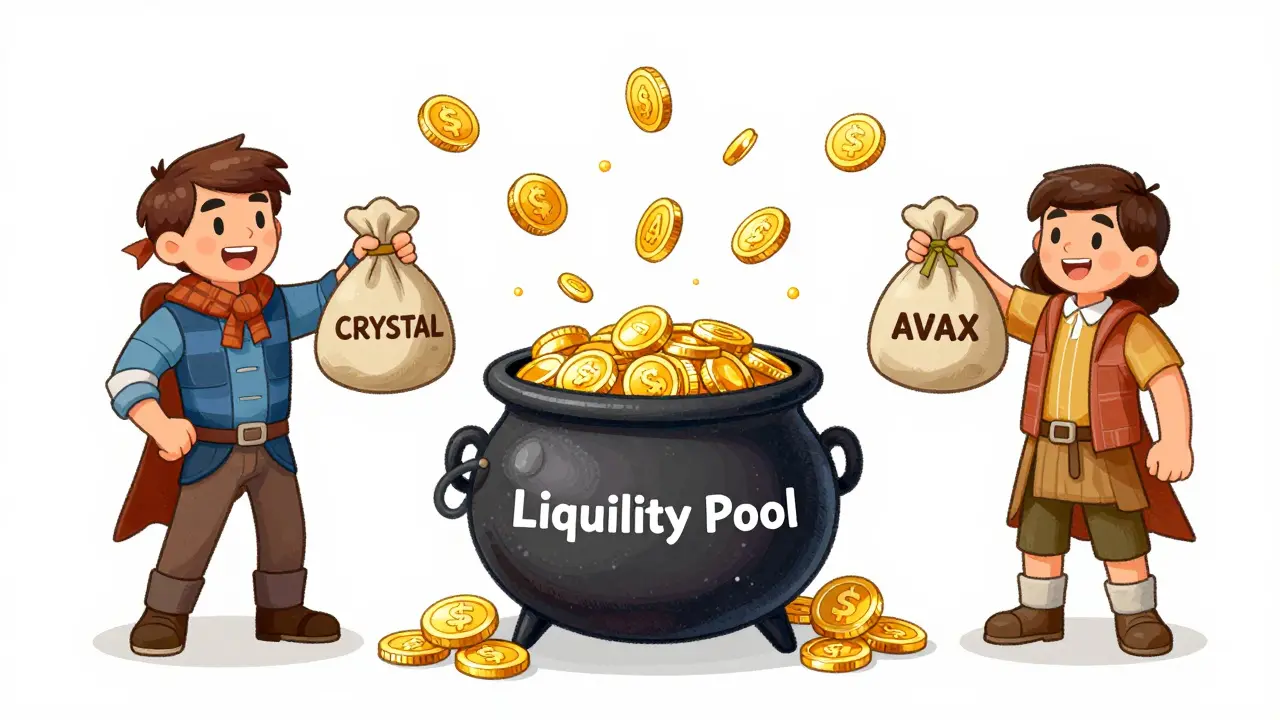
- Token Swapping: You can trade CRYSTAL for other supported tokens like USDC or AVAX. The rates are determined by the liquidity pools, not by a market maker.
- Liquidity Provision: Users can deposit pairs of tokens into pools to earn trading fees. In DeFi Kingdoms, this is often tied to in-game rewards and governance rights.
- Governance: Holding CRYSTAL allows you to vote on future developments of the game and the protocol. This gives users a say in how the platform evolves.
The native token for this world is CRYSTAL. It serves multiple purposes: paying for gas fees (indirectly), minting Hero NFTs, staking for rewards, and trading. Unlike JEWEL, which was used in the original Serendale world, CRYSTAL has a total supply that is exactly one-fourth the value of JEWEL. This scarcity model was designed to create higher potential value per token, though actual price action depends entirely on market demand.
Liquidity and Trading Volume: The Reality Check
Here is where most reviews get it wrong. They praise the concept but ignore the numbers. Let’s look at the data. As of late 2023, DeFi Kingdoms’ 24-hour trading volume hovered around $10,957. Compare that to Uniswap, which regularly processes over $1 billion in daily volume. That is a massive difference.
Why does this matter to you? Liquidity determines how easily you can buy or sell without moving the price. Low liquidity means high slippage. If you try to swap $1,000 worth of CRYSTAL on DeFi Kingdoms, you might end up receiving significantly less than expected because your trade moves the market price against you. One user reported that swapping more than $1,000 moved the price by over 5%. For serious traders, this is unacceptable. For casual players buying small amounts of in-game currency, it’s manageable.
| Feature | DeFi Kingdoms (Crystalvale) | Binance / Coinbase | Uniswap (Standalone) |
|---|---|---|---|
| Primary Purpose | Gaming + DeFi Education | Cryptocurrency Trading | Decentralized Token Swapping |
| Liquidity Depth | Low (~$10k daily volume) | Very High | High ($1B+ daily volume) |
| User Interface | Game-based (RPG) | Professional Dashboard | Minimalist Web App |
| Best For | Learning DeFi concepts | Buying/Selling large amounts | Trading altcoins efficiently |
| Fees | Gas fees (AVAX) + Slippage | Trading fees (0.1% - 0.5%) | Gas fees (ETH) + Protocol fee |
Costs and Technical Requirements
Using DeFi Kingdoms isn’t free. Even though the game itself doesn’t charge a subscription fee, you pay for every interaction on the blockchain. Since Crystalvale runs on an Avalanche Subnet, you need AVAX tokens to pay for gas fees. As of late 2023, these fees were approximately $1-$2 per transaction, spiking to over $5 during network congestion.
You also need a compatible wallet. MetaMask is the standard choice. Setting this up requires some technical know-how. You’ll need to add the Avalanche network manually, import your seed phrase securely, and bridge assets from other chains if necessary. The official documentation estimates it takes 4-6 hours for a complete beginner to become proficient. Many users report needing external tutorials to understand how liquidity provision works within the game context.
A common pain point is bridging between worlds. Moving assets from Serendale (Harmony) to Crystalvale (Avalanche) involves cross-chain bridges. These transactions can fail, especially during periods of high network activity. According to community sentiment analysis, nearly half of negative comments mentioned failed bridge transactions. Always double-check your wallet connections before initiating any transfers.
Who Should Use DeFi Kingdoms?
Let’s be clear about who benefits from this platform. It is not for day traders looking to execute rapid strategies. It is not for investors wanting to park large sums of capital in stable yield farms. The limited liquidity makes it unsuitable for those needs.
Instead, DeFi Kingdoms shines as an educational tool. If you are curious about how decentralized exchanges work, how liquidity pools function, or what impermanent loss feels like, this is a safe environment to learn. The stakes are lower because the volumes are smaller. You can experiment with providing liquidity without risking millions of dollars. The gamification aspect lowers the barrier to entry, making complex DeFi concepts accessible through gameplay.
It is also ideal for fans of the play-to-earn genre. If you enjoy collecting NFTs, building a team of heroes, and engaging with a community-driven economy, DeFi Kingdoms offers a rich experience. The social aspect is strong, with active Discord channels and regular updates from the development team.
Risks and Limitations
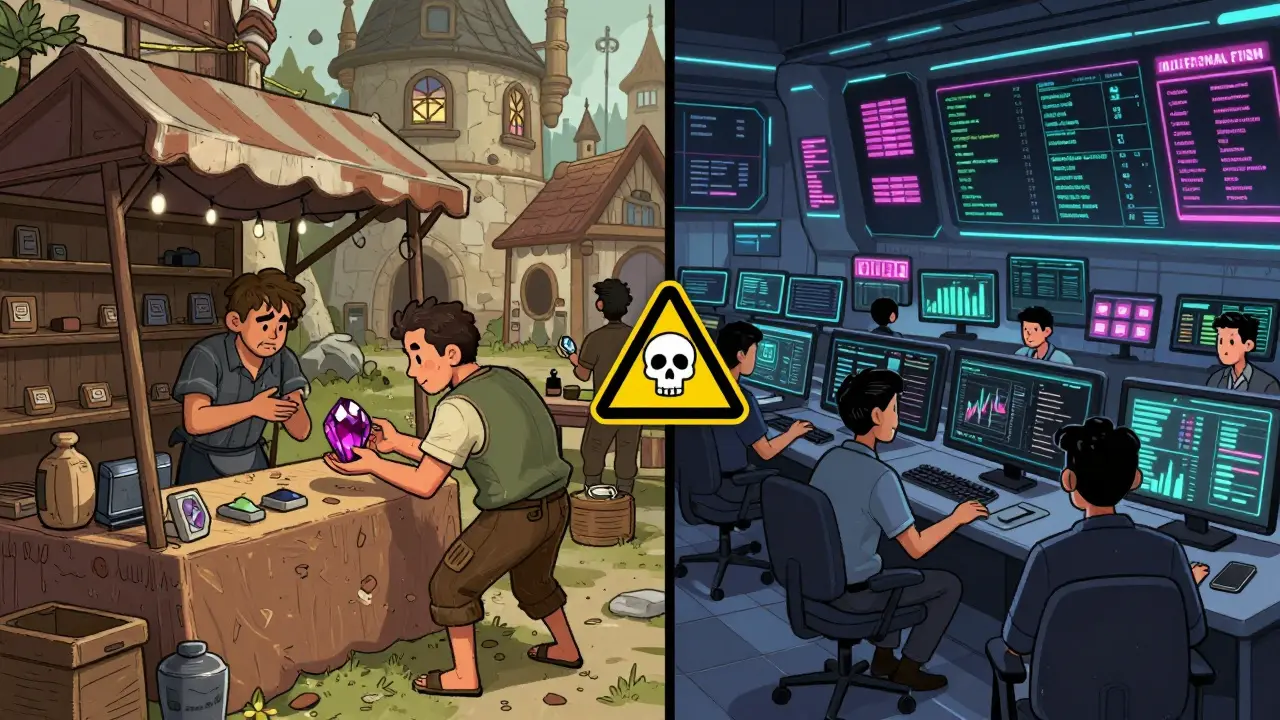
No crypto project is without risk. DeFi Kingdoms faces several challenges. First, there is the regulatory uncertainty surrounding play-to-earn models. The SEC has not clearly defined how tokens like CRYSTAL fit into existing securities laws. This lack of clarity could impact future adoption and listing on major exchanges.
Second, the platform relies heavily on community engagement. User activity peaked at 42,000 daily active users in April 2022 but settled to around 8,500 by late 2023. A declining user base can lead to reduced liquidity and lower token prices. The broader play-to-earn sector saw a 22% year-over-year decline in active users, suggesting headwinds for sustainable growth.
Finally, smart contract risks exist. While DeFi Kingdoms uses established protocols like UniswapV2, any code can contain vulnerabilities. Always verify contract addresses and never share your private keys. The team has announced plans to integrate with aggregators like 1inch to improve liquidity depth, which may mitigate some of these issues in the future.
Final Verdict
DeFi Kingdoms (Crystalvale) is a fascinating experiment in merging gaming and finance. It succeeds brilliantly as an educational platform and a fun way to engage with DeFi concepts. However, it fails as a serious trading venue due to low liquidity and high slippage. If you want to learn about decentralized exchanges while having fun, give it a try. If you want to trade efficiently, stick to established platforms like Uniswap or Binance.
Is DeFi Kingdoms a real cryptocurrency exchange?
No, DeFi Kingdoms is primarily a fantasy RPG game that includes decentralized exchange (DEX) features. It is not a centralized exchange like Binance or Coinbase. Its main purpose is gaming and education, not professional trading.
What is the CRYSTAL token used for?
CRYSTAL is the native token of the Crystalvale world. It is used for trading on the in-game DEX, minting Hero NFTs, staking for rewards, providing liquidity, and voting on governance proposals. It replaces the JEWEL token used in the original Serendale world.
Can I make money trading on DeFi Kingdoms?
It is difficult to make consistent profits through trading alone due to low liquidity and high slippage. Most users earn by participating in the play-to-earn mechanics, such as farming resources, completing quests, and providing liquidity to earn fees. Serious trading is better done on platforms with higher volume.
How much does it cost to use DeFi Kingdoms?
You need to pay gas fees in AVAX for every transaction on the Avalanche Subnet. As of late 2023, these fees ranged from $1 to $5 per transaction depending on network congestion. There are no separate trading fees charged by the platform, but slippage can effectively act as a cost.
Is DeFi Kingdoms safe to use?
Like all DeFi projects, it carries risks including smart contract vulnerabilities and regulatory uncertainty. However, it uses established protocols like UniswapV2. To stay safe, always use a reputable wallet like MetaMask, never share your private keys, and start with small amounts to understand the mechanics.