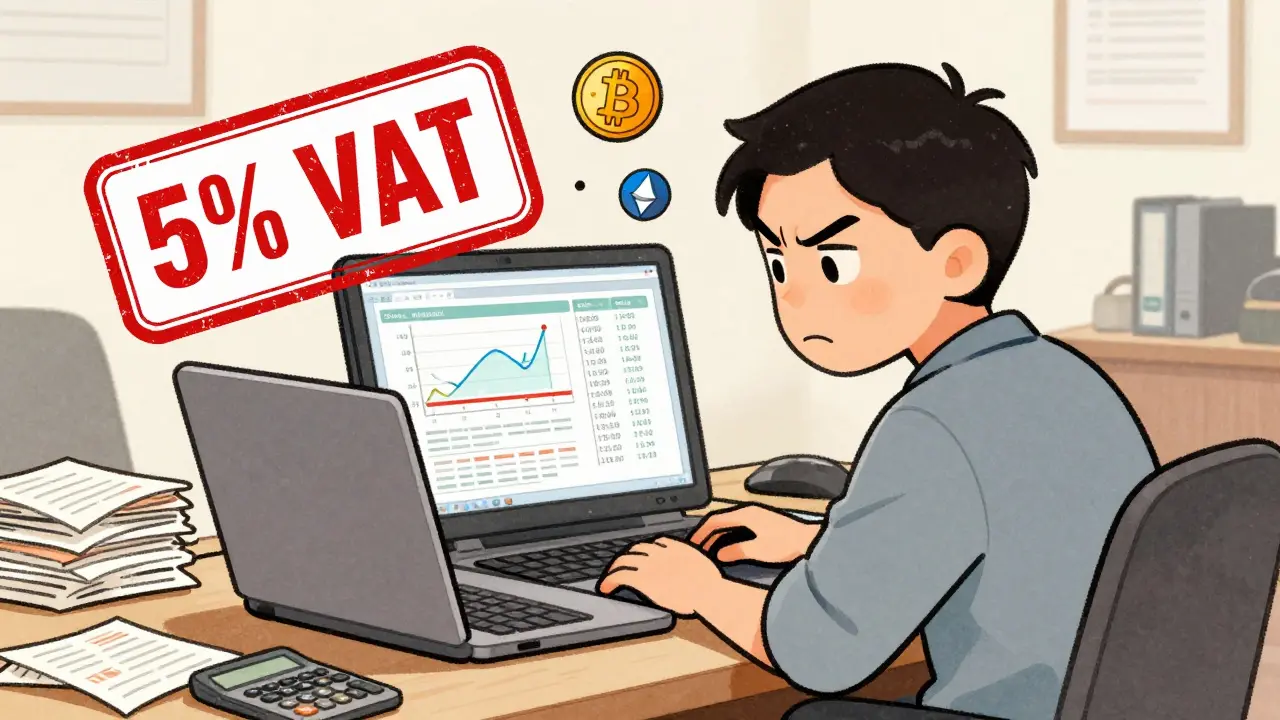
Cryptocurrency isn't legal money in Taiwan - but you still owe taxes on it
If you bought, sold, or traded Bitcoin, Ethereum, or any other crypto in Taiwan, you’re not off the hook just because the government says it’s not money. The Ministry of Finance treats digital assets as virtual commodities, and that means your trades are taxable. Whether you’re a casual trader or someone running a small crypto business, the rules are already in place - and they’re getting stricter.
How the 5% VAT applies to your crypto trades
Taiwan doesn’t have a special crypto tax law. Instead, it uses its existing Value-Added Tax (VAT) system, which applies a flat 5% rate to sales of virtual commodities. If you’re a Taiwanese resident and you sell crypto on a local exchange like BitoPro or MaiCoin, you’re required to register as a business and pay 5% VAT on your gross revenue - no deductions, no cost basis, just the total amount you received.
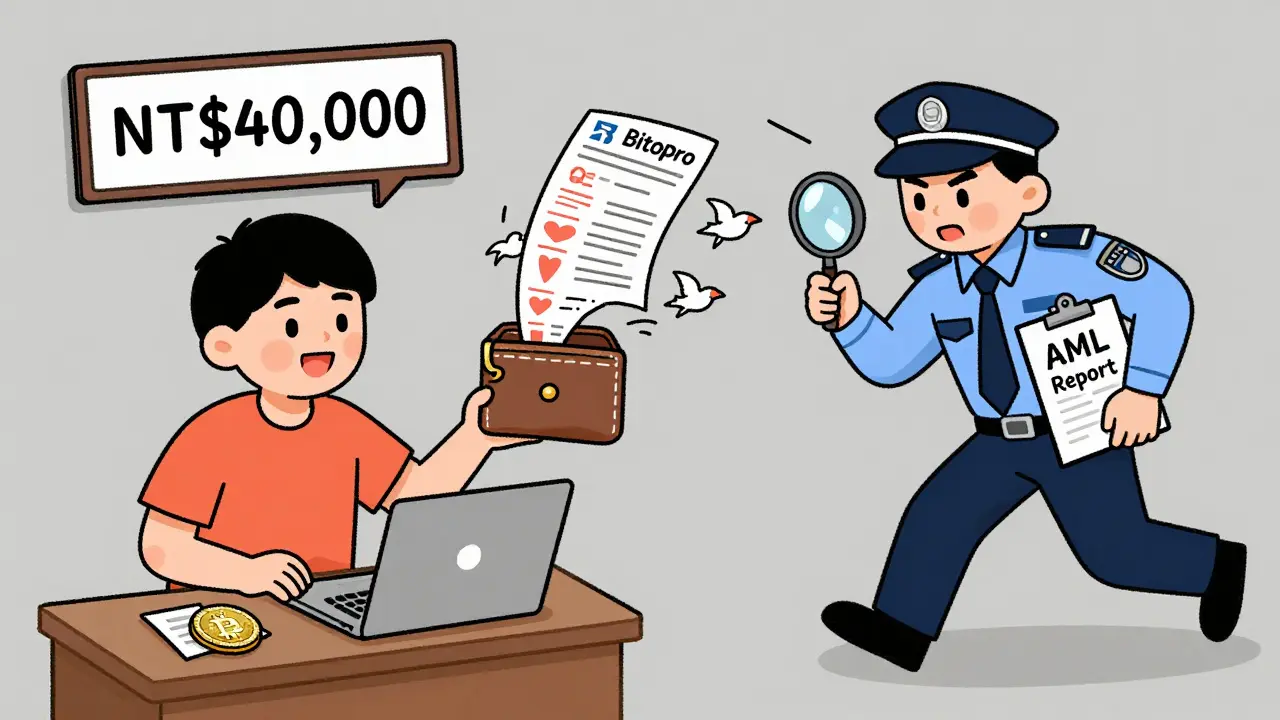
There’s one escape hatch: if your monthly sales stay under NT$40,000 (about US$1,300), you don’t need to register. That’s meant for small, occasional sellers - not people trading daily. Once you cross that line, even once, you’re legally obligated to file. Many traders ignore this, but the Financial Supervisory Commission (FSC) now requires all major exchanges to report user transactions under new AML rules. If you’re flagged, the tax office will come knocking.
Foreign sellers face a different setup. If you’re based overseas but sell crypto to Taiwanese individuals, you must register and pay the 5% VAT. But if your buyers are all Taiwanese businesses, the tax responsibility flips - they pay it instead. This creates a messy gray zone, especially for peer-to-peer traders who don’t know who they’re selling to.
Your crypto profits are also taxed as income - at 20%
On top of VAT, you owe income tax. The Ministry of Finance treats crypto gains as business income or miscellaneous income, depending on how often you trade. For most individuals, that means a 20% tax on your net profit. But here’s the catch: you need proof of what you paid for your crypto.
If you bought Bitcoin in 2020 for NT$100,000 and sold it in 2025 for NT$800,000, your taxable gain is NT$700,000. Simple. But if you bought it on an overseas exchange and didn’t keep records? You’re stuck. The tax office doesn’t accept guesses. Without purchase receipts, transaction IDs, or wallet history, they may assume your entire sale amount is profit - and tax you on that. That could mean paying 20% on NT$800,000 instead of just NT$700,000.
There’s no official method for calculating cost basis in Taiwan, unlike the U.S. or EU. No FIFO, no LIFO, no averaging. You just need to prove what you paid. That’s why keeping detailed records isn’t optional - it’s your only defense.
What platforms are required to report
Taiwan’s crypto exchange landscape is dominated by local players like BitoPro and MaiCoin, plus global giants like Binance. Since July 2024, all Virtual Asset Service Providers (VASPs) operating in Taiwan must register with the FSC and comply with strict anti-money laundering rules. That includes real-name verification for every user.
These platforms now collect and store your ID, address, transaction history, and wallet addresses. They’re legally required to report suspicious activity - and they’re increasingly sharing data with tax authorities. BitoPro and MaiCoin have already started sending summary reports to the tax office for users who exceed NT$40,000 in monthly trading volume. Binance, while international, has a large Taiwanese user base and is under pressure to comply. If you’re using any of these platforms, your activity is being tracked.
Even if you use a non-Taiwan exchange, if you withdraw to a Taiwanese bank account or use a local payment method, your transactions can still be traced. The government isn’t waiting for you to report - they’re building systems to find you.
Legal gray areas are shrinking fast
There’s still confusion about whether crypto counts as “money” under Taiwan’s Banking Act. In one 2023 court case, a business was prosecuted for taking crypto deposits, but the court ruled Bitcoin wasn’t “funds” under the law. Yet in another case, a similar business was fined for operating without a license. The inconsistency shows the courts are still figuring it out.
What’s clear is that the FSC is moving toward full integration of crypto into the financial system. In 2021, they started classifying certain crypto tokens as “securities” under the Securities and Exchange Act. That means if you’re selling tokens that promise profit based on others’ efforts - like many DeFi projects - you could be violating securities law.
And the pressure is rising. After crypto prices surged in late 2024 following the U.S. election, the Ministry of Finance announced in November 2024 that it would review crypto taxation rules. They’re not just looking at VAT and income tax - they’re considering whether to introduce capital gains tax, mandatory reporting thresholds, and penalties for non-compliance. The goal? To close loopholes before the market explodes again.

What happens if you don’t report?
Many traders assume Taiwan’s tax system is too weak to catch them. That’s a dangerous assumption. The FSC’s AML registration system gives tax authorities direct access to trading data. If you’re trading above NT$40,000/month and haven’t filed, you’re already on their radar.
Penalties for underreporting can be severe: up to 50% of the unpaid tax, plus interest. In extreme cases, the tax office can freeze bank accounts or seize assets. There’s also criminal risk. If you’re found to be deliberately hiding income, you could face charges for tax evasion - which carries jail time under Taiwan’s Criminal Code.
And it’s not just about money. If you’re running a crypto business, failing to register for VAT or income tax could disqualify you from opening a business bank account, applying for loans, or even getting a visa renewal. Compliance isn’t optional - it’s becoming part of daily life in Taiwan’s digital economy.
What you should do right now
- If you’ve traded crypto in Taiwan and made over NT$40,000 in a single month, register for VAT immediately through the National Taxation Bureau.
- Collect every transaction record: buy/sell dates, amounts, wallet addresses, exchange receipts. Use a crypto tax tool like Koinly or CoinTracker to organize them.
- Calculate your net gains using actual purchase costs - not estimated values.
- File your income tax return with your crypto gains included under “miscellaneous income” or “business income.”
- If you’re unsure, consult a Taiwanese tax professional familiar with digital assets. Most major accounting firms in Taipei now offer crypto tax services.
The window for ignoring crypto taxes is closing. The government isn’t asking for your trust - it’s building the tools to enforce compliance. The sooner you get your records in order, the less stress you’ll face later.
What’s coming next
Taiwan’s crypto tax system is still in transition. But the direction is clear: full integration into the financial regulatory framework. Expect new rules in 2026, likely including:
- Explicit capital gains tax rates for crypto
- Annual reporting thresholds for individual traders
- Penalties for unregistered VASPs or offshore platforms serving Taiwanese users
- Integration of crypto data into the national tax filing system
By 2027, Taiwan could look more like South Korea or Japan - where crypto is fully taxed, tracked, and regulated. The question isn’t whether taxes will come - it’s whether you’ll be ready when they do.
Do I have to pay tax if I only hold crypto and never sell?
No. Taiwan only taxes realized gains - meaning you owe tax only when you sell, trade, or spend your crypto. Holding it in your wallet, even if its value increases, doesn’t trigger a tax event. But keep records anyway. If you sell later, you’ll need proof of your original purchase cost.
Is crypto-to-crypto trading taxable in Taiwan?
Yes. Exchanging Bitcoin for Ethereum, or any crypto-to-crypto trade, is treated as a sale of the first asset. You must calculate the value in New Taiwan Dollars at the time of the trade and treat it as income. The cost basis of the original asset is used to determine your gain. Many traders overlook this, but the tax office considers it a taxable event.
Can I use foreign exchanges to avoid Taiwan taxes?
No. If you’re a Taiwanese resident, your worldwide income is taxable - including crypto trades on Binance, Coinbase, or Kraken. The tax office doesn’t care where the exchange is based. What matters is your residency, bank account activity, and whether you withdraw funds to Taiwan. The FSC’s AML rules mean even offshore exchanges are now required to report suspicious activity involving Taiwanese users.
What if I lost money on crypto trades?
Losses can offset gains, but only if you can prove them. You need documentation showing the purchase price and sale price of each asset. If you sold Bitcoin at a loss and bought Ethereum later, you can reduce your taxable income by that loss amount. But if you don’t have records, the tax office won’t accept your loss claim. Keep detailed logs - even if you’re losing money, you still need to report.
Are crypto mining rewards taxable?
Yes. When you receive new crypto from mining, staking, or airdrops, it’s treated as income at its market value in NT$ on the day you receive it. You’ll owe income tax on that amount. If you later sell it, you’ll also owe tax on any gain above that initial value. There’s no exemption for mining - it’s considered a business activity if done regularly.
Interesting read. I didn't realize Taiwan treated crypto as a commodity rather than currency. The 5% VAT on gross revenue is brutal if you're trading frequently. At least they have that NT$40k threshold for small sellers.
I've been trading on BitoPro for a year now and never registered. Honestly thought they wouldn't care. Guess I'm getting a letter soon.
This is why I love decentralized finance. Governments keep trying to tax the untaxable. 🌍💸 But honestly? I respect Taiwan for trying to keep up. Most places are still asleep.
So you're telling me I have to keep receipts for every single BTC I bought in 2020? That's ridiculous. I don't even remember where I bought it. Taxing digital ghosts is a joke.
If you're trading crypto in Taiwan, you need to get your records in order. Period. Use Koinly or CoinTracker - they're not expensive, and they'll save your ass when the taxman comes. I've helped three friends file last year. It's messy but doable. Don't wait until you're flagged.
They're not taxing crypto. They're taxing freedom. Next they'll want to track your thoughts. The FSC is just the tip of the iceberg. Welcome to the surveillance state, folks.
Ugh. Another 'tax compliance' lecture. Like anyone in their right mind would keep detailed logs of every crypto trade. I mean, come on. This is the 2020s, not 1987. You can't tax what you can't see.
If you're not mining or trading regularly, why are you even reading this? Just hold and HODL. Taxes are for people who need validation.
lol i just use binance and never withdraw to taiwan bank. think im safe? maybe? idk anymore
I think people are underestimating how much data these exchanges are sharing. I work in fintech compliance, and I can tell you - BitoPro and MaiCoin have been feeding the tax bureau daily reports since last summer. Even if you're using an offshore exchange, if you've ever linked your Taiwanese ID or bank account, you're in their system. It's not paranoia, it's policy. And honestly? I'd rather pay 20% on gains than risk having my account frozen or getting a criminal notice. The cost-benefit analysis here is terrifyingly clear.
Taiwan is doing what America won't. Finally someone has guts. If you're trading crypto, you're running a business. Pay your taxes or GTFO.
This is actually really well written and helpful! I was so stressed about my 2025 trades, but now I know exactly what to do. Thank you for laying it out like this - I'm grabbing Koinly tonight and getting my records sorted. You're a lifesaver!
They want records? I lost my phone with all my wallets. So what? Now I owe 800k in taxes on a coin I never even sold? This is theft.
Hey from India here - we have similar rules now, but with 30% tax on gains and no cost basis clarity either. Your post helped me understand how Taiwan’s system works better than any local article. Keep sharing this kind of stuff - it’s gold for global traders.