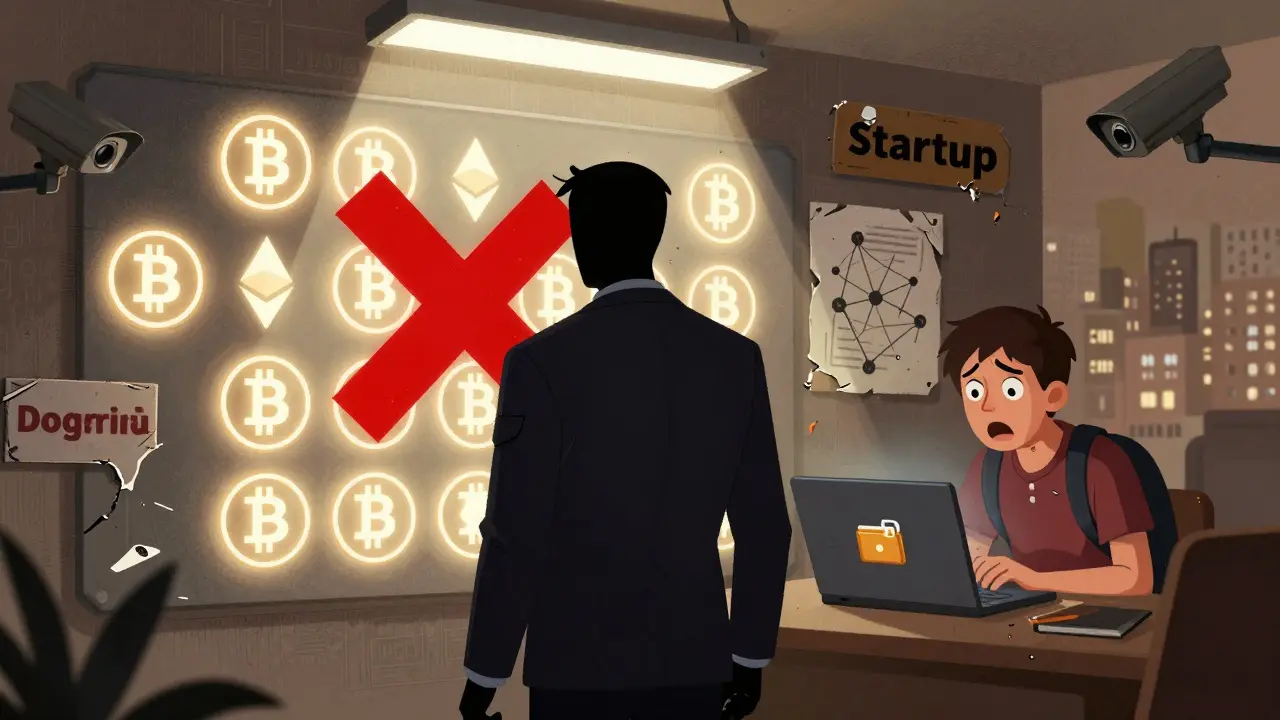
On July 24, 2025, Algeria didn’t just tighten rules-it erased an entire industry overnight. With Law No. 25-10, the country made crypto possession, trading, mining, and even talking about it a criminal offense. This isn’t a vague warning or a regulatory gray zone. It’s a full-blown ban enforced by prisons, fines, and coordinated government agencies. If you’re holding Bitcoin in Algeria, you’re breaking the law. If you posted a TikTok video explaining how Ethereum works, you could be arrested. This isn’t hypothetical-it’s happening right now.
What Exactly Is Banned?
Law No. 25-10 doesn’t just target exchanges or traders. It goes after every single part of the crypto ecosystem. The law explicitly bans:
- Possessing any digital asset-whether it’s Bitcoin, Ethereum, or a meme coin you bought for $5
- Buying, selling, or transferring cryptocurrencies
- Operating or using crypto wallets, even if you’re just storing your own coins
- Mining cryptocurrency, even if you’re using your home computer or a rented server
- Promoting crypto through ads, YouTube videos, blogs, or social media posts
- Running or supporting any platform that facilitates crypto transactions
This means a student who bought Dogecoin as a joke, a developer who built a blockchain tool, or a YouTuber who made a video titled “How to Buy Crypto in Algeria” could all face prosecution. There’s no exception for personal use, education, or non-commercial activity. The law treats all of it as equally illegal.
Who’s Enforcing It?
Algeria didn’t leave enforcement to one agency. It built a multi-layered system designed to catch anyone involved, no matter how small their role.
- The Bank of Algeria monitors banks and financial institutions to ensure no crypto-related transactions slip through. If your bank account suddenly shows a deposit from a crypto exchange-even if you didn’t initiate it-you could be investigated.
- The Banking Commission ensures that financial institutions don’t even talk to crypto companies. Any bank employee who helps a customer access a crypto wallet could lose their license.
- Security Authorities use digital surveillance to track wallet addresses, IP logs, and online activity. They’ve reportedly started monitoring Telegram groups, Discord servers, and local forums where crypto discussions happen.
- Judicial Authorities handle prosecutions. Since the law went into effect, courts have begun hearing cases against individuals accused of holding crypto, with sentences ranging from two months to a year in prison.
- Financial Crime Units treat crypto as a high-risk threat to national security, linking it to money laundering and terrorism financing-even when there’s no evidence of criminal intent.
This isn’t random enforcement. It’s a nationwide system built to catch anyone, anywhere, at any time.
Why Did Algeria Do This?
The government claims it’s protecting the Algerian Dinar. Officials say crypto threatens monetary sovereignty, fuels fraud, and opens the door to terrorism financing. They point to the Financial Action Task Force (FATF), which recommends countries crack down on unregulated digital assets.
But the timing is telling. Just a year before the ban, Chainalysis ranked Algeria as one of the top five fastest-growing crypto markets in the Middle East and North Africa. Peer-to-peer trading was surging. People were using crypto to send money across borders, bypassing slow banks and inflation. Miners were setting up operations in the south, taking advantage of cheap electricity. The crypto community was growing-fast.
Instead of adapting, Algeria chose to shut it down completely. While the UAE launched crypto licenses, and Bahrain created regulatory sandboxes, Algeria went full lockdown. The message was clear: if you can’t control it, ban it.

What Happened to the Crypto Community?
The ban didn’t just affect traders-it shattered an entire talent pool.
Before July 2025, Algeria had a thriving blockchain scene. Developers, engineers, and educators were building DeFi tools, smart contracts, and blockchain-based services. Local startups were attracting investment. Crypto recruiters were actively hiring. But after the law passed, everything collapsed.
Developers left. Some moved to Morocco or Tunisia. Others fled to Europe or Canada. Companies shut down. Meetups vanished. Online forums went dark. A 2025 survey by a regional blockchain group found that over 60% of crypto professionals in Algeria had either left the country or switched careers entirely.
It’s not just about money. It’s about opportunity. Algeria is losing its next generation of tech talent-not because they lack skills, but because the law criminalizes their expertise.
How Does This Compare to Other Countries?
Most countries are trying to regulate crypto, not eliminate it. The European Union passed MiCA, a framework that lets crypto companies operate legally if they follow strict rules. The U.S. has state-by-state regulations, but no nationwide ban. Even countries like Nigeria and Kenya, with high inflation, have not outlawed crypto-they’re working on licensing.
Algeria’s approach is more like China’s 2021 ban. Both countries treat crypto as a threat to financial control. But there’s a key difference: China still allows blockchain research and enterprise use. Algeria bans everything-even learning about it.
This puts Algeria in a tiny group: nations that have chosen total prohibition over regulation. It’s not just unusual-it’s extreme.

What Are the Real-World Consequences?
The law has created a climate of fear.
People are deleting wallets. Selling hardware. Erasing social media posts. Some are paying bribes to avoid prosecution. Others are quietly using peer-to-peer networks, but they’re terrified of being caught.
Even educators are being targeted. A university professor who gave a lecture on blockchain technology was reported by a student and is now under investigation. A tech blogger who wrote a guide on how to set up a crypto wallet got a visit from security agents. There’s no gray area. If you mention crypto, you’re a target.
Fines range from 200,000 to 1,000,000 Algerian dinars-that’s $1,540 to $7,700 USD. For many Algerians, that’s more than a year’s salary. Add jail time, and the cost of owning crypto becomes unbearable.
Is There Any Hope for Change?
Right now, almost none.
The law is too detailed, too broad, and too deeply embedded in enforcement structures to be easily reversed. The government has invested heavily in monitoring systems, trained prosecutors, and public awareness campaigns warning citizens about the dangers of crypto.
There are no signs of reform. No petitions, no court challenges, no public debate. The state controls the media, and dissent is rare. The ban is treated as settled law, not a policy under review.
For now, Algeria stands alone in Africa as a country that has chosen to erase crypto entirely-not regulate it, not tax it, not monitor it-but outlaw it completely. And the cost? A generation of tech talent gone, innovation stifled, and a country cutting itself off from the future of finance.
Is it illegal to just hold cryptocurrency in Algeria?
Yes. Law No. 25-10 criminalizes possession of any digital asset, regardless of whether you traded it, mined it, or bought it. Simply having Bitcoin or Ethereum in a wallet-even if you never used it-is enough to trigger prosecution.
Can I get in trouble for talking about crypto online?
Yes. The law explicitly bans promotion, advertising, and dissemination of information about cryptocurrencies. This includes social media posts, YouTube videos, blog articles, or even educational content. Influencers, teachers, and content creators have already been investigated under this clause.
Are there any legal ways to use crypto in Algeria?
No. There are no exceptions. Mining, trading, wallet usage, exchange services, and even academic research involving blockchain technology are all prohibited. The law leaves no room for legal gray areas.
What happens if I’m caught with crypto?
You could face a fine between 200,000 and 1,000,000 Algerian dinars ($1,540-$7,700 USD) and up to one year in prison. Enforcement is active, and authorities are prosecuting cases involving possession, promotion, and mining. There is no amnesty or grace period.
Has the ban affected Algeria’s economy?
Yes. Before the ban, Algeria was one of the fastest-growing crypto markets in the MENA region. Since July 2025, blockchain startups have shut down, developers have emigrated, and foreign investment in tech has declined. The country is losing its edge in fintech innovation, with long-term consequences for its digital economy.
LMAO they banned crypto?? 😂 This is like banning calculators because some people used them to cheat. Who even writes laws like this?? 🤦♀️
This is just state control disguised as protection. They dont want people to have power outside their system. Simple. No more no less
I feel so bad for all those devs and students who just wanted to build something cool. This isn't stopping crime, it's just crushing dreams. 💔
The regulatory architecture here is fundamentally misaligned with decentralized systems. The ontological assumption that digital assets can be contained via territorial sovereignty is a category error. The institutional overreach manifests as epistemic violence against innovation ecosystems. The state's epistemological monopoly is being enforced through punitive technocratic mechanisms that lack empirical justification.
they really banned talking about crypto wow like its a cult or something lol
Okay but like... why? 🤔 I mean, I get the fear but banning education?? That's just dumb. Also who has time to police Discord servers?? 😴
There's a deeper truth here: when a society criminalizes knowledge, it doesn't eliminate the knowledge-it just drives it underground. The real loss isn't the coins, it's the curiosity. And curiosity is the first thing that dies under authoritarianism.
This is heartbreaking. 🥺 So many young people in Algeria were finally building something real. Now they’re forced to leave or stay silent. The future is being erased. 💔🌍
This is why Africa can't progress. Overreacting to tech like it's a threat. They should be learning it not banning it
Ah yes, the classic 'ban the thing we don't understand' playbook. How quaint. The Algerian government must be so proud of their 1984-inspired fintech policy. Truly visionary. 🙃
This is not merely policy-it is cultural erasure. The state has weaponized legal language to extinguish a grassroots technological movement. The consequences will ripple for decades: a generation of engineers silenced, a culture of innovation suffocated, and a nation that chose fear over foresight. The world watches. And we are deeply saddened.
i think they just got scared of crypto lol like it was gonna take over or something idk
This is wild. 😑 They banned crypto... but what about all the other ways people move money? Seems like they picked the easiest target. Lazy enforcement.