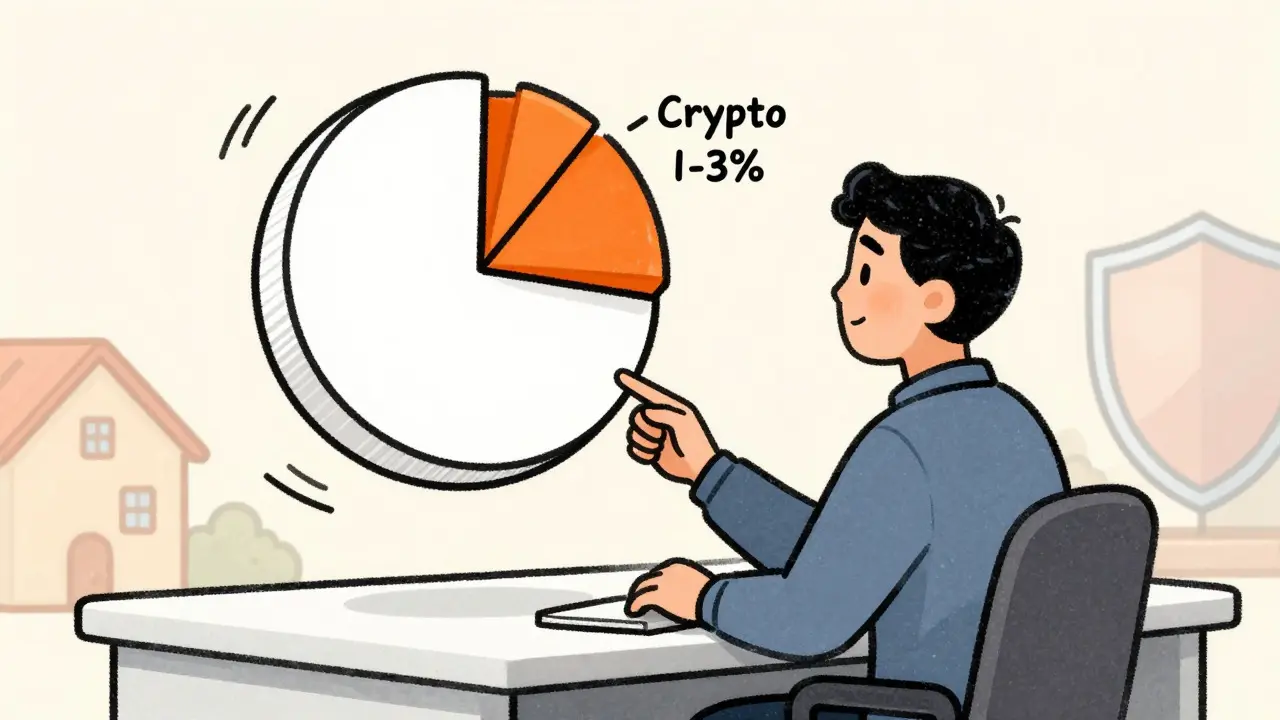
How much of your life savings should you throw at cryptocurrency? It is the question that keeps investors up at night. The answer is rarely as high as hype cycles suggest, but it is also not zero. Getting this number wrong can either cost you a fortune or leave money on the table. As of 2026, the consensus among financial advisors and data analysts has shifted from wild speculation to structured discipline. Most professionals now recommend keeping crypto portfolio size allocations below 10% of total assets, with many suggesting 5% as a prudent upper limit for the average person.
The Data Behind the 1-3% Sweet Spot
You might think you need a massive chunk of your wealth in digital assets to see real gains. The data suggests otherwise. Research from 21Shares, a leading exchange-traded product issuer, analyzed market data from April 2022 through March 2025. Their findings were clear: modest allocations of just 1% to 3% historically improved portfolio efficiency without meaningfully increasing risk.
This small slice delivered higher Sharpe ratios (a measure of risk-adjusted return) and limited drawdown impact when rebalanced correctly. Think of it like adding a pinch of hot sauce to a meal. A little adds flavor and excitement; too much ruins the entire dish. For most traditional investment portfolios, that 1-3% acts as a performance booster rather than a destabilizing force. This empirical evidence supports the case for including cryptocurrency, but only if you treat it as a satellite asset, not the sun around which your finances orbit.
Income-Based Allocation Frameworks
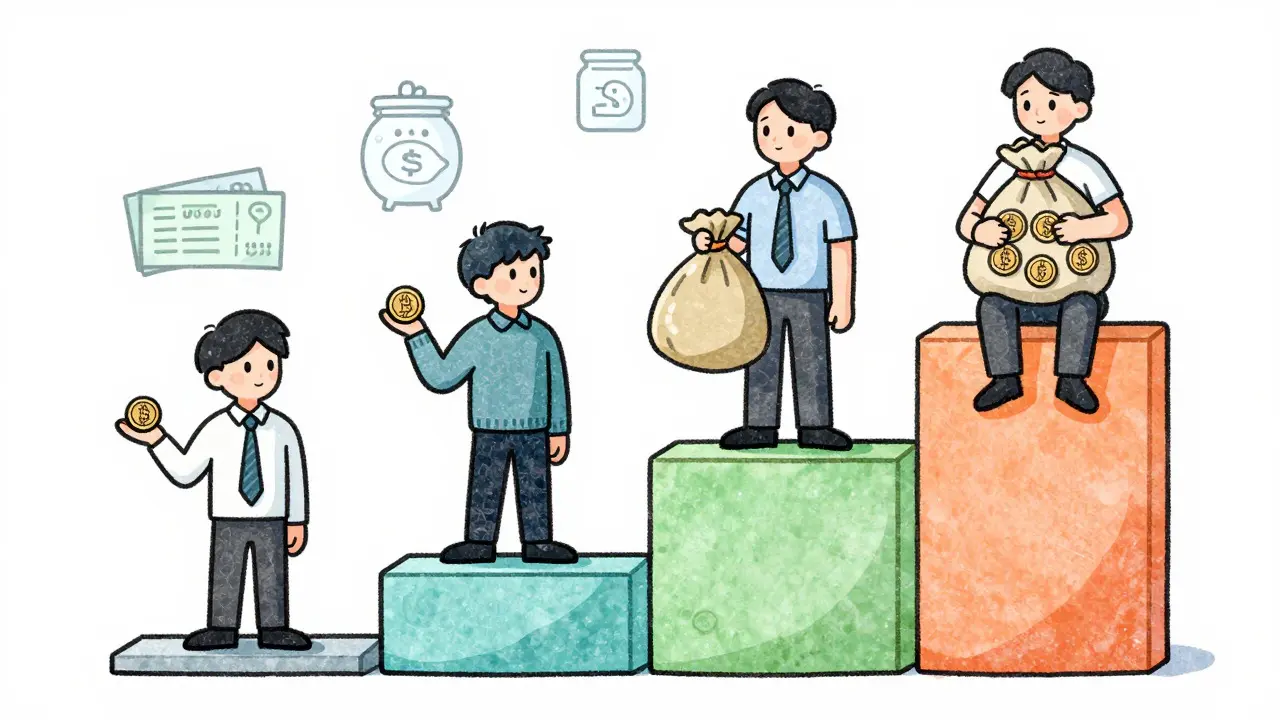
Not every investor is built the same. Your monthly income dictates how much volatility you can actually stomach. A one-size-fits-all percentage ignores the reality of cash flow and emergency buffers. The 2025 analysis by Quppy provides a practical, graduated approach based on monthly earnings. Here is how the math breaks down for different income levels:
- $1,500/month earners: Limit crypto to 1% ($15). Focus exclusively on Bitcoin using dollar-cost averaging. At this level, capital preservation is key, so stick to the safest asset in the space.
- $3,000/month earners: Allocate 3% ($90). You can introduce Ethereum alongside Bitcoin. This allows for slight diversification while maintaining a conservative core.
- $5,000/month earners: Dedicate 5% ($250). This budget supports a mix of Bitcoin, Ethereum, and perhaps some established DeFi tokens. You have enough buffer to handle minor dips without panic.
- $8,000+/month earners: Consider 10% or more ($800+). High earners can afford active strategies and long-term holds across a broader range of assets because their base financial security is stronger.
The logic here is simple: as your income rises, your ability to absorb loss increases, allowing for a slightly larger speculative portion. However, notice that even for high earners, the recommendation caps out around 10%. Going beyond that requires specialized knowledge and a stomach for extreme swings.
Structuring the Crypto Portfolio Internally
Once you decide on your total allocation, you need to split that amount wisely. Putting 100% of your crypto budget into a single meme coin is gambling, not investing. Institutional best practices from firms like XBTO recommend a specific internal diversification strategy for 2025 and beyond. Treat your crypto wallet like a mini-portfolios within your main portfolio.
| Asset Class | Allocation % | Purpose & Examples |
|---|---|---|
| Core Assets | 60-70% | Foundation of the portfolio. Highest liquidity and adoption. Examples: Bitcoin, Ethereum. |
| Altcoins | 20-30% | Growth potential. Includes Layer-1 protocols, Layer-2 solutions, and DeFi infrastructure tokens. |
| Stablecoins | 5-10% | Liquidity and yield generation. Pegged to fiat currency. Examples: USDC, USDT. |
Why keep stablecoins? They are not there to make you rich. They are your dry powder. When the market crashes, you need cash-equivalent holdings to buy the dip without selling your core assets at a loss. They also provide flexibility for rebalancing. If Bitcoin rallies hard and becomes 80% of your portfolio, you sell some into stablecoins to get back to your target 60-70% range. This disciplined rebalancing locks in profits automatically.
The Morningstar Warning: Correlation and Time Horizons
Major financial institutions are growing cautious. Morningstar’s "Role in Portfolio" framework explicitly recommends holding cryptocurrency investments for at least 10 years. This is not a short-term trade. But here is the catch: as Bitcoin and Ethereum become more mainstream, they are becoming less valuable as pure diversifiers.
In the early days, crypto moved independently of stocks and bonds. Today, correlations against major asset classes are trending upward. When the stock market sneezes, crypto often catches a cold. This reduced diversification benefit means you cannot rely on crypto to save you during a broad market crash. Combined with the fact that crypto remains prone to pricing bubbles driven by momentum investors, Morningstar suggests portfolio weightings of 5% or less. For some conservative investors, skipping it altogether is still a valid choice.
Psychological Red Flags: Are You Overallocated?
Numbers are easy; emotions are hard. The biggest risk in crypto is not technical failure; it is human behavior. Real investor experiences reveal common pitfalls that signal you have gone too far. Ask yourself these questions honestly:
- Does your mood depend entirely on whether the chart is green or red today?
- Do you feel an urge to panic-sell whenever the market dips 10%?
- Have you dipped into your emergency fund to buy more crypto?
- Are you making impulsive decisions based on tweets or social media hype?
- Is your entire net worth tied up in digital assets?
If you answered yes to any of these, your allocation is too high. The critical metric for appropriate sizing is sleep quality. If you are losing sleep over your holdings, cut them in half until you can rest again. Cryptocurrency should complement your financial plan, not replace it. It requires careful budgeting, not squeezing it in during hype cycles when FOMO (Fear Of Missing Out) takes the wheel.

Implementation: Dollar-Cost Averaging vs. Lump Sum
Timing the market is nearly impossible, even for experts. That is why systematic approaches win over time. Dollar-cost averaging (DCA) is the predominant recommendation across all income levels. Instead of dumping $1,000 in on Monday, you invest $50 every week. This smooths out your entry price and removes the emotional burden of picking tops and bottoms.
Beginners should start with Bitcoin before gradually exploring altcoins. The historical validation of this approach is stark. According to MaterialBitcoin analysis, a $1,000 investment in Bitcoin ten years ago would be valued at approximately $350,000 as of May 2025, when Bitcoin's value exceeded $90,000. That is a 366-fold increase. However, that exceptional performance came with periods where the price dropped 80% multiple times. Only DCA allows most people to stay invested through those brutal winters.
Market Dynamics in 2026: Volatility Compression
The landscape is changing. In 2025 and moving into 2026, we are seeing Bitcoin's volatility compress while its price structurally rises. This indicates a maturing asset class. Long-term opportunity may now outweigh near-term hesitation. Two simultaneous trends are at play: decreasing volatility and structural price appreciation.
This shifts the investment question from "whether" to allocate to "when." Investors remaining on the sidelines face not just volatility risk but opportunity cost. If the asset is becoming less volatile and more correlated with traditional markets, it starts to behave more like a tech stock. This makes it easier to model in a traditional portfolio, but it also means the explosive, uncorrelated gains of the past may be harder to replicate. Adjust your expectations accordingly.
Risk Management and Capital Preservation
Never forget that cryptocurrency is speculative. Pinning down fundamental values is difficult due to regulatory uncertainty and technological risks. Your primary goal in portfolio construction should be capital preservation in traditional assets. Use small cryptocurrency allocations to capture upside without jeopardizing overall financial security.
Future trajectory analysis suggests continued evolution. As institutional adoption grows and regulatory clarity improves, recommended allocations for sophisticated investors may gradually increase. But the fundamental principle remains constant: never let crypto compromise your ability to meet essential financial obligations or maintain emotional equilibrium. Keep it small, keep it diversified, and keep it long-term.
What is the ideal crypto portfolio size for beginners?
For beginners, the ideal crypto portfolio size is between 1% and 3% of total investable assets. This low percentage limits exposure to volatility while allowing participation in potential growth. Start with Bitcoin only, using dollar-cost averaging to build positions slowly over time.
Should I put more than 10% of my money in crypto?
Generally, no. Most financial advisors recommend capping crypto allocations at 10%, with 5% being safer for most people. Allocations above 10% significantly increase portfolio risk and require advanced knowledge of market dynamics, tax implications, and security practices. Only high-net-worth individuals with substantial emergency funds should consider exceeding this limit.
How do I divide my crypto budget between Bitcoin, Ethereum, and altcoins?
A balanced approach suggests allocating 60-70% to core assets like Bitcoin and Ethereum, 20-30% to diversified altcoins (Layer-1s, DeFi), and 5-10% to stablecoins for liquidity. This structure prioritizes stability while leaving room for higher-risk, higher-reward opportunities.
Is dollar-cost averaging better than lump-sum investing in crypto?
Yes, for most retail investors. Dollar-cost averaging reduces the impact of volatility by spreading purchases over time. It prevents the mistake of buying at a local peak and helps manage emotional stress during market downturns. While lump-sum investing can theoretically yield higher returns if the market immediately rises, DCA offers better psychological sustainability and risk management.
Why do financial advisors recommend such small crypto allocations?
Advisors recommend small allocations because of crypto's historical volatility and increasing correlation with traditional markets. Small percentages (1-5%) improve portfolio efficiency and Sharpe ratios without exposing the investor to catastrophic losses. It treats crypto as a speculative satellite asset rather than a foundational holding, preserving capital safety.
What are the signs that my crypto allocation is too large?
Signs include anxiety over daily price movements, checking charts constantly, dipping into emergency funds, panic-selling during dips, and letting crypto performance dictate your mood. If you are losing sleep over your holdings, your allocation is too high. Reduce it until you feel emotionally neutral about market fluctuations.
How does income level affect crypto investment recommendations?
Higher income levels allow for larger absolute amounts and slightly higher percentage allocations due to greater financial buffers. For example, someone earning $1,500/month might stick to 1% ($15), while an earner of $8,000+/month might allocate 10% ($800+). The key is ensuring the investment does not interfere with essential living expenses and emergency savings.
Should I hold stablecoins in my crypto portfolio?
Yes, allocating 5-10% to stablecoins like USDC or USDT is recommended. They act as cash equivalents, providing liquidity for rebalancing, capturing yields, and buying opportunities during market dips. They reduce overall portfolio volatility and offer a safe haven during bear markets.
honestly this is so helpful thank you for breaking it down like that i was always confused about how much to put in and now i feel way better about just sticking to the 1-3% rule its scary out there right now
i mean look at the data man, its pretty clear cut. 1-3% is the sweet spot. anyone putting more than that is just gambling with their rent money lol. glad someone finally said it straight without all the hype.
it is honestly disgusting how people throw away their life savings on digital air. you are all complicit in your own destruction if you dont listen to this. the greed is palpable and it makes me sick to my stomach every time i see another newbie dump their emergency fund into a meme coin.
I think everyone here is missing the point entirely. It's not just about the numbers, it's about the spiritual toll of watching charts all day. I used to be obsessed and it ruined my relationships. You need to step back and ask yourself if you really need that extra 5% or if you just need peace of mind. Trust me on this one.
Oh, please, spare us the 'financial advisor' nonsense because let me tell you something, those guys missed the boat by a mile when they told us to stay in bonds during the last cycle, and now they're coming back with this timid little 1-3% recommendation which is basically an insult to anyone who actually understands market dynamics and has the guts to take calculated risks because while you were sleeping on Bitcoin, others were buying houses, and frankly, I find it quite amusing how safe you all want to play it when the entire system is rigged against the little guy anyway.
the morality of speculation is questionable but the math is undeniable. we must accept that volatility is the price of freedom in this new economy. do not let fear dictate your portfolio size. let reason guide you.
its interesting how the narrative shifts from 'digital gold' to 'satellite asset' as the correlation increases. the paradigm is shifting towards institutionalization which means lower variance but also lower alpha potential for the retail investor. we are entering a phase of maturity where the easy money is gone.
obviously the mainstream media wants you to keep 1% so they can control the narrative. real wealth is built by ignoring these 'advisors' and going all in before the central banks collapse completely. wake up sheeple.
boring article. too much text.
most people cant handle the truth. they want magic beans. this post is just common sense wrapped in fancy words. keep it simple.
I really appreciate how this breaks down the income levels because it feels so much more personalized and less intimidating than just seeing a flat percentage, and I think for someone like me who is just starting out, knowing that $15 a month is a valid entry point takes so much pressure off, and it reminds me that investing is a marathon not a sprint, so I'm feeling pretty optimistic about setting up my DCA plan this week!
why do we always follow the herd? the 10% cap is for weaklings. true believers know better. stop listening to suits.
Let us delve into the abyss of financial prudence shall we? For whilst the masses tremble at the mere whisper of volatility, the discerning investor recognizes that risk is merely opportunity wearing a mask of terror, and thus we must embrace the chaos with open arms and a diversified portfolio that sings the song of stability amidst the storm.
Great breakdown! :D Don't forget to use hardware wallets for security. Stay safe out there folks! You got this! :)
LISTEN UP!!! This is the most important thing you will read today!!!! If you don't diversify properly you are DOOMED!!!! Wake up and smell the coffee!!!!
The Fed is printing money like crazy 🖨️💸 Crypto is the only way out 🚀🌕 Don't trust the banks 🏦👮♂️ They are stealing your future 🔒📉 HODL or regret it 😡🔥
One might inquire as to whether the psychological ramifications of such a conservative allocation strategy could potentially lead to a stagnation of innovative thought within the broader economic ecosystem, thereby necessitating a re-evaluation of traditional risk parameters through the lens of behavioral finance and macroeconomic instability indicators.