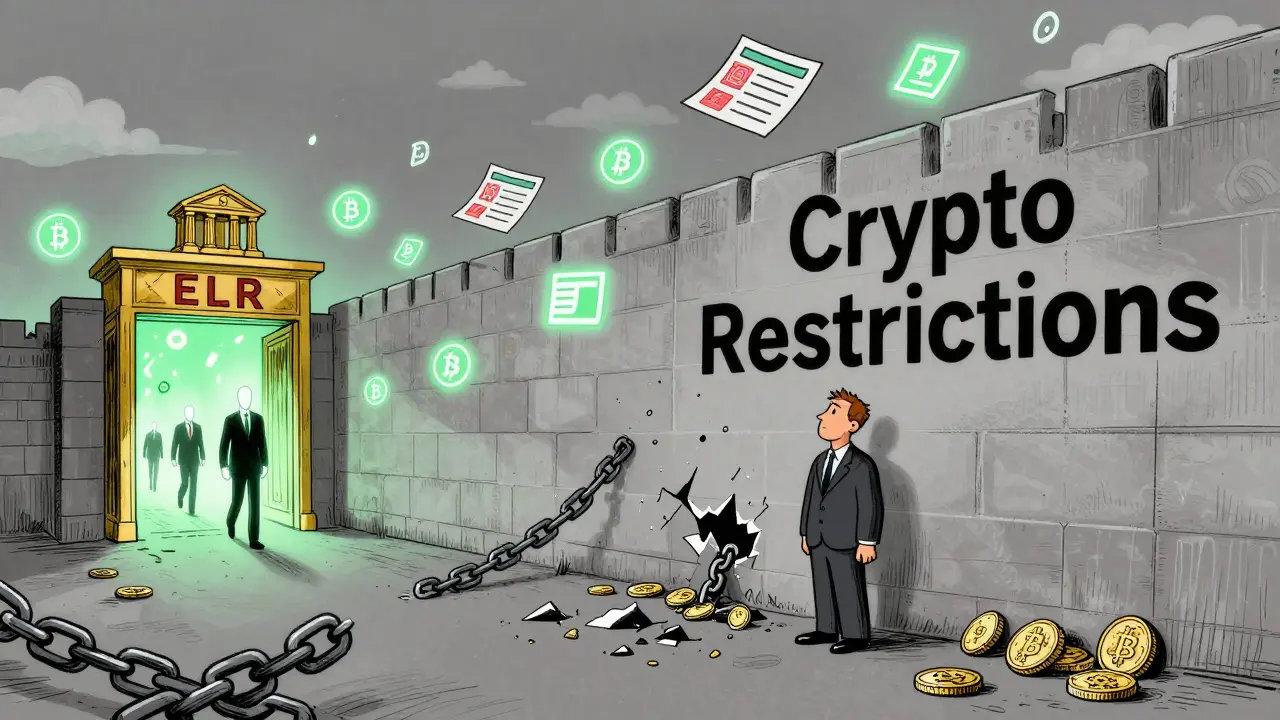
By 2025, if you're a regular Russian citizen trying to buy or trade cryptocurrency, you're fighting an uphill battle. The government hasn't outlawed crypto outright - but it's made it nearly impossible for most people to use it legally. While elite investors and sanctioned businesses have backdoors, ordinary Russians face blocked bank accounts, frozen exchange profiles, and a legal gray zone that punishes small trades as much as big ones.
It's Not a Ban - It's a Wall
Russia didn't ban crypto. In 2020, it passed a law that let people own digital assets. But it immediately blocked their use for payments. That meant you could hold Bitcoin, but you couldn't use it to buy groceries, pay rent, or even tip a delivery driver. The goal wasn't to stop crypto - it was to keep it from replacing the ruble.
After 2022, everything changed. Western sanctions cut Russia off from SWIFT and global banking. Instead of opening crypto to the public as an alternative, the government built a two-tier system. On one side: a tightly controlled pipeline for big corporations to use crypto for international trade. On the other: a wall for everyone else.
The Central Bank of Russia now says only highly qualified investors can legally trade crypto. To qualify, you need either:
- A portfolio worth at least 100 million rubles ($1.1 million USD)
- Or an annual income over 50 million rubles ($550,000 USD)
That’s less than 0.1% of the population. For everyone else? You’re on your own.
What Happens When You Try to Use Exchanges?
Major global exchanges like Binance and Coinbase don’t operate openly in Russia anymore. But that doesn’t mean Russians can’t access them - they just have to jump through hoops that get harder every month.
Here’s what Russian users report:
- Identity verification fails - 68% of users in a September 2025 survey couldn’t pass KYC without foreign IDs or proof of residence outside Russia.
- Accounts get frozen - Coinbase alone has locked 25,000 Russian accounts since 2022. Binance now requires proof of address, something it didn’t ask for before.
- Fiat off-ramps vanish - 79% of users struggle to cash out crypto into rubles. Banks refuse to process transactions linked to crypto wallets.
Trustpilot reviews tell the story: Coinbase has a 2.1/5 rating from Russian users. Binance sits at 2.8/5. The complaints? “My account disappeared.” “They asked for my Ukrainian passport.” “I sent $500 in crypto and never got the rubles.”
P2P Trading: The Only Option Left
With banks and exchanges shutting doors, Russians turned to peer-to-peer (P2P) platforms like LocalBitcoins and Paxful. These sites let people trade crypto directly with each other using bank transfers, cash deposits, or even gift cards.
It’s working - but dangerously. P2P trading in Russia jumped 217% between 2022 and 2025, according to Chainalysis. But the Central Bank warns that frequent small trades can trigger automatic bank account blocks. One Reddit user in St. Petersburg posted in October 2025: “I did three small P2P sales last month. This week, my entire savings account was frozen. No warning. No explanation.”
There’s no legal protection. If you get scammed on P2P, you can’t go to court. If your bank freezes your account, you can’t appeal. You’re on your own.

The Government’s Secret Pathway
While ordinary Russians struggle, a different system exists behind closed doors. Since summer 2023, Russia has allowed vetted companies to use crypto for international trade under the Experimental Legal Regime (ELR). These are mostly state-linked firms, energy exporters, and sanctioned entities that need to bypass Western financial controls.
They can convert rubles to crypto, send it abroad, and convert it back to dollars or euros - all legally, under government supervision. The crypto used here isn’t Bitcoin or Ethereum traded on public exchanges. It’s often tokenized rubles or stablecoins routed through offshore shell companies.
It’s not about freedom. It’s about control. The government wants to keep capital flowing for its own needs - but not for its people.
Why This Isn’t Working
Russia’s strategy is simple: lock out the public, let the elite play, and pretend crypto isn’t a threat to the ruble. But reality is breaking through.
- 87% of Russian crypto transactions now happen outside regulated channels.
- Trading volume on global exchanges dropped 83% since 2022 - not because people stopped using crypto, but because they moved underground.
- There are no legal Russian exchanges in the top 100 globally. Not one.
Even worse, the system is creating new risks. Russians are now using decentralized finance (DeFi) protocols like Uniswap and Aave - platforms that don’t require KYC, don’t answer to Russian law, and can’t be shut down by a central bank.
And while the government worries about crypto undermining sanctions, U.S. officials say the opposite: “Laundering large sums through crypto is expensive, visible, and inefficient.” Bitcoin won’t save Russia’s economy - but it’s already saving millions of ordinary citizens from total financial isolation.

What’s Next?
In October 2025, the Central Bank announced banks could finally operate in the crypto sector - but only if crypto makes up less than 1% of their total capital. That’s not a step toward openness. It’s a way to monitor and contain the flow.
Some officials are quietly pushing to lower the income threshold for “qualified investors.” But no concrete changes have been made. The message remains: if you’re not rich, you’re not allowed.
Analysts at Bernstein predict this split will last until at least 2028. The top 0.1% will have crypto access. Everyone else will rely on P2P, DeFi, and offshore tools - all with zero legal safety net.
The irony? Russia has 17.7 million crypto owners - the 8th highest in the world. But only a few thousand can use it legally. The rest are living in a digital underground, trading in the shadows, hoping their bank accounts don’t vanish next week.
Can You Still Use Crypto in Russia?
Technically, yes - if you’re willing to take risks.
Here’s what works right now:
- Use a reliable VPN to access offshore exchanges like Binance or Kraken.
- Complete KYC with a foreign passport or residency document - many users use Estonian or Georgian IDs.
- Use P2P platforms to buy crypto with rubles - but avoid frequent small trades to dodge bank blocks.
- Keep your crypto in a non-custodial wallet (like Trust Wallet or Exodus) - never on an exchange.
- Never link your Russian bank account directly to crypto activity.
It’s not easy. It’s not safe. But for now, it’s the only way.
What About the Future?
Russia’s crypto policy isn’t about regulation. It’s about power. The government doesn’t want citizens to have financial independence. It wants to control every ruble, every transaction, every digital move.
But blockchain doesn’t care about borders or bans. As long as people have internet access, they’ll find a way. The real question isn’t whether Russians can use crypto - it’s whether the state can stop them.
So far, they can’t.
It's wild how the government claims it's not banning crypto but then makes it impossible for anyone who isn't a billionaire to touch it. I read somewhere that over 80% of Russians who trade crypto do it through P2P now, and most of them are just regular folks trying to protect their savings from inflation. The fact that banks freeze accounts without warning is terrifying - imagine waking up and your life savings are gone because you sold 0.1 BTC to pay for your kid's medicine. There's no transparency, no recourse, no dignity in this system. It's not regulation, it's economic apartheid.
And the worst part? The people who designed this think they're being smart. They think they're keeping control. But what they're really doing is pushing an entire generation into decentralized systems they can't even understand - DeFi, Monero, self-custody wallets. The state wants to control money, but money is becoming invisible to them. And that scares them more than any Bitcoin rally ever could.
I'm from India, and we've got our own financial chaos, but at least here, if you're poor, you can still use UPI or mobile wallets. In Russia, if you're not rich, you're not even allowed to exist in the digital economy. That's not policy - that's punishment.
I've talked to Russian friends who use VPNs and Georgian IDs just to buy ETH. They don't even care about speculation anymore. They just want to keep their money from being erased by ruble collapse. And honestly? I can't blame them. If my country did this to me, I'd be doing the same thing.
The irony is that the more they try to lock it down, the more crypto becomes the only real currency left for ordinary people. The ruble is a political tool. Crypto is survival.
I hope someone in the Central Bank reads this and realizes that you can't outsmart technology. You can only delay it. And when you delay it too long, it doesn't come back politely - it explodes.
OKAY BUT DID YOU KNOW THAT RUSSIA’S ‘EXPERIMENTAL LEGAL REGIME’ IS JUST A BACKDOOR FOR OIL GIGANTOS TO LAUNDER MONEY THROUGH TONCOIN AND RUBLE-BACKED STABLECOINS?? THEY’RE USING OFFSHORE SHELLS IN THE CAYMANS TO CONVERT RUBLES TO USDT THEN TO EUR AND BACK. IT’S A FRAUDULENT CIRCULAR LAUNDERING LOOP AND THE CENTRAL BANK IS FULLY IN ON IT. THE ‘QUALIFIED INVESTOR’ THRESHOLD? A JOKE. THEY’RE NOT EVEN USING BITCOIN - THEY’RE USING THEIR OWN TOKENIZED RUBLE ASSETS THAT DON’T EVEN EXIST ON PUBLIC BLOCKCHAINS. THIS ISN’T CRYPTO - IT’S STATE-SPONSORED FRAUD WITH A BLOCKCHAIN LABEL.
AND DON’T EVEN GET ME STARTED ON THE KYC FAILURES. PEOPLE ARE BUYING ESTONIAN PASSPORTS ON DARK WEB FOR 3K USD. THAT’S NOT FREEDOM - THAT’S A BLACK MARKET FOR DIGITAL IDENTITY. COINBASE ISN’T BLOCKING RUSSIANS - THEY’RE BEING FORCED TO BY WESTERN REGULATORS. BUT STILL. 2.1/5 RATING? NO SHIT. THEY’RE RUNNING A DIGITAL PRISON AND CALLING IT A SERVICE.
DEFI IS THE ONLY REAL OPTION. UNISWAP ISN’T A PLATFORM - IT’S A REVOLUTION. AND THE STATE KNOWS IT. THAT’S WHY THEY’RE PUSHING THE ‘1% CAPITAL’ RULE - TO MAKE IT LOOK LIKE THEY’RE ‘OPENING UP’ WHILE ACTUALLY CONTAINING THE OUTBREAK. THEY’RE PANICKING. AND THEY’RE LOSING.
Interesting breakdown. I’ve been following crypto in Russia for a while now, and the P2P surge makes sense - when formal channels shut down, people just adapt. The real question is how sustainable this is. If banks are automatically flagging small trades, then even buying a few hundred bucks of BTC to hedge against inflation becomes risky. That’s not financial freedom - that’s financial paranoia.
I wonder if the Central Bank has done any analysis on how much of this underground activity is actually hurting the ruble or just bypassing it. Because if people are using crypto as a store of value and not a medium of exchange, then maybe the ruble isn’t being replaced - it’s just being ignored. And that’s a different kind of threat.
Also, the fact that 87% of transactions are outside regulated channels suggests the policy has already failed. You can’t regulate what you can’t see. And right now, they can’t see it. They just see the symptoms - frozen accounts, angry users, disappearing funds - and they keep tightening the screws. Classic.
Let me tell you something - this isn’t about crypto. This is about control. The Russian government doesn’t want people to have financial independence. They want every ruble accounted for, every transaction tracked, every citizen dependent. Crypto is the last thing standing between them and total financial surveillance.
And guess what? It’s working. People are waking up. They’re using Exodus. They’re using Ledger. They’re learning how to sign transactions themselves. They’re not asking permission. They’re not waiting for approval. They’re just doing it.
I’ve seen this before - in Venezuela, in Argentina, in Nigeria. When the state fails, people turn to tech. And when tech is open, decentralized, and permissionless? There’s nothing the state can do. Not really.
So yeah, the wall is high. But the people are climbing. And they’re not stopping. Not now. Not ever. This isn’t a trend. It’s a movement. And it’s not going to be stopped by a law or a bank freeze. It’s going to be stopped when the state realizes it can’t control the future - and that’s the day they lose.
It’s sad how people think regulation is the enemy when sometimes it’s just the symptom of a deeper problem. The real issue isn’t that crypto is being blocked - it’s that the ruble is collapsing and the government has no real plan to fix it. So instead of fixing the currency, they’re trying to lock down the alternative.
I get why they’re scared. If people start using crypto as a real alternative to the ruble, then the whole centralized system falls apart. But they don’t see that forcing people underground doesn’t make crypto disappear - it just makes it more dangerous. More chaotic. More vulnerable to scams and fraud.
And now you’ve got people risking everything just to buy a little BTC because their savings are evaporating. That’s not freedom. That’s desperation. And the system is feeding on it.
I don’t know the answer. But I know this - if you treat people like criminals for trying to survive, you’re not building a state. You’re building a prison.
Let’s be real - the entire ‘qualified investor’ framework is a classist farce. You need over a million dollars to trade crypto legally in Russia? That’s not regulation. That’s a membership club for oligarchs. Meanwhile, the average Russian earns maybe 50k rubles a month. That’s less than $500. So let me get this straight - if you’re not rich, you’re not allowed to protect your money from inflation? That’s not policy. That’s economic eugenics.
And the fact that they’re allowing state-linked firms to use crypto for international trade while banning ordinary citizens? That’s not hypocrisy. That’s treason. They’re literally creating a two-tier financial system where the elite get to play with digital assets and the rest of the population gets to beg for rubles that lose value every week.
Oh and by the way - the Central Bank’s ‘1% capital’ rule? That’s not openness. That’s a containment strategy. They’re letting crypto exist as a pressure valve so it doesn’t blow up their entire banking system. Brilliant. Just brilliant.
Western media loves to paint this as a human rights issue. But let’s not forget - Russia is under sanctions. The West froze our assets, cut us off from SWIFT, and now they want us to beg for permission to use crypto? The government is not the villain here. The West is.
They don’t want us to have financial independence. They want us to be weak. To beg. To collapse. So they make it hard for us to use crypto - not because it’s dangerous, but because it’s effective.
Yes, P2P is risky. Yes, banks freeze accounts. But what choice do we have? If you take away our tools to survive, you can’t blame us for using them anyway. This isn’t rebellion - it’s survival. And we’re not asking for permission.
So let me get this straight - the Russian government is fine with billionaires using crypto to bypass sanctions, but if you’re a teacher trying to save up for your kid’s surgery, you get your bank account frozen? Wow. That’s not a policy. That’s a punchline. And the punchline is: the rich get to cheat, and the rest of us get to suffer.
At this point, I’m just waiting for the government to start charging a ‘crypto survival tax’ so they can fund their own offshore accounts. Because honestly? That’s the only logical next step.
There’s a philosophical question here that no one’s asking: if money is just a social contract, what happens when the contract breaks? In Russia, the state is trying to enforce a version of money that no longer reflects reality - the ruble is losing value, trust is collapsing, and people are turning to something more stable. Crypto isn’t the problem. The broken contract is.
Blockchain doesn’t care about borders. It doesn’t care about laws. It only cares about consensus. And right now, the consensus among millions of Russians is that crypto is more real than the ruble.
The government is trying to hold onto a 20th-century model of control. But the 21st century is already here - and it’s running on decentralized code. You can’t arrest a protocol. You can’t jail a smart contract. And you can’t stop people from choosing what they believe has value.
So what’s next? The state will keep trying to regulate. People will keep using. And in the end, the code will win. Not because it’s perfect - but because it’s honest.
They banned it. People still did it. That’s the story.
Simple.
Oh please. Let’s not pretend this is about financial freedom. It’s about control. The government doesn’t care if you’re poor or rich - they care if you’re obedient. Crypto is the last thing that can’t be controlled. That’s why it’s being crushed.
And let’s not forget - the same people who are screaming about ‘Western sanctions’ are the ones who built this system. They didn’t have to make it this hard. They chose to. They wanted to punish the middle class. They wanted to make sure only the connected could survive.
And now they’re surprised people are using DeFi? Surprise! When you lock people out, they find a backdoor. That’s not a flaw in the system. That’s human nature.
Also - ‘qualified investor’? More like ‘qualified oligarch’. Let’s stop pretending this is about economics. It’s about power. And power doesn’t care who gets left behind.
Been using Binance via VPN for years. KYC is a nightmare but I got it done with a Georgian ID. My account got frozen once but I got it back after 3 weeks of emails. Worth it.
Now I just keep everything in Trust Wallet. No bank links. No exchange storage. Just me and my private keys.
It’s not perfect but it’s better than watching my savings vanish every month.
Also - P2P is the real MVP. Just don’t trade too often or your account gets flagged. Learned that the hard way.
One thing people forget - crypto isn’t just about money. It’s about autonomy. In a country where every transaction is monitored, having a wallet you control is the closest thing to privacy left. That’s why it’s spreading, even under pressure.
And the fact that Russians are using DeFi protocols like Uniswap? That’s not illegal - it’s inevitable. You can’t stop people from accessing open networks. The internet was built to be decentralized. And crypto is just the next layer.
So yes, it’s risky. Yes, it’s messy. But it’s real. And real things don’t die just because someone in a suit says they should.
This isn’t a crypto story. It’s a story about power. The state wants to own your money. Crypto says no. That’s all you need to know.
Wow. So Russians are using crypto? How cute. Meanwhile, the rest of the world is building real infrastructure. This isn’t innovation - it’s desperation dressed up as rebellion. You think you’re free because you’re using a VPN and a fake passport? You’re just playing a game designed by people who don’t care if you live or die.
And don’t tell me ‘it’s for survival’ - if you were really serious about freedom, you’d leave. But you’re not. You’re just complaining while still living in the system you hate.
Pathetic.
They banned it. People still did it. That’s the story.
Simple.