
Back in 2021, a quiet but significant event unfolded in the cryptocurrency world: the CPR CIPHER 2021 airdrop. It wasn’t a flashy launch with influencers or million-dollar ad buys. It didn’t make headlines like Bitcoin or Ethereum. But for the small group of users who participated, it was a real chance to get free tokens from a project that claimed to be building something different - a business-focused crypto ecosystem, not just another speculative coin.
Today, if you search for Cipher (CPR), you’ll see it labeled as "Cipher [Old]" on CoinMarketCap and other tracking sites. That label tells you everything you need to know. This isn’t a thriving project anymore. It’s a relic. But understanding what happened during that 2021 airdrop helps explain why some crypto projects fade - and why others never even got off the ground.
What Was Cipher (CPR)?
Cipher, or CPR, wasn’t created to be a meme coin or a quick pump-and-dump scheme. It launched in April 2018 as a utility token built on Ethereum. Its creators - a team with roots in India, the UK, and New Zealand - wanted to build a blockchain-based platform for businesses. Their goal? To make digital tools for companies easier to use, more secure, and scalable. Think of it like a Shopify for blockchain apps, but without the branding or funding.
The token itself was meant to represent partial ownership in the company, similar to shares in a public stock. That’s unusual in crypto, where most tokens are just access keys or speculative bets. Cipher wanted users to feel like stakeholders, not just traders. That vision came with a promise: no ICOs. No IEOs. No raising money from investors. Instead, they planned to grow by giving tokens away - through usage, not speculation.
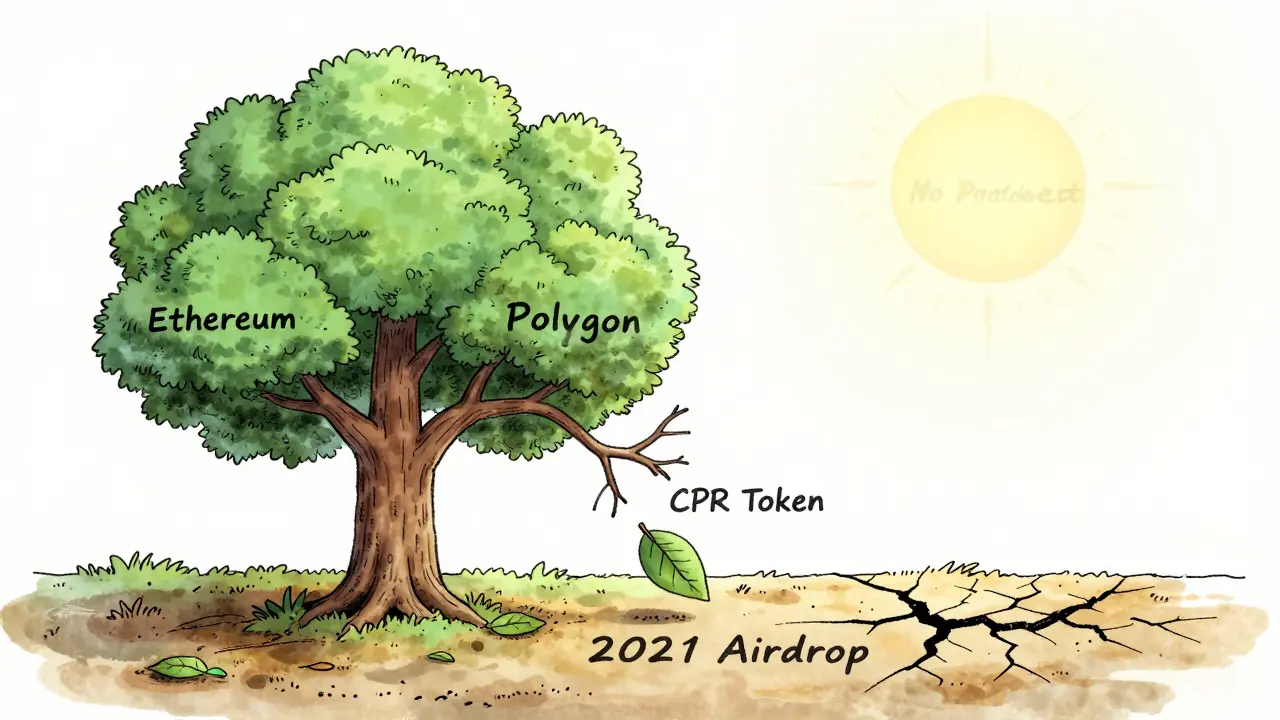
By 2021, the team had moved the token from Ethereum to Polygon PoS. Why? Because Ethereum fees were killing small transactions. Polygon offered faster, cheaper transfers. The new contract address became 0xaa404804ba583c025fa64c9a276a6127ceb355c6 the official Polygon-based CPR contract address. But not everyone knew about the switch. Many users still held the old Ethereum version - and that’s where the confusion started.
The 2021 Airdrop: How It Worked
The Cipher 2021 airdrop was conducted through CoinMarketCap (CMC). This wasn’t random. CMC had become one of the most trusted platforms for crypto data. By partnering with them, Cipher hoped to reach users who were already tracking prices, reading news, and exploring new tokens.
The mechanics were simple:
- Users had to have a CoinMarketCap account.
- They needed to complete a short profile verification (email, sometimes phone).
- Then, they could claim a small amount of CPR tokens - usually between 50 and 200 tokens per person.
There was no staking, no referral bonuses, no complex tasks. Just sign up and claim. That simplicity was intentional. Cipher didn’t want to scare people off with hoops to jump through. They wanted adoption, not hype.
Estimates suggest around 15,000-20,000 users claimed tokens during the campaign. Not millions. Not even hundreds of thousands. But for a project with no marketing budget, that was a win.
Here’s what we know about the numbers:
| Attribute | Value |
|---|---|
| Total Supply | 1.08 billion CPR |
| Circulating Supply (2021) | ~186 million CPR |
| Airdrop Distribution (estimated) | 5-10 million CPR |
| Per User Claim (average) | 75-150 CPR |
| Airdrop Value (at $0.0005) | $0.04-$0.08 per user |
At the time, CPR was trading around $0.0005. So each claim was worth less than a coffee. But in crypto, even pennies can feel like a win - especially when you didn’t pay for them.
Why the Airdrop Failed to Sustain Momentum
Here’s the hard truth: the airdrop didn’t fail because of bad design. It failed because the project never delivered on its core promise.
Cipher talked about building "the best digital applications" for businesses. They promised real-time access, secured data, and easy maintenance. But years after the airdrop, no major app was ever released. No enterprise client was ever announced. No developer tools were made public. The website stayed static. The GitHub repo went quiet.
Meanwhile, the token’s price did what most low-cap tokens do: it crashed. After hitting a peak of $0.004065 in early 2024 - likely due to a short-lived pump - it plunged back down. By early 2026, it was trading between $0.00004791 and $0.00006803. That’s over 98% down from its high.
What happened? Simple. People who got the tokens in 2021 sold them as soon as they could. No one was using them. No one was building on them. No one was even talking about them. Without utility, the token had no reason to exist.
Why "Cipher [Old]" Is a Warning Sign
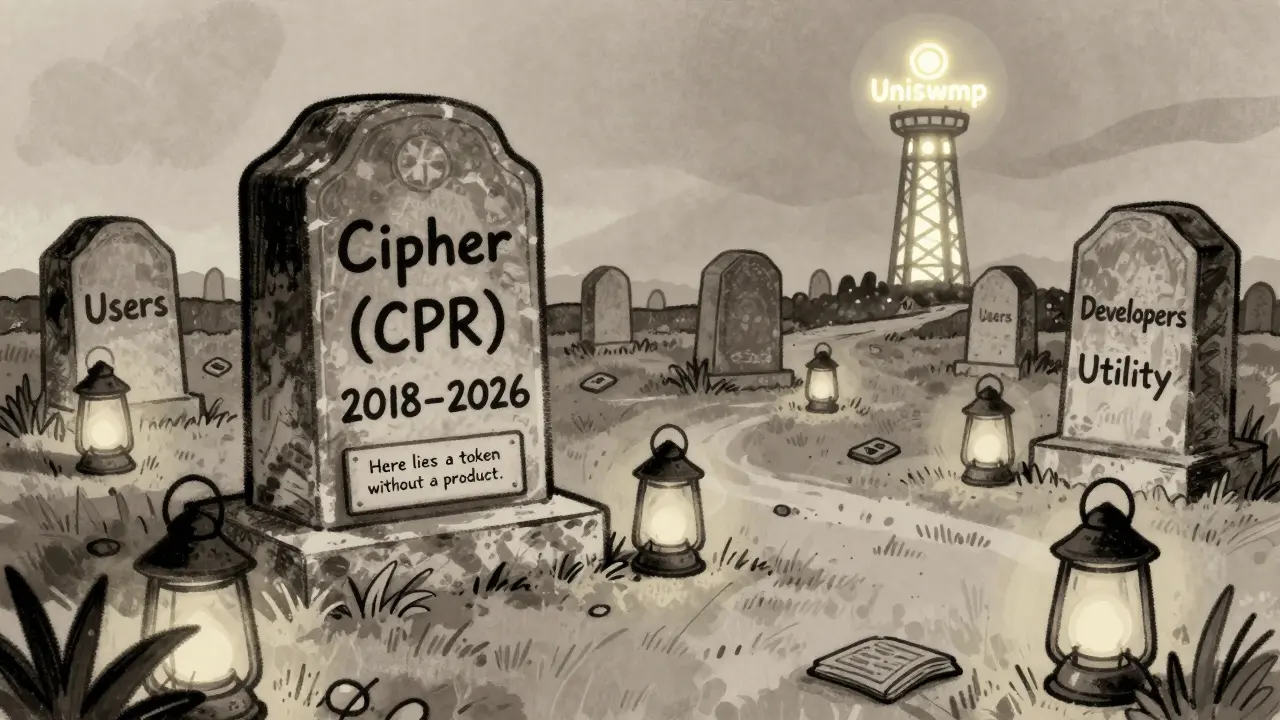
The "[Old]" tag on CoinMarketCap isn’t just a label. It’s a tombstone.
When a project gets marked as "Old," it means one of two things: either it’s been abandoned, or it’s been replaced by a new version. In Cipher’s case, there’s no evidence of a new version. No new team. No new website. No new roadmap. Just the old contract, the old token, and a fading price chart.
That’s a red flag for anyone still holding CPR. Even if you got it for free in 2021, it’s not a store of value. It’s not a utility token. It’s not even a real investment. It’s a digital artifact.
Compare it to projects like Uniswap or Chainlink. They had airdrops too. But they built real products. They had developers. They had users. Cipher had… nothing.
What You Should Do If You Still Have CPR Tokens
If you’re holding CPR today, here’s what actually matters:
- Check your wallet. Are you holding the old Ethereum version? If so, those tokens are likely worthless. The migration to Polygon was mandatory. If you didn’t move them, you can’t trade them.
- Verify the contract. Only the Polygon address 0xaa404804ba583c025fa64c9a276a6127ceb355c6 is active. Anything else is dead.
- Don’t expect a revival. There’s no community, no development, no news. This isn’t a dormant project - it’s dead.
- Sell if you can. Even if it’s worth pennies, it’s better than holding a dead asset. There are still small exchanges that list CPR. Use them to cash out.
And if you didn’t participate in the airdrop? Good. You avoided a trap.
The Bigger Lesson
The Cipher 2021 airdrop didn’t fail because of bad timing. It failed because it was built on a lie - the lie that people would care about a token without a product.
Every crypto project that survives has one thing in common: they solve a real problem. Cipher claimed to solve business problems. But they never showed how. They never showed the app. They never showed the users. They just gave away tokens.
That’s not innovation. That’s marketing.
Today, the crypto space is full of projects that do the same thing. They promise revolution. They drop tokens. Then they disappear. The 2021 airdrop was just one of thousands. But it’s a perfect case study in how not to build something lasting.
Real value isn’t in the airdrop. It’s in the code. In the users. In the product. Cipher had none of those. And now, it’s just a footnote - labeled "[Old]" - in the long history of crypto dreams that never came true.
I remember claiming my 75 CPR back then and thinking, 'Hey, free money!' Turns out it was just a digital post-it note. Funny how crypto makes us all chase ghosts. I sold mine for $0.01 on a random exchange last year. No regrets. At least I got a coffee out of it.
Still, I kinda miss the days when airdrops felt like a community thing, not just a bait-and-switch.
LMAO 😂 this is just another government-backed crypto purge. You think they didn’t *want* Cipher to fail? They let it grow for 3 years to collect data on retail investors-then quietly killed it. That ‘[Old]’ tag? That’s not a tombstone. That’s a surveillance marker. I’ve seen the pattern. Every time a project gets too decentralized, they nuke it. Wake up, sheeple.
The fundamental flaw in the Cipher paradigm was its ontological misalignment with the capitalist imperatives of blockchain utility. One cannot sustain a tokenomics model predicated on non-speculative adoption in an ecosystem inherently driven by arbitrage and liquidity extraction. The absence of institutional backing, coupled with an absence of measurable network effects, rendered the entire architecture epistemologically untenable. One must question: Was this ever a project-or merely a psychological experiment in retail token hoarding?
i just wanna say i really appreciated how the article broke down the contract address and the migration details. i had no idea my tokens were stuck on ethereum until i read this. i’ve been holding onto them for years thinking maybe one day… but honestly? i think i’m gonna delete the wallet now. it’s like keeping a broken phone just because it had one good photo on it. kinda sad but also kinda dumb to hold on.
also side note: the polygon address is legit, i checked it twice. thank you for that.
Airdrops aren’t magic. They’re a distribution mechanism. Value comes from utility, not from claiming. Cipher’s failure wasn’t bad luck-it was a failure of vision. No product, no users, no ecosystem. Just tokens in wallets. That’s not innovation. That’s a party with no music.
Honestly? I think people are too hard on Cipher. They didn’t have VC money. They didn’t have influencers. They just tried to build something real for businesses. And yeah, they failed. But at least they didn’t pump and dump. Most projects would’ve taken the money and run. Cipher gave people tokens and then… crickets. That’s not evil. That’s just bad execution. I still respect the intent.
If you held CPR after 2021, you’re either delusional or you have a gambling problem. This isn’t ‘crypto’-it’s a digital graveyard. You didn’t ‘invest.’ You didn’t ‘support innovation.’ You just collected a digital trinket. And now you’re clinging to it like it’s a childhood stuffed animal. Grow up. Sell it. Move on. There’s real work to be done in this space-stop wasting time on ghosts.
Let me be the one to say it: the real scam wasn’t Cipher. It was CoinMarketCap letting them run an airdrop in the first place. CMC is supposed to be a data platform, not a marketing funnel for dead projects. They made money off the traffic. Users got tokens. Nobody got value. That’s the real crypto tragedy: the middlemen profit while the users get left with trash. CMC should’ve vetted this harder. Or not at all. Either way, they’re complicit.
This is why I stopped reading crypto articles. Every single one ends with ‘sell if you can.’ Like we’re all just holding onto expired coupons. The entire industry is one giant funeral home with a Discord server. RIP Cipher. May your [Old] tag haunt the wallets of future fools.
I mean… if you’re still holding CPR you’re clearly not in this space for the tech. You’re here for the dopamine hits. You think you’re some kind of early adopter? Nah. You’re the guy who bought Bitcoin at $12k because his cousin said ‘it’s gonna be $100k.’ Wake up. This isn’t a game. It’s a graveyard with a whitepaper.
i just checked my wallet and i still have like 1200 CPR. i thought they were worth something. turns out they’re worth 0.06 cents total. i feel like an idiot. but hey at least i didn’t pay for them. still, i’m deleting this wallet. i’m done with crypto. it’s all just noise. 🤦♀️
the polygon address is 0xaa404804ba583c025fa64c9a276a6127ceb355c6 right? i think i got the wrong one. oops. now i know why my tokens disappeared. lol. i’m just gonna pretend i never had them. 🤷♀️