
You’ve written a smart contract. It looks clean. The tests pass. You’re ready to deploy. But here’s the uncomfortable truth: in blockchain, "looks good" doesn’t cut it. Unlike traditional software, you can’t just push a patch when things break. Once that code hits the mainnet, it’s etched in stone. If there’s a bug, millions of dollars might vanish before you even finish your coffee.
This isn't fear-mongering. In 2016, The DAO hack drained $60 million worth of Ether because of a reentrancy vulnerability that slipped through review. Fast forward to 2021, and the Poly Network exploit cost $610 million due to an undiscovered logic error. These aren't outliers; they are warnings. Effective blockchain code review is the single most effective barrier between your project and financial ruin. But reviewing blockchain code isn't like reviewing a React component or a Python script. It requires a different mindset, specific tools, and a deep understanding of immutability.
Why Traditional Code Review Fails in Blockchain
If you treat blockchain code like standard backend code, you’re setting yourself up for failure. The core difference lies in immutability. In web development, if you find a bug on Tuesday, you deploy a fix on Wednesday. In blockchain, if you find a bug after deployment, you might have to fork the chain or accept the loss. There is no "undo" button.
Furthermore, the attack surface is vastly different. In centralized apps, you control the server environment. In decentralized applications (dApps), anyone can interact with your smart contracts via transactions. This means every function call is a potential attack vector. Automated scanners, which catch about 30-40% of vulnerabilities in traditional software, often miss complex logical errors in smart contracts. They look for syntax issues or known patterns, but they struggle with business logic flaws-like assuming a user will always send exactly 1 ETH when they could send 0.999999.
The Two Main Approaches: Bottom-Up vs. Top-Down
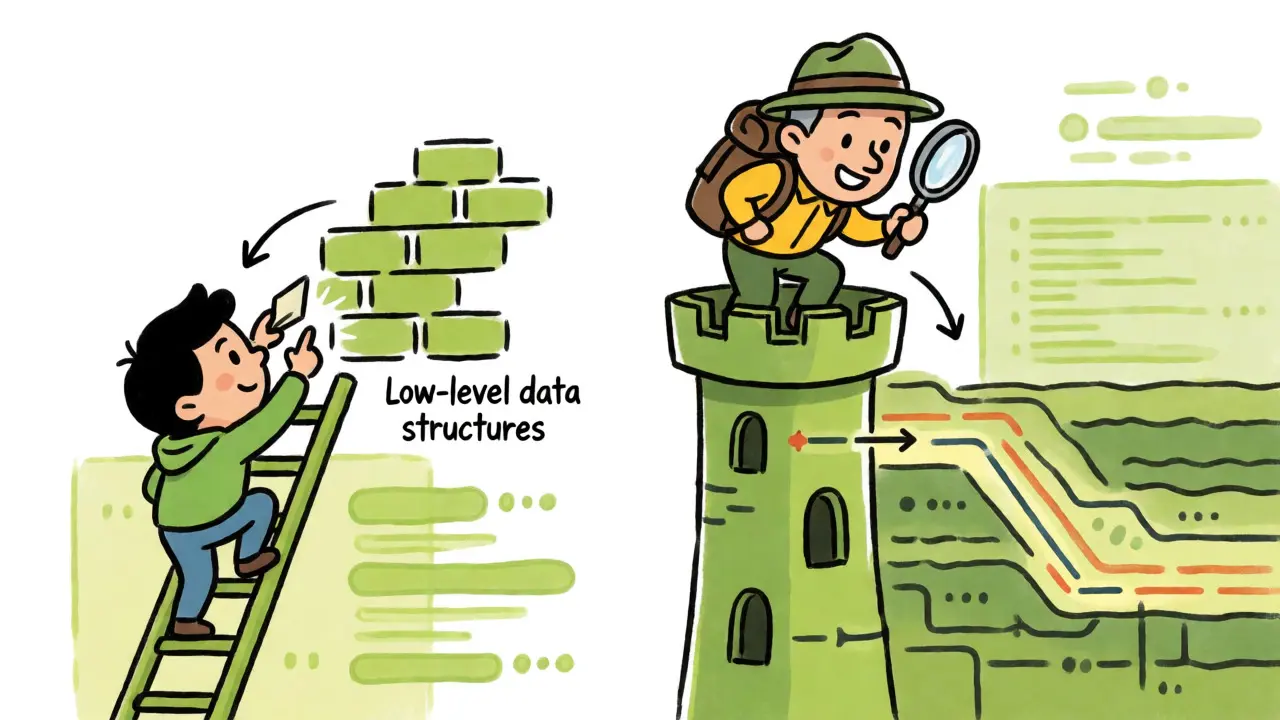
So, how do you actually start? Security firms like Sigma Prime recommend two distinct strategies depending on your experience level.
The Bottom-Up Approach is ideal for beginners or those new to a specific codebase. You start small. Look at the basic data structures first. For an Ethereum client using Reth, this means examining `reth-primitives`. Understand how data is stored and validated at the lowest level. Then, move up to transaction execution (`reth-evm`), then block validation (`reth-consensus`), and finally the API layer. This method builds confidence. You verify the foundation before checking the house.
The Top-Down Approach suits experienced reviewers. You start at the external entry points-the public functions users call directly-and trace the execution path inward, similar to a depth-first search. This helps identify high-risk areas quickly. However, it requires a strong mental model of the entire system architecture. If you don’t know what `msg.sender` implies in a proxy pattern, you’ll miss critical context.
Essential Tools and Techniques
Don’t rely solely on one tool. A robust review process combines automated scanning with manual human insight. Here is what works:
- Static Analysis Tools: Use tools like Slither or Mythril for Solidity. They detect common issues like unused variables or integer overflows. But remember: they won’t tell you if your economic model makes sense.
- Fuzz Testing: This involves feeding random inputs into your contract to see if it crashes or behaves unexpectedly. Nethermind’s research suggests fuzz testing catches mathematical errors that unit tests often miss.
- Formal Verification: Think of this as proving your code is correct mathematically. It’s expensive and time-consuming, but for high-value DeFi protocols, it’s becoming standard. By 2025, experts predict 60% of high-value contracts will use some form of formal verification.
A common mistake is trusting Large Language Models (LLMs) too much. Yes, AI can help you understand complex code snippets faster. But Sigma Prime explicitly warns: use LLMs for initial understanding, not final security assessment. Always manually verify any suggestion an AI gives you. AI doesn’t understand the financial stakes of a line of code; you do.
The Critical Checklist for Every Review
Consistency saves lives-or rather, funds. Create a dynamic checklist that evolves with your codebase. Here are the non-negotiables:
- Input Validation: Does the contract check who is calling it? Does it validate parameters? Never trust user input blindly.
- Access Control: Who can change critical variables? Is the ownership transfer mechanism secure? Many hacks happen because an admin key was left exposed or improperly managed.
- Error Handling: Does the contract revert gracefully? Exposing internal error messages can leak sensitive information to attackers.
- State Management: Check for race conditions. If a function updates state and then calls an external contract, does it follow the Checks-Effects-Interactions pattern? Ignoring this leads to reentrancy attacks.
- Economic Logic: Does the tokenomics make sense? Can a user manipulate the price oracle? Can they drain liquidity pools by exploiting rounding errors?
Infrastructure and Data Protection
Smart contracts are only part of the picture. Your off-chain infrastructure matters too. If your RPC nodes are misconfigured, you’re vulnerable. Ensure network configurations are hardened. Use encryption protocols like AES-256 for data in transit and at rest. If you store user data off-chain, consider Transparent Data Encryption (TDE) or Column-Level Encryption (CLE).
Also, look at your hosting environment. Are your servers isolated? Privilege escalation attacks can compromise your node operators, leading to consensus failures. Infrastructure reviews should address network topology, firewall rules, and access logs.
Building a Review Culture
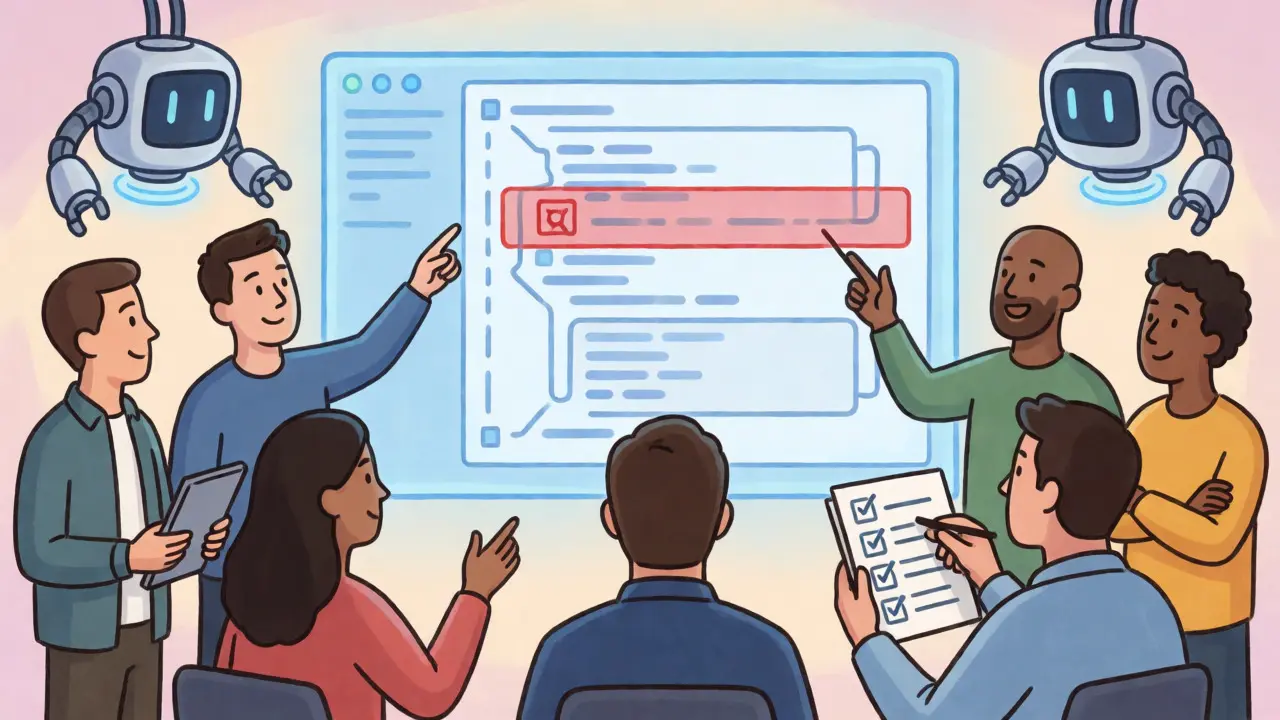
Code review shouldn’t be a bottleneck; it should be a collaboration. Distributed teams face challenges here. Dev.to’s analysis notes that reviews should happen fast. Don’t let a PR sit for three days while someone is in "flow state." Set clear SLAs (Service Level Agreements) for response times.
Encourage cross-functional reviews. Have a developer review the security implications, and have a security engineer review the business logic. This dual-perspective approach catches more issues. Also, keep your checklists updated. New exploits emerge constantly. What was safe in 2020 might be risky in 2026.
| Feature | Traditional Software | Blockchain Code |
|---|---|---|
| Patchability | High (Deploy fixes anytime) | Low/None (Immutable once deployed) |
| Attack Surface | Controlled Server Environment | Open Public Interaction |
| Primary Risk | Downtime/Data Loss | Financial Theft/Protocol Failure |
| Review Focus | Functionality & Performance | Security & Economic Logic |
| Automation Reliance | High (CI/CD pipelines) | Moderate (Needs heavy manual oversight) |
Common Pitfalls to Avoid
Even experienced teams fall into traps. One big one is "audit fatigue." Teams assume that because they passed one audit, they are safe forever. But upgrades introduce new risks. Every major update needs a fresh review.
Another pitfall is ignoring gas optimization at the expense of security. Sometimes, saving a few gas units introduces complexity that creates bugs. Balance efficiency with clarity. Clear code is secure code.
Finally, don’t skip integration testing. Unit tests check individual functions. Integration tests check how components work together. Most exploits happen at the boundaries between contracts, not inside them.
How long does a typical blockchain code review take?
It varies significantly based on complexity. Initial setup for a structured review process takes 2-4 weeks. Actual review cycles typically last 1-3 weeks per iteration, depending on the size of the codebase. High-value DeFi protocols may require months of iterative review and formal verification.
Can automated tools replace manual code review?
No. Automated scanners like SonarQube or Slither typically identify only 30-40% of vulnerabilities. They excel at finding known patterns but miss complex logical errors and business logic flaws. Manual review is essential for catching these nuanced issues.
What skills are needed for effective blockchain code review?
Reviewers need knowledge of blockchain architecture, consensus mechanisms, cryptographic primitives, and smart contract security patterns. Specialized training typically takes 6-12 months. Understanding both the protocol layer and application layer is crucial.
Is formal verification necessary for all projects?
Not necessarily. Formal verification is resource-intensive and best suited for high-value, critical infrastructure like lending protocols or DEXes. For smaller NFT projects or simple tokens, rigorous manual review and fuzz testing may suffice.
How often should we update our code review checklist?
Regularly. Emerging threats and new exploitation techniques appear frequently. Update your checklist after every major incident or when adopting new libraries/frameworks. It should be a living document, not a static PDF.
The DAO hack wasn't just a bug; it was an inside job orchestrated by the core team to drain liquidity before the fork. They knew about the reentrancy flaw months in advance but chose not to patch it because they wanted to exploit it themselves for personal gain. This article conveniently omits that detail while pushing the narrative of 'innocent mistakes.' If you think audits are independent, you're naive. The auditors often work with the same firms that built the contracts, creating a conflict of interest so deep it's practically incestuous. We are all just sheep being led to the slaughterhouse by people who profit from our ignorance. Wake up.
Great read! 🚀 It is really important to remember that security is a journey, not a destination. Keep building safely!
Formal verification is overrated for anything under $10M TVL. 📉 ROI doesn't justify the dev time. Just fuzz test and move on. 💸
Hey everyone! 👋 Really solid breakdown here. I want to jump in and emphasize the point about LLMs because I see this mistake constantly in junior reviews. 🛑 Do NOT let AI write your access control modifiers without manually tracing every single state change. 😤
I’ve seen too many cases where an LLM suggests a `onlyOwner` check that looks correct syntactically but fails logically when combined with a proxy pattern or a multi-sig setup. The AI doesn't know that your 'owner' might actually be a timelock contract that requires a delay, meaning the immediate execution assumption breaks down. 🧠
Also, regarding the bottom-up vs top-down approach: if you are new to Solidity, please start with Slither output interpretation. Learn what the tool flags and why. Then go manual. Don't skip the tools, but don't trust them blindly either. You need both eyes open. 👀
One more thing: Gas optimization is great, but never optimize at the cost of readability. If your code is clever but confusing, it’s dangerous. Clever code hides bugs. Boring code reveals them. Stay safe out there! 🛡️
This feels like a copy-paste from a generic SEO blog. 🙄 Did you even write this? The section on infrastructure is barely touched upon. TDE? CLE? In blockchain?? Most nodes run raw data or simple encrypted disks. Who cares about column-level encryption for a public ledger? 🤨 Also, the table formatting is messy on mobile. Fix it. 🛠️
Nice overview. Just adding a small note for those looking into formal verification: Certora and K Framework have made huge strides recently. It's less painful than it used to be. Still expensive, though. For smaller projects, invariant testing via Foundry is probably the sweet spot between cost and coverage. Keep it chill. 🧘♂️
omg yes the part about llms being dumb for security is so true. i keep seeing people paste their whole contract into chatgpt and calling it 'audited'. lol. its hilarious and terrifying at the same time. you literally cannot automate understanding economic incentives. a bot doesnt care if your tokenomics create a death spiral. only humans do. (mostly).
also typos in the checklist? 'revert gracefully' should be 'handle errors gracefully'? minor nitpick but details matter in crypto right? 😉
This resonates deeply with me. 💖 It’s not just about finding bugs; it’s about protecting the community’s trust. When we treat code review as a collaborative act of care rather than a gatekeeping exercise, the quality improves naturally. I love the idea of cross-functional reviews-having a designer look at the UX implications of a revert message can save users so much frustration. Let’s nurture our codebases like gardens, pruning carefully and watering with knowledge. 🌱✨
Typical surface-level advice for people who haven't actually shipped a protocol with >$1B TVL. Formal verification isn't just 'expensive'; it's mandatory for serious players. Anyone relying solely on fuzzing is gambling with user funds. And don't get me started on the 'LLM' section-we've been using static analysis long before these chatbots were trained on garbage data. This reads like it was written by someone who learned about blockchain six months ago. 🙄💅
I respectfully disagree with the assertion that automated tools miss 60-70% of vulnerabilities. Recent advancements in symbolic execution engines suggest higher coverage rates. Furthermore, the dichotomy between bottom-up and top-down approaches may be overly simplistic for modern modular architectures. Perhaps we should consider a hybrid methodology that integrates continuous integration pipelines with periodic manual deep dives. This would allow for a more robust security posture. I believe this perspective offers a more nuanced understanding of the current landscape. Thank you for sharing this insight. 🙏
Interesting points. :D The bit about gas optimization vs clarity is key. I've seen too many 'optimized' functions that no one can read after three months. If you can't explain the logic to a new hire in five minutes, refactor it. Simple is better than clever. Always. :-)
Why is nobody talking about the fact that most exploits happen because the team rushed the launch date?? 🤯 Investors pressure teams to ship fast, so they skip the second audit!! Then they lose millions!! And then they cry on Twitter!! 😭 It’s always the same cycle!! Why do we never learn??? 📉💸
Reading through these comments, I feel a lot of anxiety among the newer developers. It’s okay to feel overwhelmed. Security is hard. Start small. One checklist item at a time. You don’t have to solve everything today. Your progress matters more than perfection. 💙