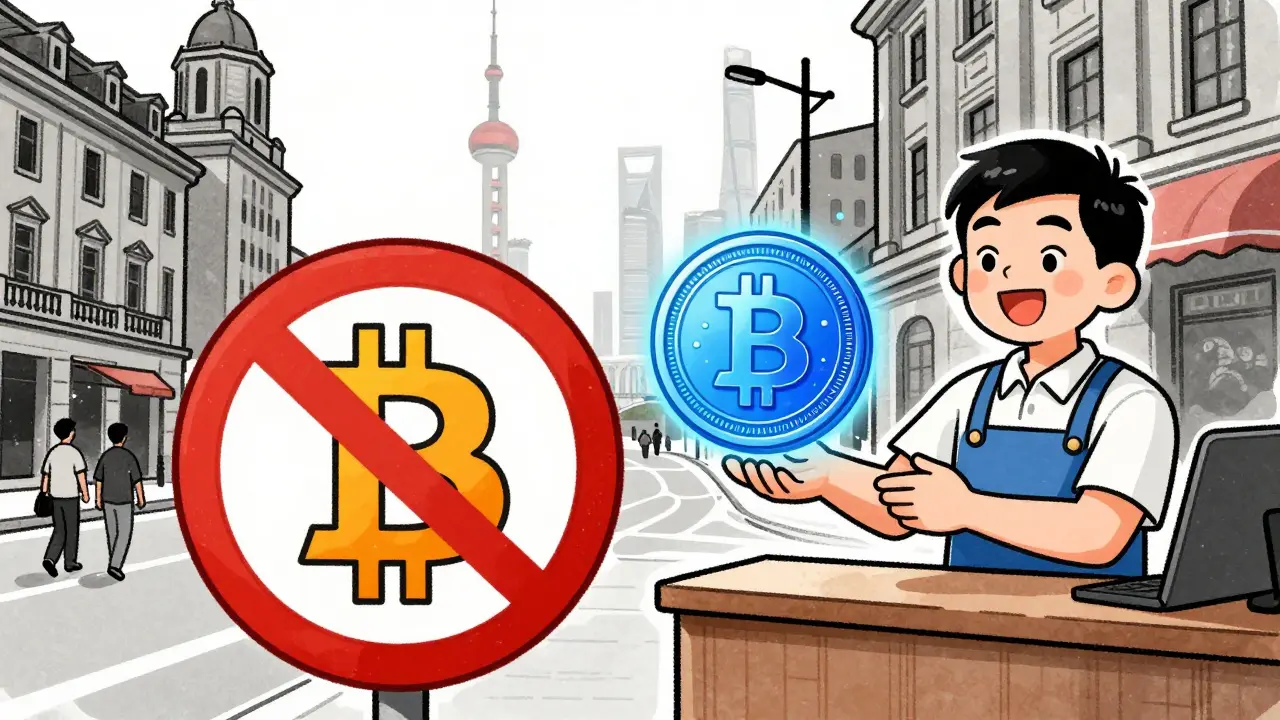
Imagine trying to buy a coffee with Bitcoin in Shanghai. You can’t. In fact, you can’t legally trade, mine, or even facilitate transactions for any decentralized cryptocurrency within mainland China. This isn’t just a strict rule; it’s one of the most comprehensive financial prohibitions in modern history. While the rest of the world debates how to regulate cryptocurrency, China has taken a different path: total exclusion of private digital assets from its financial system.
But here’s the twist. China hasn’t abandoned blockchain technology. Instead, it’s aggressively pursuing its own version of digital money-the digital yuan (e-CNY). Understanding this duality is key to grasping the current landscape. If you’re an investor, a developer, or just curious about global finance, knowing exactly what is banned, what is allowed, and why matters more than ever.
The Timeline of Restrictions: From Warning Shots to Total Ban
China’s stance on crypto didn’t happen overnight. It evolved over nearly two decades, moving from cautious warnings to absolute prohibition. Let’s look at the major milestones that shaped today’s reality.
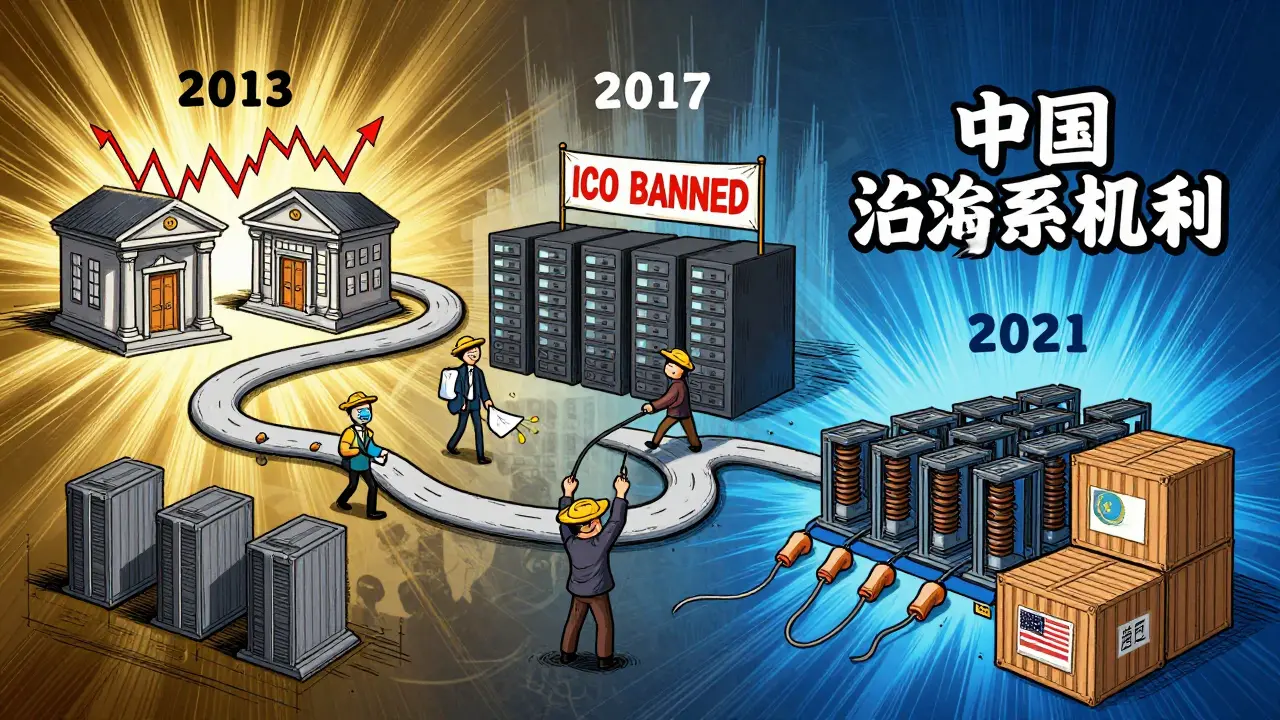
2013: The First Major Crackdown was a pivotal moment. On December 5, 2013, six major Chinese agencies, including the People's Bank of China (PBoC), issued a joint notice. They declared that banks and payment processors were forbidden from handling Bitcoin transactions. At the time, Bitcoin was classified as a "special virtual commodity" rather than legal tender. The impact was immediate. Prices on exchanges like Mt. Gox plummeted by over 30% within days. This was the first time the state made it clear: we do not want decentralized currency touching our banking rails.
2017: The ICO and Exchange Ban marked a significant escalation. By September 2017, Bitcoin was nearing its $20,000 all-time high, and Initial Coin Offerings (ICOs) were booming. The PBoC labeled ICOs as "illegal fundraising mechanisms." On September 4, 2017, authorities ordered all domestic exchanges to shut down operations immediately. Major platforms like BTCC and ViaBTC had to close their doors in China. Users were forced to withdraw funds, and many exchanges migrated overseas. This effectively killed the retail trading market inside the country, pushing activity into the shadows via peer-to-peer networks.
2021: The Final Nail in the Coffin came in May and June. The government expanded the ban to include all cryptocurrency-related activities. This wasn’t just about trading anymore; it included mining, lending, and even providing services to overseas exchanges if they served Chinese citizens. The PBoC declared all crypto transactions illegal. This move was driven by concerns over capital flight, energy consumption, and financial stability. It signaled that there would be no return to the pre-2017 era.
| Year | Action Taken | Impact |
|---|---|---|
| 2013 | Banks banned from processing Bitcoin | Bitcoin price dropped 30%; exchanges stopped accepting Yuan |
| 2017 | ICO ban and closure of domestic exchanges | Major exchanges closed or moved overseas; retail trading halted |
| 2021 | Total ban on all crypto activities including mining | Mining industry exodus; complete prohibition of transactions |
Why Did China Ban Cryptocurrency?
You might wonder why a tech-savvy nation like China would reject such a powerful innovation. The reasons are deeply rooted in economics and control, not just fear of new technology.
Capital Control is the primary driver. China maintains strict controls on the flow of money in and out of the country to stabilize the yuan. Cryptocurrencies offer a way for individuals to bypass these controls, converting yuan into Bitcoin and moving it offshore. During periods of economic uncertainty, such as the yuan devaluation in 2016, this risk becomes acute. The government cannot tolerate a parallel financial system that undermines its monetary policy.
Financial Stability is another concern. The volatility of cryptocurrencies poses risks to retail investors who may lack experience. The PBoC fears that widespread losses could lead to social unrest or demand for government bailouts. By banning speculative assets, they aim to protect the average citizen from fraud and market crashes.
Environmental Concerns played a role in the 2021 mining ban. Bitcoin mining consumes vast amounts of electricity. China has committed to carbon neutrality goals, and the energy-intensive nature of proof-of-work mining conflicted with these targets. Shutting down domestic mines helped reduce energy waste and pollution.
However, it’s crucial to note that China does not oppose Blockchain Technology. President Xi Jinping has emphasized the importance of blockchain for industrial efficiency and supply chain transparency. The distinction is clear: they want the underlying ledger technology but reject the decentralized, unregulated asset layer.
The Rise of the Digital Yuan (e-CNY)
If China hates cryptocurrency, why is it leading the world in Central Bank Digital Currency (CBDC) development? The answer lies in control. The Digital Yuan (e-CNY) is not a cryptocurrency in the traditional sense. It is a digital form of fiat money, fully backed by the state and regulated by the PBoC.
Unlike Bitcoin, which is anonymous and decentralized, the e-CNY is traceable. Every transaction can be monitored by the central bank. This allows the government to enforce monetary policy more precisely, prevent money laundering, and ensure tax compliance. For example, the government could program e-CNY to expire after a certain date, encouraging spending during economic downturns-a feature impossible with cash or Bitcoin.
The rollout has been gradual but aggressive. Pilot programs have launched in major cities like Shenzhen, Suzhou, and Beijing. Millions of users have already registered for digital wallets. The goal is to eventually replace physical cash and dominate cross-border payments, challenging the US dollar’s global hegemony.
This creates a fascinating dynamic: while Western nations debate how to regulate Bitcoin, China is building its own competing digital ecosystem. The e-CNY represents the future of state-controlled finance, offering speed and convenience without sacrificing oversight.
What About Mining? The Great Exodus
Before 2021, China dominated the global Bitcoin mining landscape. Estimates suggested that over 60% of the global hashrate originated from provinces like Sichuan and Inner Mongolia, where hydroelectric power was cheap and abundant. Companies like AntPool and F2Pool were household names in the crypto community.
The 2021 ban changed everything. Overnight, thousands of mining rigs were unplugged. Miners faced a choice: destroy their equipment or move. Many chose to migrate to countries with favorable regulations and energy policies, primarily the United States, Kazakhstan, and Canada. This event, known as the "Great Migration," reshaped the geography of Bitcoin mining.
The impact was profound. The US quickly became the largest Bitcoin mining hub, capturing a significant share of the displaced hashrate. However, the transition wasn’t seamless. Miners faced logistical challenges, higher energy costs, and regulatory uncertainty in their new homes. Meanwhile, China continued to manufacture mining hardware, maintaining its influence in the supply chain despite the domestic ban.
Today, mining in China is technically illegal, but small-scale operations may still exist in remote areas. However, the scale is negligible compared to the past. The global mining industry has diversified, reducing its dependence on any single country.

How Do Chinese Citizens Still Access Crypto?
Despite the ban, demand for cryptocurrency remains high among Chinese residents. So, how do they participate? The answer is ingenuity and risk-taking.
Peer-to-Peer (P2P) Trading is the most common method. Platforms like Binance and OKX offer P2P markets where users can buy and sell crypto directly with each other using bank transfers or Alipay. These platforms often block Chinese IP addresses, so users rely on Virtual Private Networks (VPNs) to access them. Transactions are conducted in yuan, and sellers hold crypto in overseas accounts.
Offshore Exchanges cater specifically to Chinese clients. Some exchanges maintain a low profile, operating in jurisdictions like Singapore or the Marshall Islands while marketing to Chinese speakers. They use sophisticated methods to verify identities without triggering Chinese banking alerts.
Hardware Wallets and Cold Storage are popular for holding assets. Once acquired, users store their crypto offline to avoid exchange hacks and regulatory scrutiny. This decentralizes custody, putting control back in the hands of the individual.
It’s important to understand the risks. Engaging in crypto activities in China carries legal penalties. Banks may freeze accounts if they detect suspicious transactions. Internet service providers monitor traffic, and VPN usage itself is restricted. Despite these dangers, the allure of potential profits and financial freedom keeps the underground market alive.
Global Implications and Future Outlook
China’s ban has ripple effects across the global crypto ecosystem. By removing a massive chunk of trading volume and mining capacity, it forced the industry to mature and diversify. Markets in Europe, North America, and Southeast Asia gained prominence.
For investors, this means less correlation with Chinese economic cycles but also reduced liquidity in certain altcoins that were heavily traded on Chinese exchanges. For developers, it highlights the importance of jurisdictional strategy. Building a crypto business requires careful consideration of where you incorporate and who you serve.
Looking ahead, experts believe China’s stance will remain firm. The success of the e-CNY reinforces the government’s confidence in state-controlled digital currency. There is little incentive to reverse course unless geopolitical pressures mount significantly.
However, the line between regulation and prohibition continues to blur globally. As other nations adopt stricter rules, China’s model may serve as a reference point for authoritarian regimes seeking to control digital finance. Conversely, democratic nations may lean towards lighter touch frameworks, creating a bifurcated global landscape.
In summary, China’s cryptocurrency ban is not just a local policy; it’s a defining chapter in the story of digital money. It teaches us that technology alone doesn’t determine adoption-political will and economic structure play equally critical roles.
Is it illegal to own Bitcoin in China?
Technically, owning Bitcoin is not explicitly criminalized for individuals, but all commercial activities related to cryptocurrency, including trading, mining, and exchanging, are strictly prohibited. The People's Bank of China has declared all crypto transactions illegal, meaning you cannot legally buy, sell, or transfer Bitcoin using Chinese financial systems. Holding it privately may not result in immediate prosecution, but attempting to convert it to yuan or engage in business with it carries severe legal risks.
Can I use the Digital Yuan (e-CNY) abroad?
Currently, the e-CNY is primarily designed for domestic use within China. However, pilot programs for cross-border payments are underway. China is exploring partnerships with other countries to facilitate international settlements using the digital yuan. While you cannot yet walk into a shop in New York and pay with e-CNY, future developments may enable limited cross-border functionality, particularly in trade agreements between China and partner nations.
Why did China ban Bitcoin mining?
China banned Bitcoin mining primarily due to environmental concerns and energy consumption. Proof-of-work mining requires massive amounts of electricity, conflicting with China’s carbon neutrality goals. Additionally, the government wanted to eliminate the infrastructure that supported the broader cryptocurrency ecosystem, which they view as a threat to financial stability and capital controls.
Does China support Blockchain technology?
Yes, China strongly supports blockchain technology for enterprise and government applications. The government distinguishes between the underlying distributed ledger technology and decentralized cryptocurrencies. Blockchain is seen as a tool for improving supply chain transparency, data security, and administrative efficiency. Numerous state-backed blockchain initiatives are active in sectors like logistics, healthcare, and finance.
Will China lift the cryptocurrency ban in the future?
Most analysts believe a full reversal of the ban is unlikely in the near term. The government’s commitment to the digital yuan and strict capital controls suggests a long-term preference for state-controlled digital assets. However, regulations could evolve to allow specific, highly regulated forms of digital assets or blockchain-based securities, similar to how other countries manage fintech innovations. But for decentralized cryptocurrencies like Bitcoin, the door remains firmly closed.
i mean its kinda wild how they just said no to it all. like really? no bitcoin at all? i guess if you live there you just gotta use the digital yuan or whatever. seems super strict but maybe thats what they want for control.
It’s actually pretty fascinating when you break down the timeline, isn’t it? We often look at crypto as this unstoppable force of nature, but seeing how a major economy can just shut the door on it makes you realize that regulation is still king. I think a lot of people forget that blockchain itself isn’t the enemy here; it’s the lack of oversight and the potential for capital flight that really spooks governments. It’s a great reminder that technology doesn’t exist in a vacuum-it has to play by the rules of the geopolitical game. If you’re interested in the technical side, looking into how the e-CNY works versus Bitcoin’s proof-of-work model is a real eye-opener for understanding where different nations are heading with their financial infrastructure.
Typical authoritarian overreach. They ban innovation because they can’t control it, then build their own surveillance tool and call it progress. The 'digital yuan' is just a leash with extra steps. Meanwhile, the US mining industry got a massive boost from the exodus, which proves that free markets adapt while command economies stagnate. It’s not about 'financial stability,' it’s about maintaining the party’s stranglehold on wealth. The fact that they still manufacture the hardware while banning the software is peak hypocrisy. You can’t have it both ways, Beijing.
The article’s conflation of 'capital controls' with 'protectionism' is intellectually lazy. The PBoC’s rationale is rooted in macroeconomic sovereignty, a concept that eludes those who fetishize decentralized anarchy. To suggest that the ban is merely about 'control' ignores the systemic risk posed by unregulated speculative assets in a developing market. The e-CNY is a sophisticated instrument of monetary policy, allowing for programmable liquidity-a feature that fiat cash simply cannot replicate. Those who dismiss this as mere 'surveillance' fail to grasp the nuances of modern central banking and the necessity of state-backed value stores in preventing hyperinflationary spirals.
Look, let’s cut through the bureaucratic fog. China didn’t ban crypto because they’re evil overlords; they banned it because they realized too late that they were letting the wolves into the henhouse. The energy consumption argument was just the convenient excuse to pull the plug before the whole system imploded under the weight of speculation. Now they’re sitting on a pile of blockchain patents and a digital currency that tracks every penny you spend. It’s a dystopian masterpiece, really. The irony is thick enough to spread on toast: they killed the wild west to build a prison with better Wi-Fi.
I’ve been thinking about this for a while. Is it possible that the ban was inevitable given the cultural emphasis on collective stability over individual freedom? The West sees crypto as liberation, but maybe China saw it as chaos. It’s not right or wrong, just different values driving different outcomes. The migration of miners to the US was interesting though-did we really want that much energy usage here? Or did we just see an opportunity? It’s a complex dance between ideology and economics.
One thing that strikes me... is the sheer speed of the enforcement. From warnings in 2013 to a total ban in 2021... it shows a level of coordination that most democracies could only dream of. But... does it work? The underground P2P markets are thriving. People find a way. It reminds me of prohibition in the US... crime didn't stop, it just went underground and became more dangerous. So... maybe the ban created more problems than it solved? Just food for thought.
As someone who has traveled extensively in Asia, I can tell you that the attitude on the ground is mixed. Older generations are terrified of losing their savings to scams, so they support the ban. Younger tech-savvy folks are frustrated but adaptable-they use VPNs and offshore exchanges without blinking. It’s a cat-and-mouse game. Also, don’t underestimate the role of Alipay and WeChat Pay. For many Chinese citizens, the convenience of these apps outweighs the allure of Bitcoin. They don’t need decentralization when their centralized systems work flawlessly for daily life. :)
The notion that 'demand remains high' is somewhat overstated when you consider the demographic realities. The average Chinese citizen is not a libertarian idealist; they are pragmatic survivors. The ban eliminated a layer of financial complexity that offered little utility beyond speculation. The e-CNY provides instant settlement and integration with existing social credit mechanisms, which is arguably superior for a society prioritizing efficiency over anonymity. Your romanticization of 'underground markets' ignores the significant legal risks and lack of consumer protection involved. It is a naive perspective.
I must say that while I appreciate the detailed breakdown of the historical milestones provided in the article, I find myself somewhat concerned about the implications for global financial interoperability, especially considering that the divergence between Western regulatory frameworks and Eastern prohibitions creates a fragmented landscape that complicates cross-border transactions for legitimate businesses, and furthermore, the reliance on peer-to-peer networks for circumvention introduces significant security vulnerabilities that ordinary users may not be equipped to handle, thereby potentially exposing them to fraud or loss of funds, which is a situation that neither regulators nor consumers should find desirable in the long run.
This is huge! The shift in mining geography is going to change everything for the grid in places like Texas. Imagine all that hash power moving to renewable sources or even stranded gas flares. It’s exciting stuff! The ban forced the industry to grow up and spread out. No single point of failure anymore. That’s a win for resilience! Let’s go! :D
You’re all missing the point. This isn’t about money. It’s about power. The moment you allow an asset outside the state’s purview, you undermine the state’s authority. China understood this decades ago. The West is playing catch-up, pretending that ‘innovation’ trumps sovereignty. It doesn’t. The digital yuan is the endgame for controlled societies. And honestly? Most people prefer the comfort of control over the burden of freedom. Don’t kid yourselves. The ban worked perfectly because the population wanted it to.
I wonder if we’ll see other countries follow suit. Brazil and India have been tightening regulations too. Is the era of wild-west crypto coming to an end globally? It feels like we’re entering a phase where either you comply with CBDCs or you operate in the shadows. What do you think is the tipping point for other major economies?