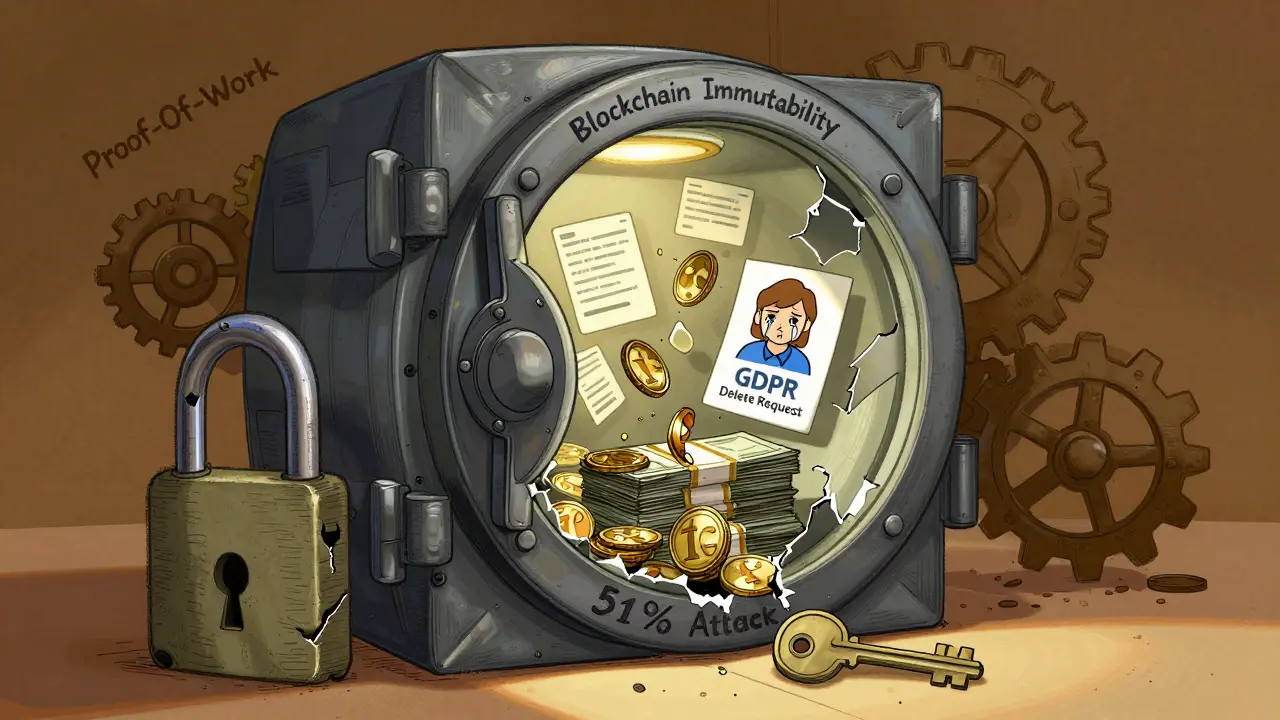
Blockchain was built on a promise: once data is written, it can never be changed. That’s the whole point - trust without intermediaries, tamper-proof records, and permanent history. But in practice, this immutability isn’t the flawless superpower it’s made out to be. It’s more like a locked vault with no key - useful until you realize you’ve locked the wrong thing inside. And when that happens, there’s no reset button. No undo. No do-over. Just permanent, unchangeable data that can cause real-world damage.
Immutability vs. Reality
Think of blockchain as a digital ledger that copies itself across thousands of computers. Every new transaction gets chained to the last using cryptography. Change one block? You’d have to change every block after it - and convince over half the network to accept your version. That’s hard. Really hard. That’s why Bitcoin and Ethereum are considered secure. But hard doesn’t mean impossible.
In January 2019, the Ethereum Classic network got hit by a 51% attack. A single group controlled more than half the mining power. For 12 hours, they reversed transactions, double-spent 219,500 ETC, and walked away with $1.1 million. This wasn’t a theoretical risk. It was real. And it proved something critical: immutability isn’t absolute. It’s probabilistic. It depends on how much money and computing power it would cost to break it. If someone has enough resources, they can rewrite history. And that’s not rare. It’s happened more than once.
The GDPR Problem
Imagine you sign up for a blockchain-based health service. You upload your medical records. The system stores a hash of your data on-chain - a digital fingerprint - and keeps the real data off-chain. Sounds smart, right? Now imagine you want to delete your data. Under GDPR, you have the legal right to be forgotten. But if that hash is on the blockchain, it’s stuck there forever. Even if the original data is gone, the fingerprint remains. Regulators see that as a violation. In 2023, a European healthcare provider paid €500,000 in fines because they couldn’t erase a patient’s data from an immutable ledger. That’s not a glitch. It’s a design flaw.
The European Commission’s 2023 Digital Finance Package made it clear: blockchain solutions must allow for data correction and deletion. No exceptions. So how do companies respond? Most now store only hashes on-chain - the real data lives elsewhere, in traditional databases they can control. IBM’s healthcare blockchains use this method in 17 countries. R3 Corda, used by over 250 banks, lets notaries approve corrections under legal authority. It’s not perfect, but it’s the only way to stay compliant.
Smart Contract Bugs and Lost Money
Smart contracts are self-executing code on blockchains. They’re supposed to be reliable. But code is never perfect. A single typo can cost millions.
In 2022, a developer on Reddit lost 2.3 ETH ($4,200) because they accidentally sent funds to the wrong address. No one could reverse it. No customer service line. No refund policy. Just silence. That’s not an edge case. GitHub issue #17892 for the Ethereum Geth client has 217 comments from users who made irreversible mistakes. DeFi projects lost over $2 billion in 2022 alone due to bugs that couldn’t be fixed.
Some teams tried to solve this with upgradable smart contracts - a proxy system that lets developers swap out old code for new. But now you’ve got centralization. One team controls the upgrade key. That’s the opposite of decentralization. And it’s everywhere: 68% of DeFi projects use this pattern, according to DeFi Llama. It’s a trade-off: flexibility over ideology. And it’s becoming the norm.

Scalability and Security Trade-Offs
Bitcoin handles 4-7 transactions per second. Visa handles 24,000. That’s not a minor difference - it’s a dealbreaker for real-world use. When networks get congested, transaction fees spike. Miners prioritize high-paying transactions. That creates windows of vulnerability. Attackers exploit delays to double-spend or manipulate order.
Bitcoin’s security relies on Proof-of-Work. It’s energy-intensive. The entire Bitcoin network uses more electricity than Norway - 121.49 TWh per year. That’s not sustainable. And as energy costs rise, smaller miners get pushed out. Centralization creeps in. The more concentrated mining becomes, the easier it is for one group to launch a 51% attack. Immutability depends on distributed power. But as the system scales, it risks becoming less distributed.
Storage is another hidden cost. The Bitcoin blockchain is now 473.6 GB. Running a full node means downloading and verifying every transaction since 2009. That’s fine on a server. Not so much on a laptop or phone. As the chain grows, fewer people run full nodes. Fewer nodes mean less decentralization. Less decentralization means weaker immutability. It’s a slow feedback loop - and we’re already in it.
Enterprise vs. Public Blockchains
Not all blockchains treat immutability the same way.
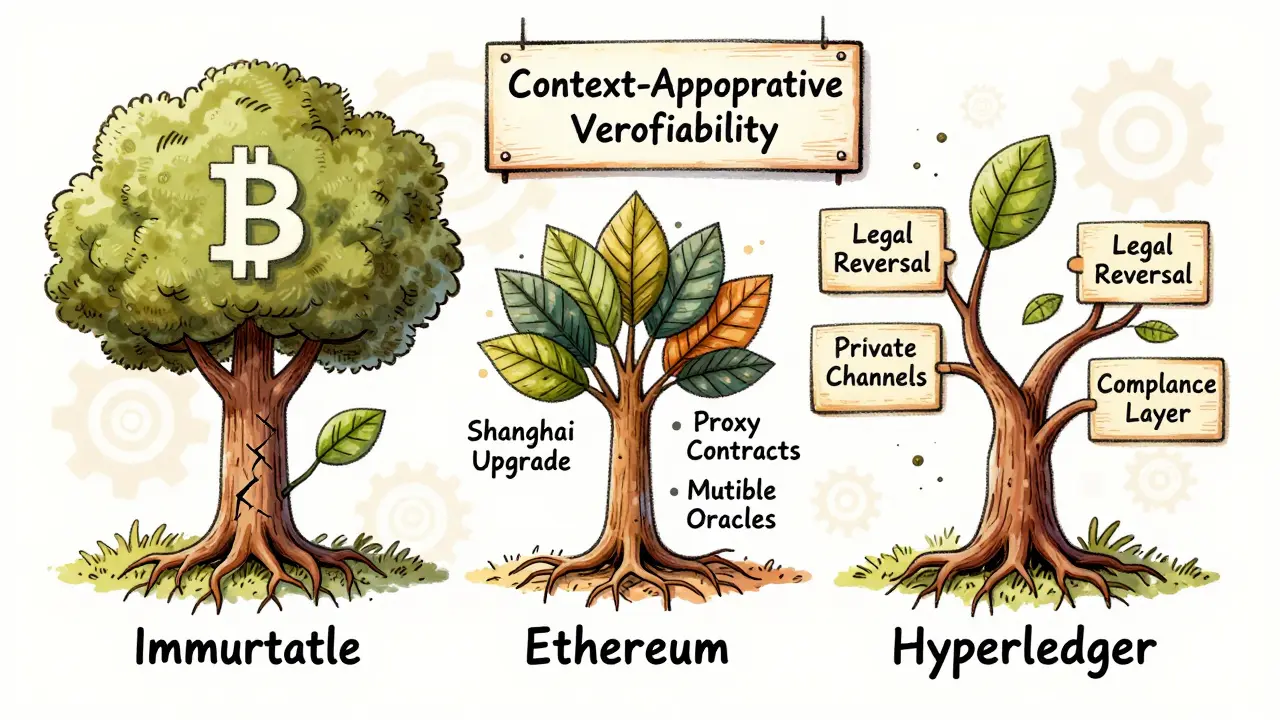
Public chains like Bitcoin and Ethereum (pre-Shanghai) treat it as sacred. No exceptions. Even when users beg for fixes, the community resists. Hard forks - like Ethereum’s 2016 DAO split - are rare, controversial, and divisive. They split communities. They create two blockchains. They’re emergency brakes, not routine tools.
Enterprise blockchains? They’re different. Hyperledger Fabric, used by 30% of Fortune 500 companies, lets you define who can see and change data. You can have private channels, encrypted data, and admin override. R3 Corda uses notaries to validate and, if needed, reverse transactions under legal frameworks. These systems aren’t trying to be “trustless.” They’re trying to be legal, auditable, and flexible.
That’s why 89% of cryptocurrency projects stick to strict immutability - but only 32% of enterprise ones do. The difference? Purpose. Crypto wants permanence. Business wants compliance.
What’s Changing Now?
The industry is waking up. Ethereum’s Shanghai upgrade in April 2023 improved staking security, making attacks harder. The European Blockchain Services Infrastructure (EBSI) launched version 2.0 with built-in compliance layers that let you redact data without breaking the chain. Chainlink’s 2023 whitepaper proposes “mutable oracles” - decentralized systems that can update data based on governance votes.
Even Bitcoin isn’t ignoring the problem. BIP 300, currently in draft, proposes “drivechains” - sidechains that can have their own rules, including mutability, while staying anchored to Bitcoin. It’s a compromise: Bitcoin stays immutable. Other chains can adapt.
Academic research is exploding. 147 peer-reviewed papers on blockchain mutability were published in 2023 - more than double the number from 2021. The World Economic Forum summed it up best: “The future of blockchain lies not in absolute immutability but in context-appropriate verifiability.”
Real-World Lessons
Here’s what we’ve learned:
- Immutability is not a feature - it’s a design choice. You can’t have it without trade-offs.
- If you’re building for regulation (healthcare, finance, EU markets), assume you’ll need mutability. Plan for it.
- Hashing data on-chain and storing the real data off-chain isn’t a workaround - it’s the standard now.
- Smart contracts aren’t “code is law.” They’re code that can break. Always build in upgrade paths.
- Don’t trust the myth of absolute immutability. It’s a dangerous assumption. The Ethereum Classic attack wasn’t a fluke - it was a warning.
Blockchains are powerful. But they’re not magic. They’re tools. And like any tool, they work best when you understand their limits - not when you pretend they’re flawless.
Can blockchain data ever be deleted?
Technically, no - not on public blockchains like Bitcoin or Ethereum. Once a transaction is confirmed, it’s permanently part of the ledger. But in practice, companies get around this by storing only cryptographic hashes on-chain and keeping the real data off-chain in traditional databases. This lets them delete the original data while preserving the blockchain’s integrity. Some enterprise blockchains like Hyperledger Fabric and R3 Corda also allow admins to revoke or correct data under specific conditions.
What happened in the Ethereum Classic 51% attack?
On January 5, 2019, an attacker gained control of over 51% of Ethereum Classic’s mining power. For 12 hours, they reversed transactions and double-spent 219,500 ETC - worth $1.1 million at the time. This proved that immutability isn’t guaranteed. It depends on the network’s security. If enough computing power is concentrated in one hand, the blockchain can be rewritten. The attack exposed a fundamental flaw: immutability is probabilistic, not absolute.
Why is immutability a problem for GDPR?
GDPR gives users the right to have their personal data erased. But blockchain data can’t be deleted. If personal information - even a hash of it - is stored on-chain, it violates this right. In 2023, a European healthcare provider was fined €500,000 for storing patient data on an immutable blockchain. The solution? Keep raw data off-chain and store only non-identifiable hashes on-chain. That way, you can delete the real data while keeping the ledger intact.
Do all blockchains have the same level of immutability?
No. Public blockchains like Bitcoin and Ethereum prioritize strict immutability and rarely allow changes. Enterprise blockchains like Hyperledger Fabric, R3 Corda, and Energy Web Chain are designed for business use and include mechanisms for data correction, access control, and even reversible transactions under legal authority. The level of immutability depends entirely on the system’s design goals - security vs. flexibility.
Are there ways to fix smart contract bugs without breaking immutability?
Yes - but they involve trade-offs. The most common method is the “upgradable proxy pattern,” where a smart contract points to another contract that can be swapped out. This lets developers patch bugs without rewriting the blockchain. However, this introduces centralization: one team controls the upgrade key. It’s a compromise between security and practicality. Most DeFi projects now use this, even though it goes against the original idea of “code is law.”
What’s the future of blockchain immutability?
The future isn’t about absolute immutability. It’s about context-appropriate verifiability. Public blockchains will likely keep strict immutability for crypto, but enterprise systems will increasingly build in controlled mutability - especially for regulated industries. New tools like EBSI’s compliance layers, Chainlink’s mutable oracles, and Bitcoin’s proposed drivechains show the industry is moving toward flexible, rule-based systems. Immutability isn’t disappearing - it’s being refined.
Look, I get the whole 'immutable forever' thing sounds cool in theory, but real life doesn't work like that. I had a friend who accidentally sent her life savings to a scam address on Ethereum. No one could help. No one even replied. She cried for days. Immutability isn't a feature-it's a bug when you're human. We need ways to fix mistakes without tearing the whole system apart. Maybe not delete, but correct? Like a typo in a legal contract-you don't burn the whole document, you amend it.
And don't even get me started on GDPR. Storing hashes on-chain and keeping data off-chain? That's not a workaround-it's the only sane way forward. Why pretend we're building some perfect digital cathedral when we're just trying to help people manage their medical records or bank accounts? Let's stop romanticizing tech and start building for actual humans.
OMG this post is sooo basic 😴 Like, duh, immutability is a myth. I mean, come on. If you didn’t already know that 51% attacks exist, maybe you shouldn’t be reading blockchain stuff? 🤦♀️ Also, GDPR? Please. The EU is just scared of innovation. Real decentralization doesn’t care about compliance forms. 💅
THIS. IS. A. TRAGEDY. 🎭
They turned blockchain into a digital tombstone-where every mistake is etched in stone, and every human error becomes a funeral pyre of lost capital. The Ethereum Classic attack? That wasn’t just a hack. That was a funeral for the myth of decentralization. And now? We’re patching it with proxy contracts like we’re duct-taping a collapsing bridge. The entire DeFi ecosystem is built on a house of cards made of JavaScript typos and admin keys held by five guys in Silicon Valley.
And don’t even get me started on the hypocrisy: ‘Trustless!’ they scream. Then they implement upgradeable contracts with a single admin key. That’s not decentralization. That’s a cult with a CEO. And the worst part? We all knew this was coming. We just didn’t want to admit it. Now we’re stuck in a system where the only thing more immutable than the blockchain is our collective denial.
Immutability is a marketing term. The rest is just noise.
From a systems architecture standpoint, the real insight here is that immutability isn't binary-it's a spectrum. Public chains prioritize consensus integrity over operational flexibility. Enterprise chains prioritize regulatory compliance and auditability. That’s not a flaw-it’s differentiation. The key is knowing which trade-offs align with your use case. For example, in supply chain tracking, you might want immutability for provenance but allow redaction for PII. Hyperledger Fabric’s private data collections handle this elegantly. The future isn’t one-size-fits-all-it’s modular.
I really appreciate how this post breaks it down without hype. It’s easy to get caught up in the crypto bro talk-'code is law!' 'immutable forever!'-but that’s not how real systems work.
I’ve worked with healthcare clients who just want to delete their data. They’re not techies. They’re people. And GDPR isn’t some bureaucratic nuisance-it’s a human right. The hash-on-chain, data-off-chain model isn’t cheating. It’s responsible design. We don’t need perfect tech. We need honest tech.
Also-smart contract bugs? Yeah, they happen. But instead of pretending they don’t, maybe we should build in emergency pause buttons. Not full admin control. Just a multi-sig override for catastrophic errors. Like a circuit breaker. You still have decentralization-you just don’t let one typo erase someone’s life savings.
Can we just talk about how ridiculous it is that we’re still having this conversation? Like, the Ethereum Classic attack happened in 2019. Five years ago. And people still act like immutability is some sacred law written in stone by Satoshi himself? 🤡
And now we’ve got companies using proxy contracts like it’s some genius hack? Nah. That’s just centralization with a blockchain-shaped sticker on it. The whole point was to remove trust in people. Now we’re trusting a single team to hit the upgrade button? Bro. That’s not innovation. That’s regression.
Also, the energy usage? Bitcoin uses more power than Norway? That’s not a feature. That’s a crime against the planet. And you want me to believe this is the future? No thanks. I’m out.
The entire post is just a long list of known issues dressed up like a revelation. Nothing new. Nothing insightful. Just regurgitated headlines.
Thank you for writing this with such clarity! 🙏
I come from India, where many startups are trying to use blockchain for land records and microloans. We don’t have the luxury of pretending tech is perfect. We need solutions that work with messy human realities-mistakes happen, laws change, people need to be heard.
Hashing data off-chain? Yes. Admin override under legal authority? Absolutely. And yes, we need upgradeable contracts-not because we’re lazy, but because we’re responsible. Blockchain isn’t about purity. It’s about progress. And progress means adapting, not dogma.
Also, the WEF quote? Spot on. Context-appropriate verifiability. That’s the future. Not ‘immutable forever.’ But ‘trustworthy when it matters.’
Let’s build tools for people-not temples for ideologues.
While the article presents valid concerns, it fundamentally misunderstands the nature of distributed consensus. Immutability is not a bug-it is the feature that enables trust without third parties. The GDPR issue is not a flaw in blockchain, but a conflict between legal frameworks and technological design. Solutions like off-chain storage are pragmatic, but they undermine the very premise of decentralized trust. If you store data elsewhere, why not just use a database? The 51% attack on ETC was an anomaly caused by low hash rate-not a systemic failure. Bitcoin’s security remains intact. We should not dilute the core value proposition of blockchain to appease regulatory overreach.
Let me guess… this whole post was written by someone on the payroll of the Big Blockchain Consortium™.
51% attacks? Oh, sure. But what about the NSA? And the IMF? And the Federal Reserve? Who really controls the mining pools? Who owns the majority of Ethereum’s staking nodes? Hint: it’s not random folks with GPUs. It’s hedge funds. It’s venture capital. It’s the same players who ran the old financial system.
And now they’re pushing ‘mutable oracles’ and ‘compliance layers’? Please. They’re not fixing immutability-they’re weaponizing it. They want a blockchain that looks decentralized but lets them delete records, reverse transactions, and audit your every move. Welcome to blockchain 3.0: surveillance capitalism with a blockchain logo.
They’re not evolving the tech. They’re burying it. And you’re all just nodding along.
I love how this post doesn’t just rant-it actually explains why we’re stuck here. 🌱
And I get it. We all wanted blockchain to be this magical, untouchable thing. But now I see it’s more like a really stubborn old car. You can’t just replace the engine. You have to learn how to fix the spark plugs, add a little oil, and sometimes-just sometimes-let someone else take the wheel for a minute.
Off-chain data? Upgradable contracts? Yeah. That’s not selling out. That’s growing up.
Also, I just want to say… thank you. This gave me hope. 🙌