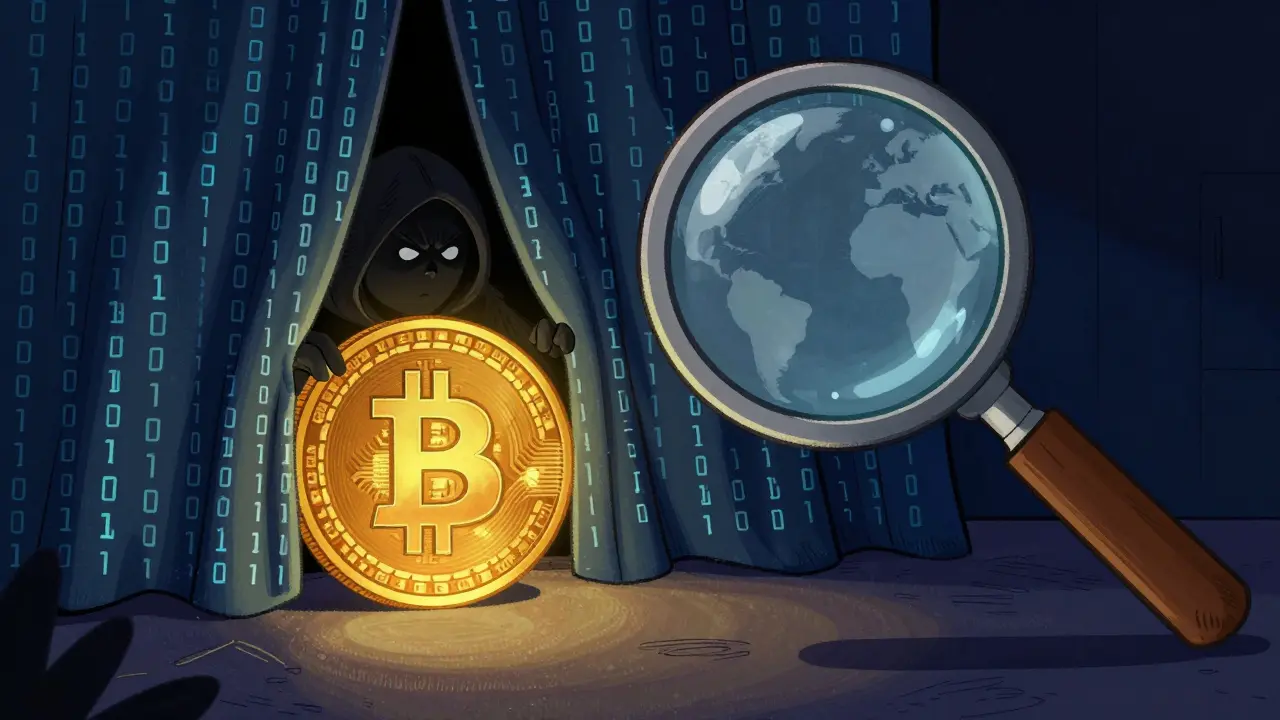
The Toolkit of Evasion: How the Money Moves
If you're a sanctioned entity in 2024, you aren't just sending a single Bitcoin transfer and hoping for the best. The strategies have become surgical. Bitcoin remains the king of the underground, accounting for 68% of these transactions. Ethereum follows at 20%, with stablecoins filling the remaining 12% to avoid the volatility that comes with traditional coins. One of the most effective tools in the evasion kit is the cross-chain bridge. These tools allow users to swap assets from one blockchain to another, effectively "jumping" networks to break the audit trail. In 2024, about 19% of sanctions-evading transactions used these bridges. It's like switching cars in a crowded parking lot to lose a tail. Furthermore, the scale of these moves is massive; 55% of wallets flagged by the Office of Foreign Assets Control (or OFAC) processed more than $500,000 in single transactions.The Infrastructure of Illicit Flow
Where does all this money actually land? It doesn't just float in the ether; it needs an off-ramp. A shocking 85% of inflows to sanctioned entities were concentrated in just two places: Garantex and Nobitex. Garantex, in particular, became a primary target for U.S. Treasury enforcement. It didn't just facilitate random trades; it was a hub for ransomware proceeds. We're talking about money from the Conti and LockBit gangs flowing directly into their systems. For example, the known money launderer Ekaterina Zhdanova used Garantex to swap over $2 million in Bitcoin for Tether (USDT), proving that centralized exchanges with lax KYC (Know Your Customer) rules are the weakest link in the global sanctions chain.| Metric | Value / Percentage | Key Insight |
|---|---|---|
| Bitcoin Volume | 68% | Dominant asset for sanctioned entities |
| Ethereum Volume | 20% | Secondary preference for smart contract utility |
| Stablecoin Volume | 12% | Used for value preservation (e.g., USDT) |
| Cross-Chain Bridge Use | 19% | Primary method for breaking tracking trails |
| DeFi Funneling | 33% | Increasing shift toward non-custodial platforms |

Geopolitics and the Digital Shift
Sanctions aren't just about individual criminals; they're about nations. In 2024, we saw a major shift toward jurisdictional sanctions. Sanctioned countries now command nearly 60% of the total value involved, a record high. Iran has been particularly aggressive in its pivot. As traditional banking doors slammed shut, Iranian centralized exchanges saw a surge in usage. The patterns here aren't just about evasion-they look like capital flight, with citizens and entities moving wealth into digital assets to protect it from inflation and seizure. Russia remains a powerhouse of illicit activity, but the focus has shifted toward cybercrime. In 2024, $800 million in ransomware payments were routed through sanctioned wallets-a 22% jump from the previous year. Darknet markets, largely based in Russia, facilitated another $1.1 billion in transactions. It's a symbiotic relationship: the state provides the shield, and the cybercriminals provide the funds.The DeFi Dilemma: A New Frontier for OFAC
For years, enforcement agencies focused on centralized exchanges where they could simply demand a freeze on an account. But the rise of Decentralized Finance (or DeFi) changed the game. In 2024, 33% of illicit funds moved through DeFi platforms. Because DeFi protocols run on automated smart contracts without a CEO or a compliance officer, there is no one to call when you want to freeze a wallet. OFAC responded by flagging 150 DeFi liquidity pools that were facilitating transactions with sanctioned entities. This creates a high-stakes cat-and-mouse game. If the software doesn't have a "kill switch," regulators have to find ways to pressure the people interacting with the protocol or target the front-end interfaces users use to access the blockchain.
The Arms Race: Analytics vs. Anonymity
Is the government winning? It's complicated. On one hand, blockchain analytics has become incredibly sophisticated. Tools can now trace transactions across multiple networks and use AI to spot patterns that a human eye would miss. On the other hand, the sheer volume of data is overwhelming. Total crypto transaction volume hit $10.6 trillion in 2024-a 56% increase. Finding $15 billion in a $10 trillion ocean is a monumental task. Furthermore, the emergence of more sophisticated privacy coins and enhanced mixing protocols means that the "visibility" we have today might be the peak before a new wave of anonymity tools takes over.What This Means for the Future
We're entering an era where the blockchain is the primary battlefield for financial warfare. As we move through 2025 and 2026, expect to see a few things:- Tighter Inter-Agency Cooperation: The U.S. Treasury is no longer working in a vacuum; they are coordinating with international allies to shut down off-ramps globally.
- AI-Driven Enforcement: Regulators will use machine learning to predict where illicit funds will move before they even land.
- The DeFi Crackdown: We will likely see new legal frameworks that force DeFi developers to implement some form of sanctions filtering at the protocol level.
Why do different analytics firms report different totals for sanctioned transactions?
The discrepancies (like the gap between Chainalysis's $15.8 billion and CoinLaw.io's $2.7 billion) stem from different methodologies. Some firms track any wallet that has ever interacted with a sanctioned entity, while others only count direct inflows. Additionally, different firms use different sets of "known" illicit addresses, and as new addresses are discovered, the totals are often revised upward.
What are cross-chain bridges and why are they used for evasion?
Cross-chain bridges allow users to transfer assets from one blockchain (like Bitcoin) to another (like Ethereum). Sanctioned entities use them to "hop" networks, which makes it harder for investigators to follow a single linear trail of transactions across a single ledger.
How does DeFi make sanctions enforcement harder?
Unlike centralized exchanges, DeFi platforms operate on autonomous smart contracts with no central authority. There is no compliance department to process a legal request to freeze an account, meaning funds can move automatically regardless of the user's identity or sanctioned status.
Which cryptocurrencies are most commonly used by sanctioned entities?
Bitcoin is the most common, representing 68% of the volume in 2024. Ethereum follows at 20%, and stablecoins like Tether (USDT) make up about 12%. Stablecoins are particularly prized for their ability to hold value without the price swings associated with BTC or ETH.
What role did Garantex play in the 2024 illicit crypto landscape?
Garantex acted as a major high-volume off-ramp for sanctioned parties. It was heavily used to process proceeds from Russian-linked ransomware attacks (such as LockBit and Conti) and provided exchange services to designated money launderers, making it a critical piece of infrastructure for sanctions evasion.
The gap in reporting between Chainalysis and CoinLaw is wild. It just goes to show how much of the "blockchain transparency" is actually just a facade when you're dealin with pro mixers and hop-chaining. Most people think a ledger is an open book, but it's more like a puzzle where half the pieces are intentionally melted. We gotta realize that the tech evolvs faster than the regs can even write the definitions. It's a classic cat and mouse game but the mouse has a jetpack.
How quaint that people still believe AI-driven enforcement is a viable solution. One simply doesn't "predict" the movement of funds when the actors are utilizing non-custodial protocols designed specifically to thwart such primitive attempts at surveillance.
Lol imagine thinking the US Treasury actually wants to "stop" this 🙄 they probably have their own backdoors into these bridges anyway. It's all just a giant theater production to make us feel like the system is in control while the elites move their bags in the shadows 👁️🕵️♂️
It is quite fascinating to observe the tension between the desire for absolute privacy and the necessity of global security, as we are essentially witnessing the birth pains of a new financial era where the very definition of a "border" is becoming obsolete. If we look at the Iranian situation mentioned, it's not even about crime in the traditional sense but rather a desperate survival mechanism for people whose local currency is basically confetti, which makes you wonder if the ethics of sanctions are even applicable in a decentralized world where the state's power to freeze assets is purely theoretical at the protocol level.
DeFi protocols are essentially math. You can't arrest a smart contract.
Really hope we can find a balance here! 😊 It's scary to think about ransomware, but the tech is so promising for the rest of us. Let's keep pushing for a cleaner ecosystem! ✨
just sad that people use this for harm when it could help so many people in poor countries
The sheer audacity of Garantex to operate as a hub for such filth is truly appalling. One would think that in a civilized society, such blatant disregard for international law would be met with immediate and total eradication. It is a stain on the digital asset landscape.
Westrn countries always try to act like they own the rules of global finance but look at them struggle with a few bridges lol. My country is way more adaptable and we dont need these fake analytics to tell us who is moving money. Pure comedy!!
the data is fundamentally flawed because the sampling of tagged wallets is based on legacy heuristics that dont account for the current volume of liquidity pools in defi which basically means the 15.8 billion is a lowball estimate if you actually track the slippage and internal swaps within a single pool without a bridge
If anyone is worried about their own privacy with these new rules, just remember that self-custody is still your best bet. Just be careful where you off-ramp.
This is a clear indication of the systemic failure of the current regulatory regime to handle the asynchronous nature of cross-chain liquidity provision which is essentially a weaponized form of financial arbitrage utilized by adversarial states to bypass the hegemony of the dollar-denominated banking system. We are seeing a strategic pivot toward non-custodial infrastructure that effectively renders the OFAC list a piece of digital scrap paper because the enforcement mechanism relies on the cooperation of centralized intermediaries that simply no longer exist in the high-velocity trade of sanctioned assets.
Great breakdown! For those wondering, the 'cross-chain bridge' is basically like a currency exchange but for different blockchains. It's the most critical part of the stack right now! Stay curious and keep learning! 🚀
Actually btc is still the king becaus everyone knows how to use it!! 👑 Stablecoins are just for the weak hands who are scared of volatility haha. Just wait till the next bull run and these sanctions wont even matter lol 🚀📈
Omg did you guys see that part about the ransomware gangs? Just totally wild how much money they're moving! I bet there's some crazy drama behind the scenes with the LockBit guys right now lol!
It is heartening to see that the tools for transparency are improving. I believe that over time, the community will gravitate toward a more honest and open system of exchange.
Keep it simple: don't do bad things with your coins and you'll be fine.
I totally agree with the point about the "weakest link" being the exchanges with lax KYC. It's a huge gap in the armor. If we can just get more standardized global KYC protocols, the $15.8 billion figure would drop significantly. We really need a collaborative approach between countries to make this work, otherwise, it's just a game of whack-a-mole where the mole just moves to a different country's server.