Blockchain Identity Verification Cost Calculator
Calculate how much your business could save by implementing blockchain identity verification. The article mentions Dock Labs found blockchain reduces identity verification costs by 65%. This tool helps you quantify potential savings based on your current operations.
Your Potential Savings
Based on current industry estimates
Current Monthly Cost: $0.00
Projected Monthly Cost: $0.00
Annual Savings: $0.00
Imagine logging into a bank, signing a lease, or proving you’re over 18 at a concert - all without showing your driver’s license, passport, or any personal document. No forms. No uploads. No waiting days for approval. Just a quick scan on your phone, and you’re done. That’s not science fiction. It’s what blockchain identity authentication makes possible today.
Why Your Identity Is Broken
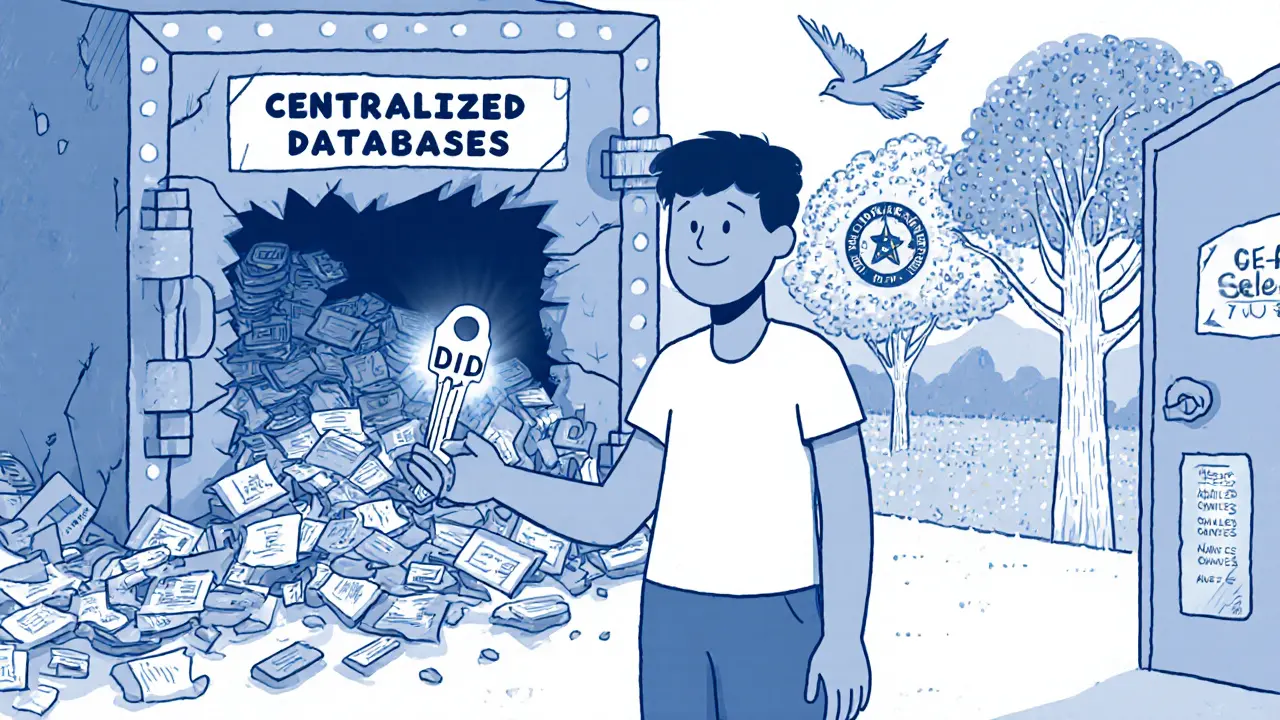
Right now, your identity is scattered. Your bank has one version. Your doctor has another. Your social media accounts? Each one holds a piece. And every time you sign up for a new service, you’re forced to hand over your name, address, date of birth - again. And where does all that data live? In centralized databases. That’s a problem. In 2017, Equifax lost the personal data of 147 million people. One breach. One weak server. Millions of lives disrupted. That’s not an outlier. It’s the rule. Centralized systems are honey pots for hackers. And you? You have zero control over what happens to your data once you hand it over. Blockchain identity flips this. Instead of storing your info in one place, it gives you control. You hold the keys. You decide who sees what. And you don’t need to trust a company or government to verify you. The math does it for you.How Blockchain Identity Actually Works
It’s simpler than it sounds. Think of it like a digital wallet - but instead of holding crypto, it holds your verified identity attributes. These aren’t raw documents. They’re encrypted, cryptographically signed claims called verifiable credentials. For example:- Your university issued a credential saying you graduated in 2020 - signed with their private key.
- Your government issued a credential proving you’re over 18 - signed with their digital seal.
Key Benefits You Can’t Ignore
1. No more waiting days for KYC Traditional identity checks - like opening a bank account or applying for a loan - take 24 to 72 hours. Why? Because someone has to manually verify your documents. Blockchain cuts that to under two seconds. J.P. Morgan’s Kinexys division found that blockchain-based verification slashed mortgage applicant processing time from days to hours. That’s not a minor tweak. That’s a revolution. 2. No more data breaches Centralized databases are single points of failure. Blockchains aren’t. Your identity data isn’t stored on a server. It’s distributed across hundreds or thousands of nodes. Even if one node is hacked, nothing is stolen. The data doesn’t live there. Only the proof does. 3. You own your identity - not a corporation You don’t need Facebook to log in. You don’t need Google to prove who you are. You don’t need to give up your data to use a service. You control everything. Want to revoke a credential? You can. Want to share only your age, not your full birthdate? You can. That’s self-sovereign identity - and it’s the only model that puts power back in your hands. 4. One identity, everywhere Right now, you have 10 different logins for 10 different services. With blockchain identity, you have one digital identity that works across banks, hospitals, government portals, and even online marketplaces. No more creating new accounts. No more forgotten passwords. Just use your wallet. 5. Lower costs for businesses Dock Labs found blockchain reduces identity verification costs by 65%. Why? No more manual reviews. No more paper trails. No more compliance headaches. Companies like banks and insurers save millions annually by automating verification with blockchain credentials.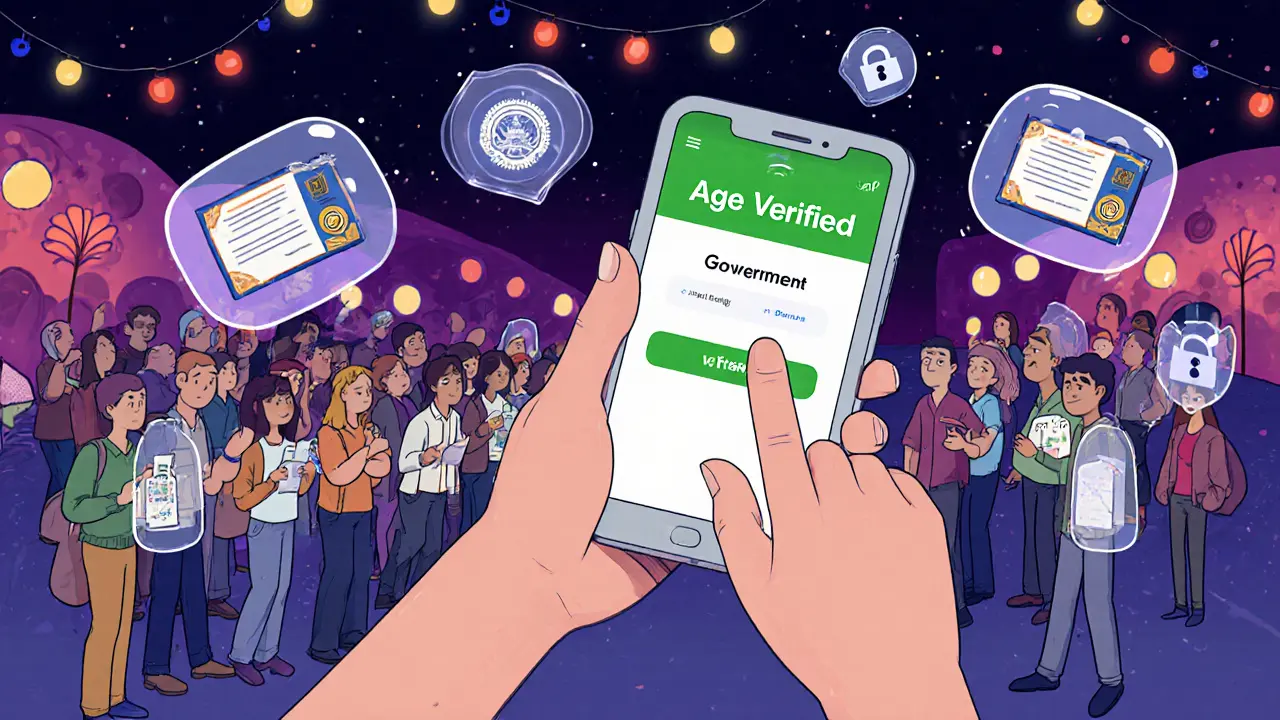
Real Examples - Not Theory
In Switzerland, the SwissCovid digital ID system launched in 2022. It let citizens prove their vaccination status without storing personal data on any central server. Over 50,000 users participated. 92% rated it as “easy and secure.” At a music festival in Berlin, a user named “IdentitySeeker42” on Reddit said they used a blockchain wallet to prove they were 21 - no ID card needed. The check took 15 seconds. The line behind them? Still waiting for staff to scan passports. Even governments are catching on. The European Union’s eIDAS 2.0 regulation, effective in 2026, will legally recognize blockchain-based digital identities. That’s huge. It means your digital ID will be as valid as your physical passport.Where It Falls Short
This isn’t magic. There are real hurdles. Key recovery is still hard. If you lose your phone and didn’t back up your recovery phrase, you lose your identity. No “forgot password” button. No customer service rep who can reset it. That’s a dealbreaker for many. Solutions like 1Kosmos BlockID now offer multi-factor recovery, but most consumer apps still don’t. Integration with old systems is messy. Banks and hospitals still run on 20-year-old software. Connecting them to blockchain identity requires APIs, gateways, and a lot of testing. Microsoft and IBM have built enterprise tools for this, but small businesses can’t afford the complexity. People don’t understand it. A user on HackerNews said losing their phone meant losing their identity - and the recovery process was “more complicated than resetting a password.” That’s the biggest barrier. Technology alone won’t win. User experience will.Who’s Using It - And Who’s Leading
The market is exploding. MarketsandMarkets projects the blockchain identity sector will grow from $1.23 billion in 2023 to $8.64 billion by 2028. That’s a 46.7% annual growth rate. Leading players:- Microsoft Entra Verified ID: Used by enterprises for employee and customer verification. Holds about 35% of the enterprise market.
- 1Kosmos BlockID: Focuses on government and financial services. Uses biometrics and blockchain to replace passwords.
- Sovrin Network: Open-source, nonprofit platform built for self-sovereign identity. Used in public sector pilots.
- Hyperledger Indy: Enterprise-grade blockchain for identity, backed by Linux Foundation.
What’s Next?
The next wave is smarter, faster, and more intuitive. In April 2024, the Decentralized Identity Foundation announced AI-powered adaptive assurance. Imagine this: You log in to your bank from your home Wi-Fi. Low risk. Just a simple credential check. You try to log in from a hotel in Tokyo at 3 a.m. High risk. The system asks for a biometric scan. It adjusts based on context - without asking you for more documents. By 2026, NIST expects quantum-resistant cryptography to be built into identity systems. That’s not a future problem. It’s a now-preparedness move. Gartner predicts that by 2027, 30% of consumer digital identities will be blockchain-based. In 2023, it was 5%. That’s a sixfold jump in four years.How to Get Started
You don’t need to be a coder to try this. 1. Download a wallet that supports DIDs - like Microsoft’s Authenticator app, or a Sovrin-compatible app like Sovrin Wallet or Trinsic. 2. Get a verifiable credential. Some universities, governments, and employers now issue them. Look for “Get your digital ID” links on official sites. 3. Use it. Try logging into a service that accepts blockchain identity. Some platforms like Bitwarden and Polygon ID already support it. For non-tech users, expect a 8-10 hour learning curve. For developers? 2-3 hours to integrate a wallet API.Final Thought: It’s Not About the Tech. It’s About Trust.
Blockchain identity isn’t just faster or cheaper. It’s fundamentally different. It replaces institutional trust with cryptographic trust. You don’t need to believe a bank or a government. You just need to believe math. The old system was built on control. The new one is built on consent. And that’s not just an upgrade. It’s a reset. If you’ve ever felt like your data was being sold, stolen, or misused - this is your chance to take it back. The tools are here. The standards are set. The only thing left is for you to use them.What is self-sovereign identity (SSI)?
Self-sovereign identity (SSI) is a model where individuals own and control their digital identity without relying on central authorities like governments or corporations. With SSI, you store your verified credentials in a digital wallet, decide who can access them, and revoke access anytime. It’s built on decentralized identifiers (DIDs) and verifiable credentials, using cryptography to prove facts about you without revealing unnecessary data.
Is blockchain identity safer than passwords?
Yes - dramatically. Passwords are stolen in 81% of hacking breaches, according to Verizon’s 2023 Data Breach Report. Blockchain identity replaces passwords with cryptographic keys and verifiable credentials. Even if a hacker intercepts a transaction, they can’t reuse it. There’s no password to guess, no database to crack. Your identity is tied to your private key - and only you hold it.
Can I use blockchain identity for everyday things like shopping or streaming?
Not yet widely, but it’s coming. Platforms like Polygon ID and Microsoft’s Entra Verified ID are partnering with e-commerce and entertainment services to allow age verification, loyalty program access, and secure logins using blockchain credentials. By 2027, Gartner predicts 30% of consumer identities will be blockchain-based. Right now, it’s mostly in finance, healthcare, and government - but consumer adoption is accelerating fast.
What happens if I lose my phone or recovery phrase?
You lose access to your identity - unless you’ve set up recovery options. Most modern wallets now offer multi-factor recovery: a trusted contact, a hardware backup, or a social recovery system where friends or family help you regain access. But if you didn’t set this up, there’s no reset button. This is the biggest usability challenge. Treat your recovery phrase like your house key - if you lose it, you’re locked out.
Is blockchain identity legal?
Yes, in many places. The European Union’s eIDAS 2.0 regulation, effective in 2026, legally recognizes blockchain-based digital identities as valid for all official purposes. In the U.S., 22 states have passed laws recognizing blockchain credentials as legally binding. While federal law is still catching up, courts and businesses are increasingly accepting them. As long as the credential comes from a trusted issuer and follows W3C standards, it holds legal weight.
How is this different from digital IDs from my government?
Government digital IDs are usually centralized - meaning your data lives in a government database, and you’re just logging in to access it. Blockchain identity is decentralized: you hold the data, and the government just issues a signed credential. You control who sees it, when, and how much. With a government digital ID, you’re trusting the state. With blockchain, you’re trusting cryptography - and you’re still in charge.
Blockchain identity is not a revolution-it’s an inevitability. The current paradigm is archaic, fragile, and fundamentally insecure. The fact that we still rely on centralized databases for identity verification is a testament to institutional inertia, not technical necessity. Cryptographic verification is not optional-it’s the baseline for any system claiming to be modern.
OMG I JUST CRIED READING THIS. 🥹 I’ve spent YEARS jumping through hoops just to open a bank account-sending scans, waiting days, getting rejected because a PDF was blurry. And now? I can just… prove I’m me? Without handing over my entire life history? This isn’t tech-it’s freedom. I feel like I’ve been living in a black-and-white world and someone just handed me a color palette. I’m downloading a wallet tonight. I’m telling my mom. I’m telling my coworkers. This changes everything. 💖
Real talk-this is the kind of thing that could actually fix trust in tech. I’ve been in IT for 18 years and I’ve seen too many companies promise ‘secure’ systems that turned out to be glorified Excel sheets with a lock icon. Blockchain identity? It’s not hype. It’s architecture. The fact that you can prove you’re 21 without showing your birthdate? That’s not just smart-that’s respectful. And honestly, if your grandma can use this, we’ve won. Start with Microsoft Authenticator. It’s free. It’s simple. Just try it.
Let’s be brutally honest: this is a solution in search of a problem that only technocrats care about. The average person doesn’t want to manage private keys. They want a password reset link. They want a customer service rep to fix their account. This system assumes users are rational, technically literate, and security-conscious-which they are not. And let’s not pretend governments and corporations will voluntarily cede control. This isn’t liberation-it’s a luxury for Silicon Valley elites who think everyone should live like them. The 99% just want to log in without a PhD in cryptography.
THIS IS THE FUTURE AND I’M SO EXCITED 😭✨ I’ve been waiting for this my whole life. No more giving my SSN to a sketchy website just to sign up for a newsletter. No more ‘verify your identity’ pop-ups that feel like being interrogated. I just want to be me-without handing over my soul to Big Data. This is the internet I dreamed of in 2005. We’re not just upgrading systems-we’re redefining human dignity in the digital age. 🙌 Let’s gooooo!
Blockchain identity? More like blockchain propaganda. Who gave these tech bros the right to decide how we live? The government already knows everything about us. The banks already track our spending. Why should we trust some decentralized ledger run by people who think ‘DAO’ is a real word? This isn’t freedom-it’s a distraction. Real security is a locked door. Not a fancy algorithm. And if you lose your phone? You’re screwed. That’s not innovation. That’s negligence dressed up as enlightenment.
I’ve seen how identity systems work in developing countries-where people don’t have birth certificates or government IDs. This isn’t just convenient. It’s life-changing. Imagine a farmer in rural India proving his age to access a loan without needing a passport he never had. This tech could give dignity to millions who’ve been invisible to systems designed for the privileged. It’s not perfect-but it’s a start. And that’s more than we’ve had before.
Let me ask you this: if your identity is stored on a blockchain, who’s really controlling it? Who wrote the code? Who holds the master keys? Who’s auditing the ‘trusted issuers’? You think governments won’t backdoor this? You think corporations won’t monetize your ‘consent’? This isn’t self-sovereignty-it’s surveillance with a new logo. They’re just replacing one master with ten silent ones. And when they decide you’re ‘high risk’? You won’t even know why you’re locked out. This is the new digital redlining. And we’re handing them the keys.
Interesting. The technical foundations are solid, but the human layer is the real challenge. Most people don’t understand private keys. Most won’t back them up. Most will panic if they lose access. The solution isn’t better tech-it’s better onboarding. Simpler interfaces. Clearer language. Maybe even voice-guided recovery. We need to build for the scared, not the savvy.
If identity is a conversation between you and the world, then passwords are shouting into a void. Blockchain is whispering a secret only the right person can hear. The math doesn’t lie. The system doesn’t beg for data. It doesn’t track you. It just answers the question asked. That’s not convenience. That’s ethics. And maybe-just maybe-that’s the most radical thing we’ve built in decades
I just tried using my blockchain ID to log into a test portal last night. It took 8 seconds. I felt… powerful. Like I finally had a key to my own life. No forms. No stress. Just me and my phone. I told my sister, who’s 72, and she said, ‘So it’s like a digital keychain?’ I said yes. She said, ‘Then I’m doing it.’ That’s the real win-not the tech, but the moment someone who never trusted tech felt safe using it. 🌱
For anyone nervous about this-start small. Get a verifiable credential from your university or employer. Try it once. See how it feels. You don’t need to abandon your old identity. Just add this as a new tool. Like having a keycard instead of a key. One doesn’t replace the other-it just gives you more options. And honestly? The peace of mind? Worth it. You’re not losing control-you’re reclaiming it. Slowly. Safely. One credential at a time.