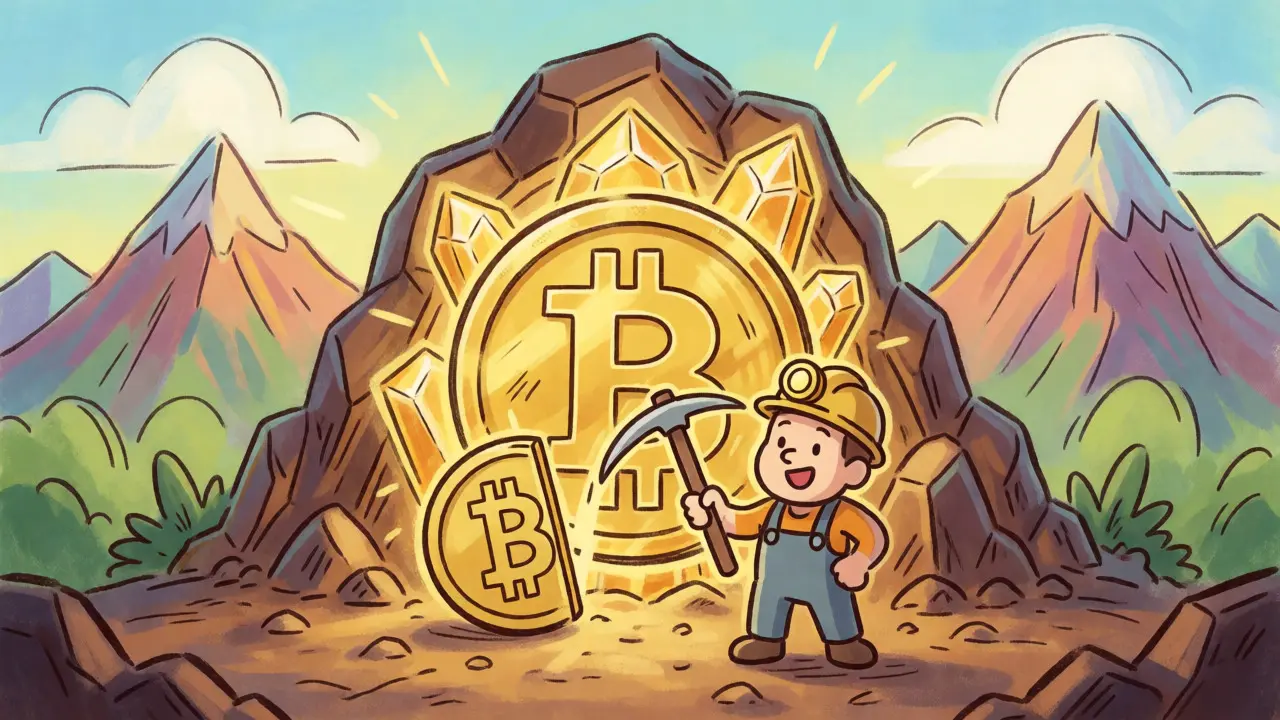
Imagine a gold mine where the amount of gold you find gets cut in half every four years. That is exactly what happens to Bitcoin's declining block reward schedule. When Satoshi Nakamoto launched the network in 2009, miners earned 50 BTC for every block they validated. Today, that number has shrunk dramatically. This isn't a bug; it's the core feature that makes Bitcoin scarce. But how does this reduction actually work, and why does it matter for your wallet or your mining rig?
The Math Behind the Scarcity
The rule is simple but rigid. Every time the network mines 210,000 blocks, the reward given to miners drops by 50%. Since blocks are created roughly every 10 minutes, this event-known as a halving-occurs approximately every four years. It’s not based on the calendar date, but on the chain height. If miners speed up, halvings happen sooner; if they slow down, they happen later. The protocol adjusts difficulty to keep that 10-minute average steady.
This mechanism ensures that the total supply of Bitcoin will never exceed 21 million coins. We are currently living through the fourth era of Bitcoin issuance. After the April 2024 halving, the block reward sits at 3.125 BTC. Before that, it was 6.25 BTC. Going back further, we had 12.5 BTC, then 25 BTC, and finally the original 50 BTC. Each step halves the inflation rate, making new bitcoins harder to produce over time.
| Halving Event | Approximate Year | Block Height | Reward Per Block |
|---|---|---|---|
| Genesis (Start) | 2009 | 0 | 50.00000000 BTC |
| First Halving | 2012 | 210,000 | 25.00000000 BTC |
| Second Halving | 2016 | 420,000 | 12.50000000 BTC |
| Third Halving | 2020 | 630,000 | 6.25000000 BTC |
| Fourth Halving | 2024 | 840,000 | 3.12500000 BTC |
| Fifth Halving (Projected) | 2028 | 1,050,000 | 1.56250000 BTC |
Why Miners Don’t Just Quit
You might wonder: if rewards drop so fast, why do miners keep buying expensive hardware? The answer lies in two things: price appreciation and transaction fees. Historically, each halving has preceded a significant rise in Bitcoin’s market price. While correlation doesn’t always equal causation, the reduced supply of new coins hitting exchanges often meets steady or rising demand, pushing prices up. For miners, even though they earn fewer coins per block, those coins might be worth significantly more dollars.
However, relying solely on price increases is risky. As the block subsidy (the newly created coins) shrinks, another revenue stream becomes critical: transaction fees. Users pay these fees to have their transactions included in a block. Right now, fees make up a small portion of miner income compared to the subsidy. But by the year 2140, when the last bitcoin is mined, the subsidy will effectively be zero. At that point, miners must survive entirely on transaction fees to secure the network.
The Long-Term Security Challenge
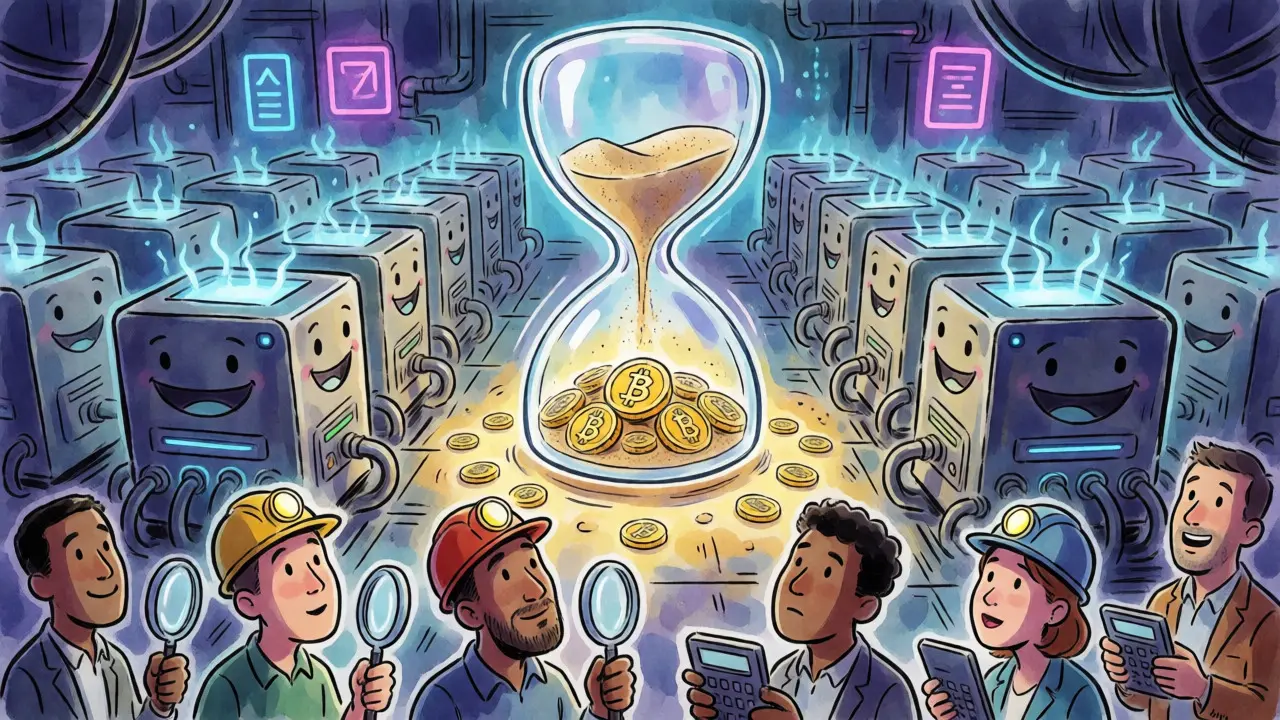
This shift from subsidy to fees creates a potential security dilemma. If transaction fees aren't high enough, miners might find it unprofitable to validate blocks. Fewer miners mean less computational power protecting the network, which could theoretically make it easier for an attacker to rewrite history. Experts from firms like EY and Nervos have pointed out that as operational costs (like electricity) remain constant or rise, while rewards fall, the margin for error gets thinner.
Miners are already adapting. Many are moving to regions with cheaper energy or investing in more efficient ASIC machines. Some large mining pools are also experimenting with layer-2 solutions like the Lightning Network, hoping that increased usage on these secondary layers will eventually drive more traffic-and thus more fees-back to the main Bitcoin chain. It’s a delicate balance. The network needs enough fee pressure to incentivize miners, but not so much that users get priced out of using Bitcoin.
Bitcoin vs. Traditional Money
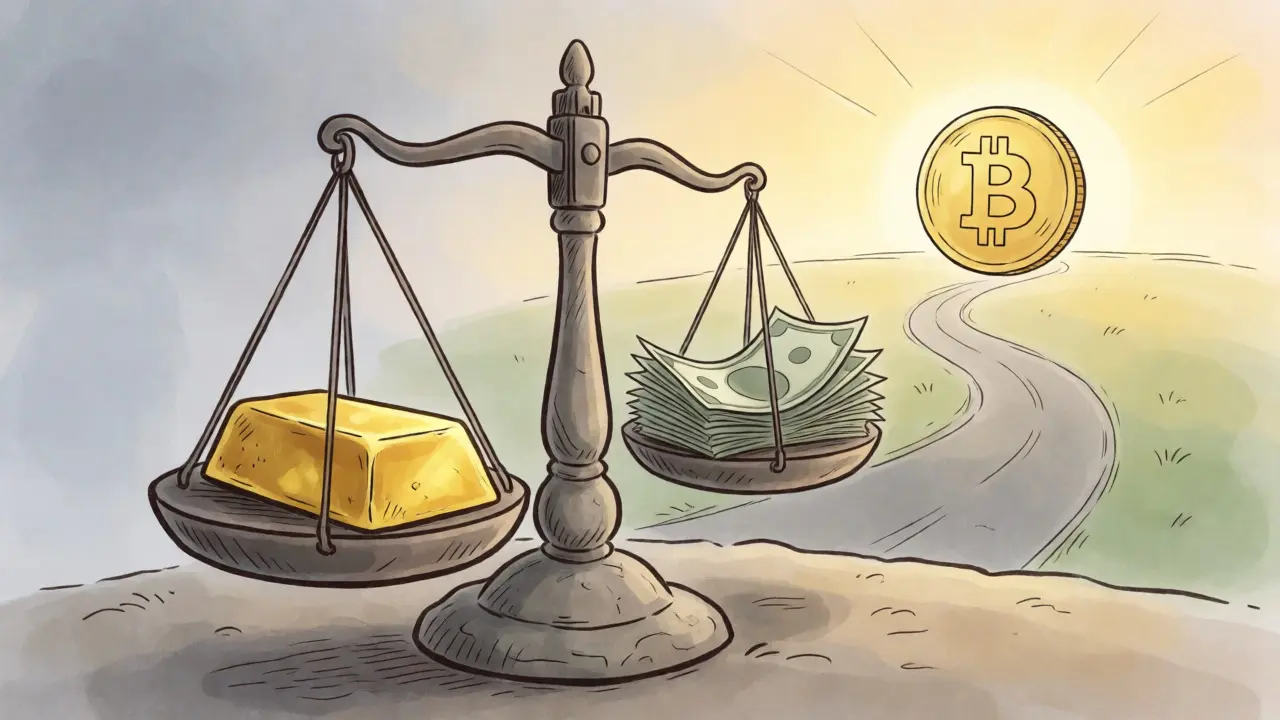
Compare this to the US Dollar or the Euro. Central banks can print money whenever they want, often leading to inflation. Bitcoin’s declining block reward schedule is its anti-inflationary shield. It mimics the extraction dynamics of precious metals. Think about gold: as surface deposits run dry, you have to dig deeper, use more machinery, and spend more energy to extract the next ounce. Bitcoin works similarly. The "energy cost" of producing a new coin rises as the reward falls, creating verifiable scarcity.
This predictability is what attracts institutional investors. Unlike fiat currencies, where monetary policy can change overnight based on political decisions, Bitcoin’s issuance curve is hardcoded. No committee can vote to increase the supply cap from 21 million to 22 million without overwhelming consensus from millions of nodes worldwide. This immutability is a key selling point for anyone worried about currency debasement.
What Happens Next?
The next halving is projected for 2028, cutting rewards to 1.5625 BTC. By then, the conversation will likely focus heavily on fee markets. Will we see higher fees during times of congestion? Will layer-2 adoption reduce main-chain fees too much? These are open questions. Currently, analysts at Coinbase suggest that while supply shocks from halvings can boost prices, long-term value depends on utility and adoption.
If you are a holder, understanding this schedule helps you contextualize market cycles. If you are a miner, it dictates your business plan. You cannot control the halving, but you can optimize your efficiency. The declining block reward schedule isn't just a technical detail; it is the heartbeat of Bitcoin’s monetary policy, ticking away toward a fixed future where scarcity is absolute.
When is the next Bitcoin halving?
The next halving is projected to occur in 2028, specifically when the blockchain reaches block height 1,050,000. At that point, the block reward will decrease from 3.125 BTC to 1.5625 BTC.
Does the block reward ever reach zero?
Yes, eventually. Due to integer division limits in the code, the reward will become negligible around the year 2140. After this point, no new bitcoins will be generated, and miners will rely solely on transaction fees.
Why do halvings affect Bitcoin's price?
Halvings reduce the supply of new bitcoins entering the market. If demand stays the same or grows, basic supply-and-demand principles suggest the price should rise. Historical data shows price surges following previous halvings, though other market factors also play a role.
Can the block reward schedule be changed?
Technically, yes, via a hard fork. However, changing the supply schedule would require near-unanimous consensus among miners, developers, and node operators. Given the economic incentives to maintain scarcity, such a change is considered practically impossible.
What happens if transaction fees are too low?
If fees are too low to compensate for lost block subsidies, miners may shut down inefficient operations. This reduces network security (hashrate). To prevent this, the ecosystem may need higher fees or improved scaling solutions to ensure miners remain profitable.
It is really inspiring to see how the protocol keeps getting tighter on supply. This scarcity model is what gives Bitcoin its long-term value proposition for us in emerging markets where local currencies fluctuate wildly. I always tell my community that patience with the halving cycles pays off because the network becomes more secure and predictable over time.
Great breakdown of the mechanics! 😊 It's fascinating how the difficulty adjustment works alongside the reward reduction. I've been reading up on how miners are adapting to lower margins by seeking renewable energy sources, which seems like a positive side effect of the economic pressure. :)
i think people forget that the code is law here. no committee can just print more btc like they do with fiat. it feels philosophical almost... like we are watching a digital gold standard emerge from pure math. the fact that it cant be changed without consensus makes it so much stronger than anything else imo
The article misses the point entirely about the security budget. You cannot simply assume transaction fees will scale linearly with price appreciation. If layer 2s absorb all the traffic, the main chain becomes a settlement layer with negligible fees, rendering miners insoluble unless BTC appreciates exponentially forever. That is not a monetary policy; that is a speculative bubble waiting to pop when the subsidy vanishes completely. The author treats miner economics as an afterthought when it is actually the single greatest vulnerability of the entire system post-2140.
To add to the discussion on security: historically, fee revenue has remained a very small percentage of total miner income (often under 5-10%). For the network to remain secure solely on fees, we would need either a massive increase in block space demand or a significant drop in hash rate efficiency costs. Currently, most large pools are hedging by holding their mined BTC rather than selling immediately, which artificially supports the price but doesn't solve the fundamental fee market issue long term.
I agree with the points about institutional interest. The predictability is definitely a big draw for them compared to traditional assets.
Dude, this stuff gets me so hyped!! Every halving feels like the whole world is finally waking up to the magic of decentralized money. It’s like we’re part of a giant global experiment that actually works. I can’t wait for the next one, the vibes are going to be insane!
We must remember the moral imperative here! By hardcoding this scarcity, Satoshi gave humanity a shield against the tyranny of central bankers who debase our labor with invisible inflation. It is not just about profit; it is about justice. Every satoshi mined is a testament to truth over politics. We owe it to future generations to preserve this immutable ledger against those who would dilute it for short-term gain.
Thank you for sharing this informative piece. It provides a clear perspective on why the halving schedule is critical for understanding Bitcoin's economic model. The transition from subsidy-based security to fee-based security is indeed a complex challenge that requires careful monitoring by both developers and investors alike.
From a cryptographic standpoint, the decoupling of issuance from validation is elegant but risky. As we approach the asymptotic limit of 21 million, the marginal cost of production rises due to hardware inefficiencies and energy constraints. We are seeing a shift toward 'hashprice' optimization rather than just raw hashrate growth. This cultural shift in mining operations-moving from speculative expansion to operational efficiency-is crucial for the network's resilience against external shocks like energy price volatility.
You are wrong if you think fees won't rise! Demand is exploding globally. Look at India and Africa adoption rates. When billions come online, the competition for block space will force fees up regardless of L2s because people want finality on L1. Stop being so pessimistic and look at the data trends. The network is robust and the incentives align perfectly for long-term holders. Believe in the process!
That is a valid concern regarding the security budget,, however,, historical precedent suggests that technological innovation often creates new forms of value capture.,, We should also consider that the definition of 'security' may evolve beyond just PoW mining into staking-like models or hybrid consensus mechanisms in the distant future.,, It is important to remain open-minded about these potential adaptations while respecting the current protocol constraints.,,
The interplay between the declining subsidy and the emergent fee market represents a profound shift in the economic topology of the blockchain ecosystem, necessitating a reevaluation of traditional miner business models which have historically relied heavily on the predictable influx of newly minted coins as a primary revenue stream rather than secondary transactional revenues. As the network matures, the reliance on speculative asset appreciation to subsidize security becomes increasingly precarious, potentially leading to periods of consolidation among mining entities that possess superior capital structures and access to low-cost energy resources, thereby altering the decentralization metrics that are so fiercely protected by the community.
Simple explanation helps. Good read.