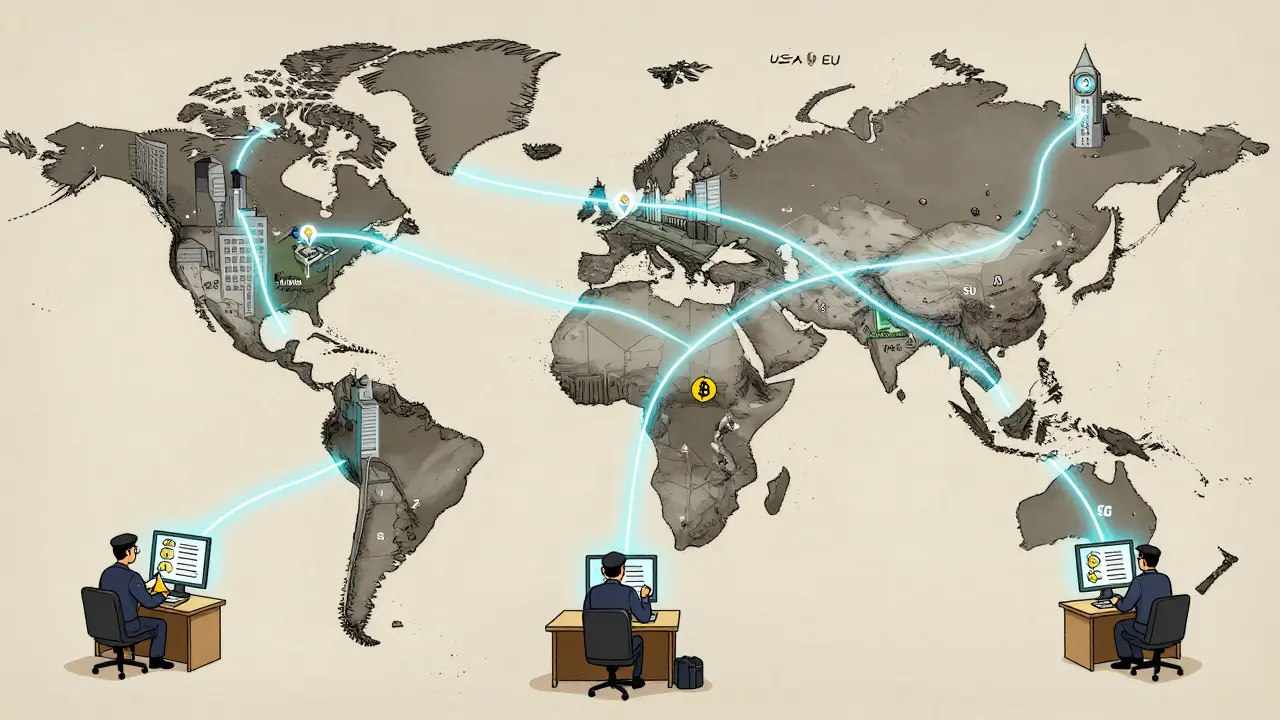
What is the Automatic Exchange of Crypto Tax Information?
Starting in 2026, countries around the world began sharing detailed tax data on cryptocurrency transactions - not because they wanted to, but because they had to. This isn’t some theoretical policy. It’s real. And if you’ve bought, sold, or traded crypto in the last year, it affects you. The system is called the Crypto-Asset Reporting Framework (a global standard developed by the OECD to automatically share tax data on crypto transactions between countries), or CARF. It’s the crypto version of the Common Reporting Standard (CRS) that already tracks bank accounts, pensions, and dividends across borders.
Before CARF, tax authorities had little way of knowing who owned what crypto, where it was traded, or how much profit was made. You could buy Bitcoin on a platform in Singapore, sell it through a U.S.-based exchange, and send the proceeds to a wallet in New Zealand - and no government would know. That’s changed. Now, every time a crypto service provider processes a trade, transfer, or conversion, they must report it. And that data gets sent automatically to your home country’s tax office.
How CARF Works: The Mechanics Behind the Scenes
CARF doesn’t rely on you filing a form. It works because Reporting Crypto-Asset Service Providers (entities like exchanges, wallet providers, and decentralized finance platforms that handle crypto transactions) - or RCASPs - are legally required to collect and report information about their users. This includes:
- Your full legal name
- Your tax identification number (like a Social Security Number or NZ IRD number)
- Your residential address
- Details of every crypto transaction: buys, sells, swaps, staking rewards, airdrops, and even NFT trades
- The value of each transaction in fiat currency (USD, EUR, NZD, etc.) at the time it happened
These details are compiled into a standardized XML file - the same format used for bank account reporting under CRS - and sent to your country’s tax authority. That authority then shares the data with any other country where you might be a tax resident. So if you’re a New Zealander living in Spain but using a U.S. exchange, both Spain and New Zealand will get the same report.
The first wave of reports started in 2026, covering 2025 activity. Countries like those in the European Union implemented this through DAC8 (the eighth amendment to the EU’s Directive on Administrative Cooperation, mandating crypto tax reporting across all member states). The EU required its members to pass laws by December 31, 2025, and start collecting data from January 1, 2026. The first official exchanges of data between EU countries happened in late 2026.
Who’s Included? 67 Countries and Counting
As of early 2026, 67 countries have committed to implementing CARF. That covers nearly every major economy: the U.S., the UK, Canada, Australia, Japan, Germany, France, Singapore, Hong Kong, and yes - New Zealand. Even countries that used to be crypto havens, like the Cayman Islands and Bermuda, have joined. Why? Because if they didn’t, their local exchanges would lose access to global markets. It’s not optional anymore.
The U.S. didn’t adopt CARF directly. Instead, the IRS created a reciprocal system: U.S. brokers report data on foreign users to other CARF countries, and in return, they get data on U.S. citizens trading on foreign platforms. This means if you’re a U.S. citizen using Binance or Kraken outside the U.S., your trades are still reported back to the IRS. There’s no loophole.

What Happens If You Don’t Report?
You might think, "I’ve never filed crypto taxes before. Will I get caught?" The answer is yes - and it won’t be gentle. Tax authorities aren’t asking for voluntary disclosure anymore. They’re receiving full transaction histories directly from exchanges. If your tax return says you made $5,000 in crypto gains, but the exchange reports $48,000, you’ll get a letter. Not a warning. A demand for back taxes, penalties, and interest.
In Australia, the ATO matched 1.2 million crypto transactions from local exchanges in 2025 alone. In Germany, over 300,000 taxpayers received notices after their exchange data came in. New Zealand’s IRD has already flagged 14,000 crypto-related cases since January 2026. They don’t need you to confess. They already know.
How This Changes Crypto Behavior
This isn’t just about compliance - it’s reshaping the market. Some traders are moving away from centralized exchanges entirely, using peer-to-peer platforms or self-custody wallets to avoid reporting. But even that has limits. If you cash out through a bank account linked to your real identity, the money trail leads right back. And if you use a DeFi protocol that’s now regulated under CARF - like Uniswap or Aave - your transactions are still captured.
Some jurisdictions are trying to stay competitive by offering zero crypto tax rates. But even those places now report to CARF countries. So if you live in a zero-tax country but are a tax resident elsewhere, you’re still liable. The system is designed to close that gap. It’s not about where you trade - it’s about where you live.

The Real Challenge: Technology and Consistency
Implementing CARF isn’t easy. Exchanges have to build new systems to track every type of crypto activity - including staking rewards, liquidity pool fees, and wrapped tokens. Wallet providers must identify users who aren’t KYC’d. Tax agencies need to process millions of data points in a standardized format. And there’s still inconsistency.
Some countries classify crypto as property. Others treat it as currency. Some tax staking as income. Others wait until you sell. This creates confusion. A U.S. taxpayer might get a report showing $10,000 in staking income, but in New Zealand, that’s not taxable until sold. The system doesn’t solve tax law differences - it just forces disclosure. That means you still need to understand your local rules.
What Should You Do Now?
Here’s the practical advice - no fluff:
- Track every transaction. Use a crypto tax tool like Koinly, CoinTracker, or ZenLedger. They now pull directly from over 150 exchanges and automatically map CARF data.
- Know your tax residency. If you’re a citizen of one country but live in another, you may owe taxes in both. The data will show up in both places.
- Don’t wait for a notice. File your 2025 crypto taxes now. Even if you’ve never filed before, the first wave of audits is already underway.
- Don’t assume anonymity helps. If you used an exchange that reports, your identity is already in the system. Self-custody doesn’t hide you from banks or fiat gateways.
The era of crypto tax secrecy is over. The technology is in place. The rules are written. The data is flowing. The only question left is: are you prepared?
Frequently Asked Questions
Do I need to report crypto if I didn’t sell it?
Yes. If you swapped one crypto for another (like ETH for BTC), earned staking rewards, received airdrops, or used crypto to buy goods or services, those are taxable events in most countries. CARF captures all of them. Even if you didn’t cash out to fiat, you still owe tax on the gain at the time of the trade.
What if I used a non-KYC exchange like a DeFi platform?
CARF applies to all regulated service providers, including many DeFi platforms now classified as RCASPs. If you interact with a platform that has a legal entity in a CARF country - like Uniswap Labs in the U.S. or Aave in Switzerland - your transactions are being reported. Even if you didn’t give your ID, the platform may still link your wallet to your IP address, device ID, or bank transfer - and report it.
Can I avoid this by moving to a country with no crypto tax?
Not if you’re still a tax resident elsewhere. Tax residency is based on where you live, work, and have ties - not where you bank. If you’re a New Zealander living in Portugal for 180 days a year, you’re still liable to New Zealand. CARF ensures your home country gets the data. Moving doesn’t erase your tax obligations.
What happens if I didn’t report crypto in past years?
Most countries offer voluntary disclosure programs - but they’re closing fast. In the U.S., the IRS has a Streamlined Filing Compliance Procedure. In Australia, the ATO allows back-filing with reduced penalties if you come forward before they contact you. In New Zealand, IRD has started sending letters to non-filers with 2021-2025 data. The window for easy amnesty is shrinking.
Is my data safe? Could it be leaked or misused?
The data exchange uses encrypted, government-to-government channels under strict OECD security protocols. It’s not public. But if you’re hiding income, your data is now in the hands of tax authorities who can cross-check it with bank records, property purchases, and even credit card spending. Privacy here doesn’t mean secrecy - it means protection from hackers, not from the law.
This is the end of crypto freedom. They've been waiting for this moment since 2017. They don't care about innovation, they care about control. Your gains? Their revenue. Your privacy? Gone. Welcome to the surveillance economy, folks.
I've been tracking this since the OECD first floated CARF in 2023 and honestly the implementation is shockingly smooth. The real win isn't the reporting-it's how exchanges finally standardized their data feeds. Koinly's API integration alone saved me 40 hours last quarter.
Ah yes. The inevitable march of bureaucratic efficiency. Let us all bow before the almighty XML schema. How quaint that we once thought decentralization meant freedom. Now we're just nodes in a global tax ledger. How poetic.
In India, we've been reporting crypto since 2022. The 30% tax is brutal but transparent. At least now I know exactly what I owe. No more guessing. No more panic before April 15. CARF just made global compliance predictable. That’s worth something.
Life is too short for tax stress 😌 Just use Koinly. Automate. Breathe. Crypto is still the future. Taxes are just the paperwork.
We often mistake compliance for oppression. But what if this isn't about control? What if it's about equity? For years, the wealthy hid crypto gains while others paid taxes on wages. Now, the ledger is fair. The system is blind. Maybe that's not a dystopia. Maybe it's justice.
I get it. It's scary. But if you're doing the right thing, this shouldn't feel like a threat. It should feel like relief. No more hiding. No more anxiety. Just clean books and peace of mind.
If you're not prepared for this, you're not ready for the future. This isn't a trap. It's a wake-up call. Stop waiting for someone else to fix it. Start tracking. Start filing. Your future self will thank you.
They said crypto was anonymous. They were wrong. The blockchain is public. Your identity isn't. Now they're connecting the dots. And you? You're the one who didn't look.
I used to think self-custody was the answer. Then I realized: if you cash out through Coinbase or a bank, they know who you are. The real risk isn't the exchange. It's the link between your wallet and your bank account. That's the trail they follow.
I moved from Canada to Colombia last year. Thought I was safe. Then my US bank flagged a $2k crypto deposit. Turns out, CARF doesn't care where you live-it cares where you're a tax resident. My Canadian passport still tied me to CRA. I had to file back taxes for 2023. Lesson learned: residency > location.
The implementation of CARF represents a monumental shift in global financial governance. It is not merely a regulatory update, but a structural evolution in cross-border fiscal transparency. The standardized XML format, harmonized with CRS, ensures interoperability across jurisdictions, thereby minimizing compliance friction. Entities classified as RCASPs are now legally bound under Article 12 of the OECD Framework to report not only transactional value but also counterparty residency. This is not an infringement-it is the foundation of a new, equitable fiscal order.
You think this is about taxes? No. This is about data harvesting. Every trade, every wallet address, every IP log-this is the foundation for a global financial AI. They're building a predictive model of your behavior. Your crypto isn't being taxed. It's being profiled.
i just use trust wallet and never cash out 😅 maybe that works? idk
This is the beginning of the Great Reset. The banks, the IMF, the UN-they’ve been planning this for decades. They want to kill cash, kill crypto, kill freedom. They’re using "tax compliance" as a cover. The moment they control your transactions, they control your life. Don’t trust the narrative. The data is already being sold. You’re already a product.
If you didn’t file, you’re a criminal. Not a victim. A criminal. Stop whining. Pay up. Move on.
I'm from the Netherlands. My mom's from India. I grew up with two tax systems. CARF doesn't change that. It just makes it clearer. I still owe taxes where I live. But now I know exactly where to send them. No more confusion.
I ran the numbers. If you held BTC from 2021 to 2025 and never sold, you're still on the hook for staking rewards, NFT trades, and bridging tokens. The IRS doesn't care if you didn't cash out. CARF reports every swap. I had 17 taxable events in 2025 I didn't even realize counted. This isn't about audits. It's about hidden liabilities.
The CARF framework, while conceptually robust, suffers from structural asymmetries in enforcement. Jurisdictions with mature digital infrastructure-like Singapore or the EU-implement with near-zero latency. Emerging markets, however, lack the API integration capacity. The result? A two-tiered system where compliance is a function of technological access, not legal obligation. This is regulatory colonialism disguised as transparency.