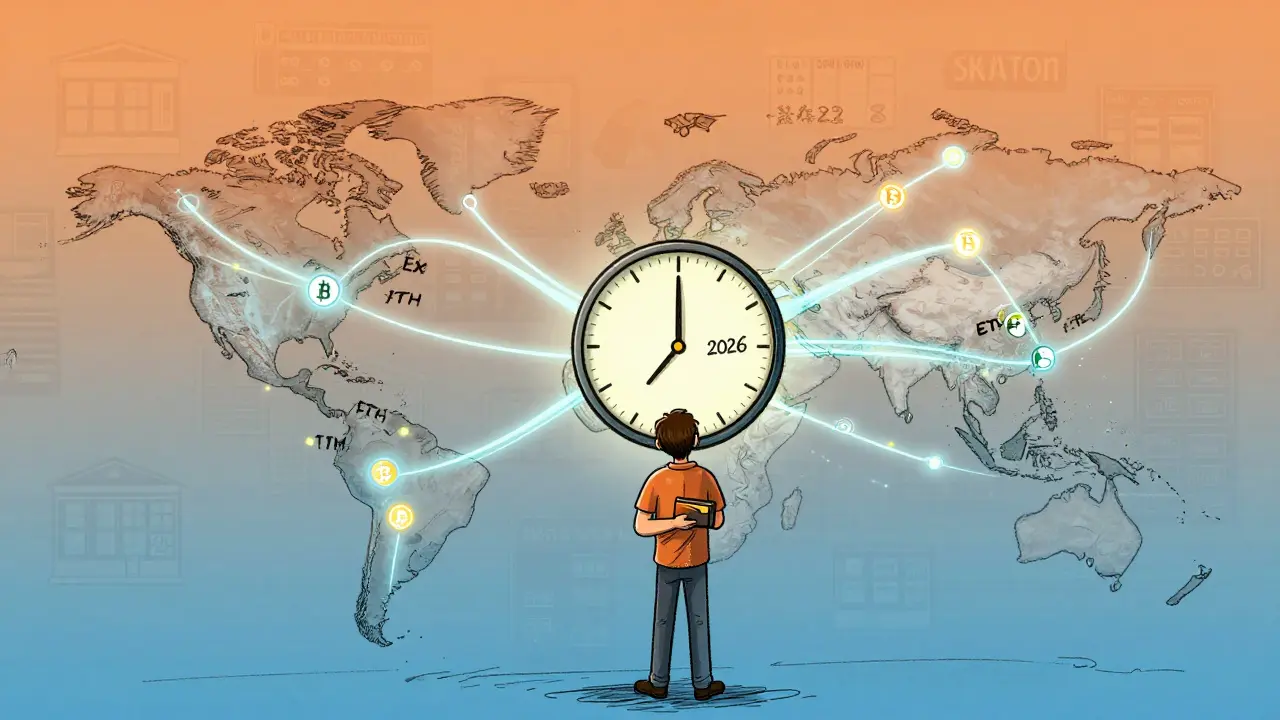
When you buy, sell, or trade crypto, you might think it’s a private transaction. But that’s changing-fast. Starting in 2026, countries are sharing your crypto tax data with each other automatically. No more hiding behind anonymous wallets or offshore exchanges. The system is real, it’s global, and it’s already rolling out. If you’re holding or trading crypto, this affects you-whether you know it or not.
How It Works: The CARF Framework
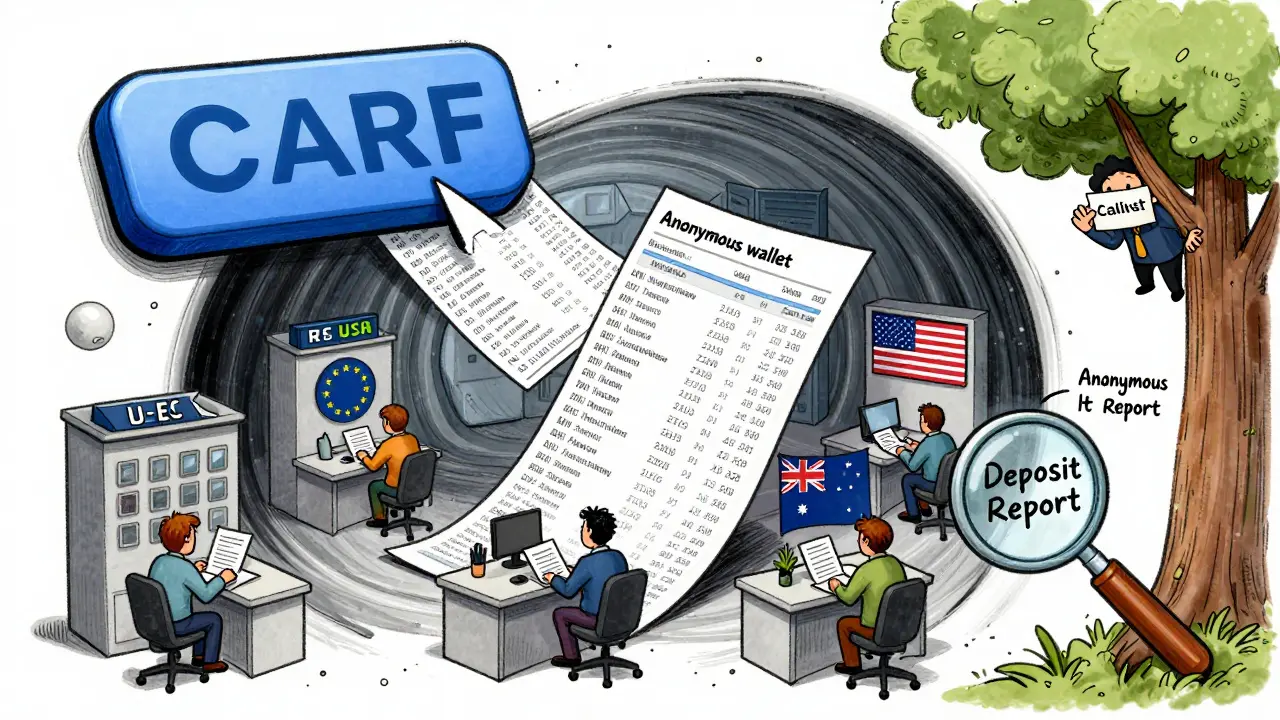
The system behind this global shift is called the Crypto-Asset Reporting Framework (a global standard developed by the OECD to collect and automatically share tax data on crypto transactions). Think of it as the Common Reporting Standard (CRS) for crypto. CRS has been around since 2014 and already forces banks to share financial data across borders. CARF does the same-but for Bitcoin, Ethereum, and every other digital asset.Here’s the simple version: if you use a crypto exchange, wallet provider, or any service that acts as a broker, they now have to report your transactions to your home country’s tax authority. And that country shares that data with every other country that’s signed up. So if you’re a New Zealander who traded crypto on a U.S.-based exchange, your New Zealand tax office will get details from the U.S. agency-and vice versa.
The data includes:
- Your name, address, and tax ID
- Types of crypto assets bought, sold, or traded
- Transaction dates and values in local currency
- Gains or losses from each trade
- Which platform handled the transaction
This isn’t optional. The OECD (the Organisation for Economic Co-operation and Development, the international body leading this global tax initiative) made it mandatory for all participating countries. And they’ve already got 67 of them on board.
Who’s Doing It? The Global Rollout
The European Union was first off the line. In October 2023, EU countries passed DAC8 (the eighth amendment to the EU’s Directive on Administrative Cooperation, requiring crypto platforms to report user data to tax authorities). By January 1, 2026, every EU exchange must start reporting. That means if you’re trading on Binance, Kraken, or Coinbase from France, Germany, or Spain, your data is already being sent to your home tax office.The United States isn’t far behind. The IRS (the U.S. Internal Revenue Service, responsible for enforcing tax laws and now collecting crypto transaction data from foreign platforms) will require non-U.S. brokers to report transactions involving American taxpayers. In return, the U.S. will send data on foreign users who traded through American platforms like Coinbase or Robinhood.
Other major players? Australia, Canada, the UK, Japan, Singapore, South Korea, Switzerland, and Brazil-all committed. That covers over 90% of global crypto trading volume. Even countries that used to be crypto havens, like Malta and Portugal, are signing on. Why? Because if you don’t, your citizens will keep trading on platforms in countries that do-and you’ll lose tax revenue.
By 2028, nearly every country with a functioning tax system will be connected. There’s no escape route.
What This Means for You
Let’s say you bought Bitcoin in 2023 on a German exchange while living in New Zealand. You didn’t report it. You thought, "No one’s watching." But now, the German exchange reports your transaction to Germany. Germany sends it to New Zealand. New Zealand’s Inland Revenue Department matches it with your tax return-and finds a gap.That’s not a minor mistake. That’s tax evasion. And penalties are brutal.
Here’s what you’re up against:
- Back taxes for up to 7 years (depending on your country)
- Interest charges that compound yearly
- Fines up to 75% of the unpaid tax
- Criminal charges in extreme cases (yes, jail is possible)
And it’s not just about big trades. Even small gains from swapping one token for another, staking rewards, or earning crypto from airdrops are now tracked. The system doesn’t care if you made $10 or $10,000. If it happened on a regulated platform, it’s reported.
Even if you use a non-custodial wallet, you’re not safe. If you ever bought crypto on a platform that reports (like Binance or Coinbase), that purchase history gets tied to your identity. And when you later cash out to a bank account, the bank reports the deposit. Cross-referencing happens automatically.
What Brokers Must Report
Not every crypto service has to report. Only Reporting Crypto-Asset Service Providers (RCASPs) (regulated entities like exchanges, custodial wallets, and trading platforms that are legally required to collect and report user data) are bound by the rules. That includes:- Centralized exchanges (Binance, Kraken, Coinbase)
- Custodial wallets (BlockFi, Crypto.com, Ledger Live if it holds keys)
- Peer-to-peer platforms that facilitate trades (like Paxful or LocalBitcoins, if they act as intermediaries)
- DeFi platforms that offer lending, staking, or yield farming if they’re registered as financial institutions
But here’s the catch: if you use an unregulated platform-say, a decentralized exchange like Uniswap or a private peer-to-peer trade-you might think you’re off the radar. Not quite.
When you cash out to a bank account, the bank reports the deposit. The tax authority sees a $50,000 deposit with no source. They check: "Did this person report any crypto sales?" If not, they flag it. They don’t need to know you used Uniswap. They just need to know you didn’t pay tax on $50,000 of income.
Why This System Is So Powerful
Before CARF, tax agencies had to request data manually. It took months. Often, they got nothing. Now, data flows automatically every year. No paperwork. No appeals. No delays.The system uses XML User Guide (a technical standard published by the OECD in October 2024 that defines exactly how data must be formatted for cross-border exchange) to ensure every country receives the same structured data. That means no confusion, no loopholes, no "I didn’t understand the form" excuses.
It’s also linked to the existing CRS system. So if you have a bank account, a crypto wallet, and a brokerage account, all three are now connected under one reporting umbrella. Your entire financial picture is visible to tax authorities.
And the technology is built to scale. The OECD didn’t design this as a pilot. It’s a permanent, global infrastructure. Think of it like the internet for tax data. Once it’s live, it doesn’t go away.

What You Should Do Now
If you’ve traded crypto and haven’t reported it, don’t wait. The clock is ticking.Here’s what to do:
- Collect all your transaction history. Use tools like Koinly, CoinTracker, or ZenLedger to auto-import data from exchanges.
- Calculate your capital gains and losses for every year you traded.
- File amended tax returns for past years. Most countries offer voluntary disclosure programs with reduced penalties.
- Start reporting every year going forward. Keep records forever.
Don’t try to hide it. The system isn’t going to miss you. It’s designed to catch everyone.
The Bigger Picture
This isn’t just about taxes. It’s about control. Governments are no longer willing to let crypto operate in the shadows. The same way they regulate banks, they’re now regulating crypto. And they’re doing it together.Some people say this kills decentralization. Maybe. But here’s the truth: if you want to use crypto as a real asset-buying property, getting a mortgage, or cashing out to pay bills-you need legitimacy. And legitimacy means playing by the rules.
For most people, this change isn’t a threat. It’s a cleanup. It ends the wild west era where only a few got away with tax evasion. For everyone else, it brings fairness. And for those who’ve been honest all along? It means you’re finally on equal footing.
What’s Next?
By 2027, the first full year of reporting will be complete. Tax authorities will start cross-checking millions of records. If you’re not ready, you’ll be one of the first flagged.And it won’t stop there. The OECD is already looking at how to expand CARF to cover:
- Non-fungible tokens (NFTs)
- Stablecoins pegged to fiat currencies
- Central bank digital currencies (CBDCs)
- DeFi lending and borrowing
Every new type of crypto activity will be added. There’s no turning back.
This isn't just about taxes-it's about control. They're turning crypto from a rebellion into a spreadsheet. I get it, I do. But when they start tracking every Satoshi like it's a bank transfer, you can't help but feel like your freedom got sold off to an algorithm. We didn't sign up for this.
Honestly I'm surprised it took this long. People acting like crypto was some kind of tax-free utopia was always naive. The moment you convert to fiat or use a regulated exchange, you're already in the system. It's not that they're watching-it's that you never actually left the grid.
Ah yes, the inevitable march of bureaucratic enlightenment. How quaint. The OECD, that bastion of democratic transparency, now has your staking rewards on file. And you thought your private keys were safe. How adorable.
There's a deeper philosophical layer here, isn't there? We built this system to escape centralized control, and yet, we willingly handed our transaction history to platforms that are now legally bound to report it. The irony is almost poetic. Are we not, in our desire for convenience, surrendering the very autonomy we sought to reclaim?
For those who are panicking about back taxes: please, take a breath. Most countries have voluntary disclosure programs with reduced penalties. Koinly, CoinTracker, ZenLedger-they exist for a reason. Start with your 2023 trades. Organize. Document. Submit. You're not alone in this. Many have walked this path before you, and they're fine now. It's not a death sentence. It's a recalibration.
I know it feels scary. But honestly? This is a good thing. People who’ve been honest all along are finally getting treated fairly. No more ‘I got lucky with Dogecoin’ excuses. The system’s cleaning up. And honestly? That’s something to celebrate, even if it’s uncomfortable.
The notion that this is ‘fair’ assumes everyone has equal access to accounting tools, legal counsel, and tax literacy. For the average person in a developing economy, this is a trap disguised as transparency. You call it cleanup. I call it exclusionary enforcement.
In India, we’ve been waiting for this since 2022. The moment they started taxing crypto at 30%, we knew the game was over. Now the world’s catching up. Good. Let them track it. But don’t pretend this is about fairness-it’s about revenue. And we’ve all been playing along because we needed liquidity.
This is actually good news 😊 No more shady trades. No more ‘I forgot to report’ excuses. Time to get real. Use Koinly. File. Move on. Life’s too short for tax drama 🙌
i just bought eth last year and never reproted it 😅 hope they dont find me
I’m from the Netherlands. We’ve been reporting crypto since 2017. It’s not that scary. You just need to be honest. And honestly? It’s kind of nice to not feel like a criminal just because you bought Bitcoin.
You think this is bad? Wait till they start taxing NFTs like real estate. You’re gonna look back at 2026 and laugh. This is just Phase One. Buckle up. The future’s here, and it’s got a W-2 form.
They're not coming for the whales. They're coming for the people who think they're anonymous because they used a VPN and a fake name on Binance. Wake up. Your identity is already linked to your wallet. This isn't surveillance. It's accounting.
I’ve been helping people file their crypto taxes for years. The biggest mistake? Waiting. Don’t wait until you get a letter. Start now. Even if it’s just one transaction. Just open Koinly. Import your history. Look at the numbers. You’ll be surprised how manageable it is. You’ve got this.
I remember when crypto was just a weird internet money. Now it’s part of the global financial infrastructure. It’s not evil. It’s evolution. The system’s not trying to kill decentralization-it’s trying to integrate it. And honestly? We needed this. The wild west was fun for a while. But you can’t build a house on a sandstorm.
So let me get this straight-you’re telling me if I swap USDC for DAI on Uniswap and then cash out to my bank, they’ll know I didn’t pay tax? That’s not a loophole. That’s a glaring hole in their system. And you’re acting like they’re all-knowing gods? Newsflash: tax agencies are still using Excel sheets. They’re not magic. They’re just slow. And slow means we still have time.