
You cannot use Bitcoin or Ethereum to buy coffee in Shanghai. If you try to send crypto from a wallet based in mainland China to pay for goods, you are breaking the law. As of July 2026, cryptocurrency payments are strictly prohibited in mainland China. This isn't just a suggestion; it is a criminal offense backed by some of the world's most aggressive financial enforcement.
But here is where it gets tricky. While private crypto is dead in the water domestically, China is leading the world in state-controlled digital money. They aren't against digital transactions-they just want total control over them. To understand what this means for businesses and travelers, we need to look past the simple "no" and dig into the complex landscape of the e-CNY, the mBridge project, and the severe penalties that come with ignoring these rules.
The Complete Ban: What Is Actually Illegal?
Let’s clear up any confusion immediately. In mainland China, the following activities are illegal:
- Trading cryptocurrencies: You cannot buy or sell Bitcoin, Ethereum, or other altcoins on exchanges like Binance or Coinbase if you are operating within mainland China.
- Mining: Crypto mining was banned nationwide in 2021, and enforcement has only tightened since then.
- Holding assets: As of May 2025, even holding crypto can trigger legal penalties. The People's Bank of China (PBOC) issued a decree effective June 1, 2025, that explicitly covers individual ownership.
- Using crypto for payments: Using digital assets to settle debts or purchase goods is considered illegal fundraising or unauthorized financial activity.
This regulatory stance makes China fundamentally different from its neighbors. Just across the border in Hong Kong, the Securities and Futures Commission (SFC) allows licensed crypto trading. In Singapore, the Monetary Authority of Singapore (MAS) oversees stablecoin usage. But in mainland China, the door is shut. The government views decentralized finance as a threat to monetary sovereignty and capital controls.
If you are a business owner looking to accept crypto from Chinese customers, you hit a wall. There are no legitimate payment gateways for domestic transactions. Any service claiming to offer this is operating in a legal gray area at best, or running an illegal operation at worst. Engaging with such services exposes you to asset seizure and potential criminal charges.
The Rise of the Digital Yuan (e-CNY)
China didn't ban crypto because they hate technology. They banned it because they wanted to replace it with something better-for them. Enter the e-CNY (Digital Yuan). This is the world's most advanced Central Bank Digital Currency (CBDC).
Unlike Bitcoin, which is decentralized and anonymous, the e-CNY is centralized and fully transparent to the government. When you spend e-CNY, the People's Bank of China knows exactly who paid whom, how much, and why. This aligns perfectly with Beijing's goals of maintaining financial stability and preventing capital flight.
| Feature | Bitcoin/Ethereum | e-CNY (Digital Yuan) |
|---|---|---|
| Control | Decentralized (No single owner) | Centralized (People's Bank of China) |
| Anonymity | Pseudonymous (Wallet addresses) | Fully traceable by government |
| Legal Status in China | Illegal | Legal tender (Official currency) |
| Use Case | Store of value, speculative investment | Daily payments, cross-border settlement |
| Volatility | High | Stable (pegged to CNY) |
The e-CNY is already in pilot stages across multiple major cities. For consumers, it works similarly to Alipay or WeChat Pay but sits directly on the central bank's ledger. For businesses, it offers instant settlement without intermediary fees. However, do not mistake this for permission to use private crypto. The e-CNY is designed to kill the need for private digital assets, not coexist with them.

Cross-Border Exceptions: The mBridge Project
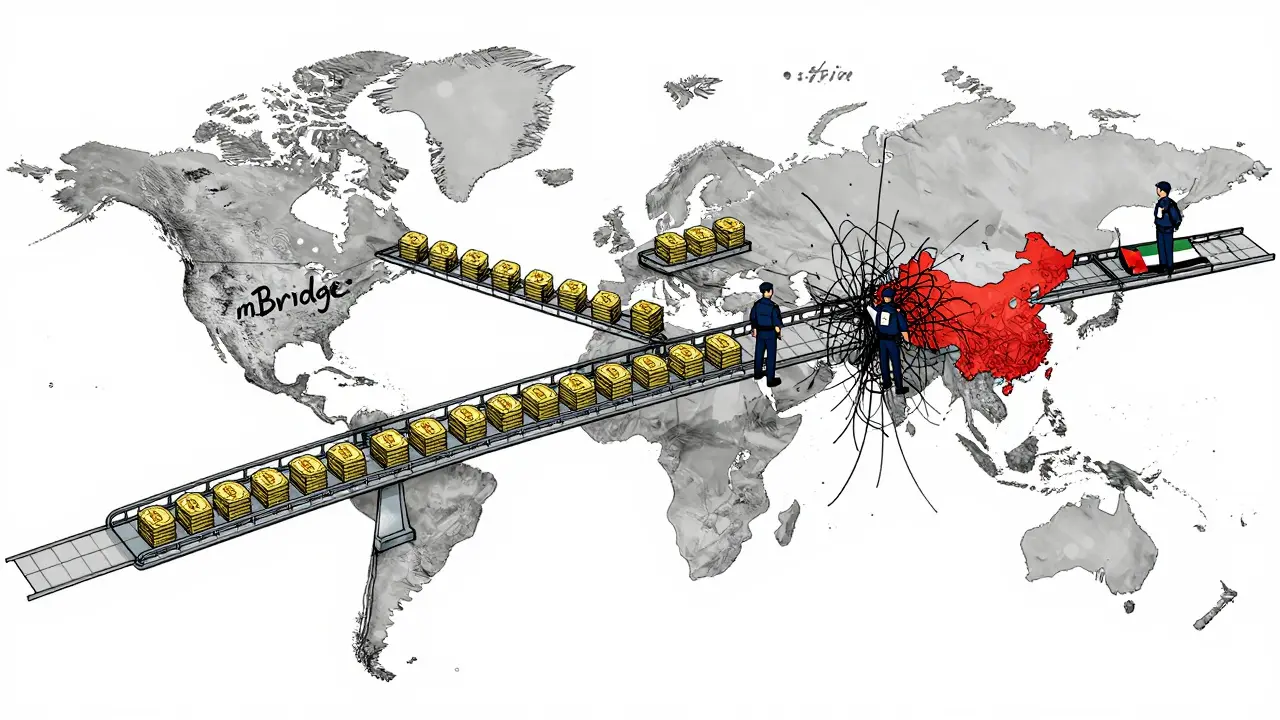
Here is the nuance that often confuses international traders. While domestic crypto payments are banned, China is actively exploring blockchain for cross-border trade through the mBridge (Multi-CBDC Platform).
mBridge is a multi-central bank digital currency pilot involving China, Hong Kong, Thailand, and the UAE. It uses blockchain technology to facilitate faster, cheaper international settlements. Millions of dollars have been processed in trial settlements. This shows that China embraces the underlying technology of blockchain when it serves state interests.
However, there is a catch. These transactions are not done in Bitcoin or Ethereum. They are done in digital versions of fiat currencies (like the digital yuan or digital dirham). Furthermore, these operations happen within strict regulatory sandboxes. You cannot simply sign up for mBridge as a small business. It is reserved for large-scale institutional players working within approved frameworks.
If you are a multinational corporation looking to optimize cross-border payments with Chinese partners, keep an eye on mBridge developments. But for now, this does not open the floodgates for general crypto adoption. It reinforces the idea that blockchain is useful, but only under strict government supervision.
Enforcement and Penalties: Why You Should Care
China’s enforcement mechanisms have intensified significantly through 2024 and 2025. It is not enough to say "it's risky." It is dangerous. Here is what happens if you break the rules:
- Asset Seizure: Banks and payment processors monitor accounts for suspicious flows. If they detect connections to crypto exchanges, your funds can be frozen and seized.
- Criminal Charges: The 2025 regulations established full criminalization of ownership and trading. Individuals involved in illegal fundraising or moving capital outside the country using crypto face prison time.
- No Legal Recourse: In 2022, legal interpretations explicitly denied investor claims in crypto-related civil disputes. If you get scammed while trading crypto illegally, the police will not help you recover your losses. In fact, they may arrest you for participating in the illegal activity.
The Cyberspace Administration of China (CAC) and the Ministry of Industry work together to enforce these bans. They require entities handling large amounts of data to report personal information protection officers, making it harder to hide illicit financial activities behind privacy shields.
For expats living in China or tourists visiting, the risk is real. Using offshore platforms or Over-the-Counter (OTC) trading networks might seem like a loophole, but it operates in a high-risk legal gray area. Authorities have conducted raids on OTC desks and arrested individuals for facilitating these trades.
What This Means for Businesses and Travelers
If you run an e-commerce store targeting Chinese customers, you cannot integrate Stripe, PayPal, or any crypto payment processor for domestic orders. Your only option is to partner with local payment giants like Alipay or WeChat Pay, which operate entirely in fiat currency (CNY).
For freelancers or remote workers receiving payments from abroad, the situation is equally tight. You cannot receive Bitcoin directly into a Chinese bank account. Many professionals use third-party intermediaries or offshore accounts, but this carries significant compliance risks. The safest route is to receive payments in traditional fiat currencies through regulated channels.
Travelers should avoid trying to convert their crypto holdings into cash upon arrival. There are no official exchange kiosks for Bitcoin. Attempting to find underground markets is not only illegal but also unsafe due to the prevalence of scams.
Future Outlook: Will the Ban Lift?
In July 2025, the Shanghai State-owned Assets Supervision and Administration Commission held meetings discussing strategic responses to stablecoins and digital currencies. Some experts speculated that the rapid evolution of digital assets could soften China's position. However, as of mid-2026, no concrete policy changes have emerged.
The consensus among analysts is that domestic restrictions will remain absolute. The priority is financial stability and capital control. The e-CNY is too far along in its development to allow competition from private crypto. Instead, expect expanded sandbox programs for cross-border applications, particularly in trade finance and supply chain management.
China’s strategy is clear: embrace blockchain technology benefits while maintaining strict control over monetary policy. They want the efficiency of distributed ledgers without the unpredictability of decentralized markets. Until that balance shifts-which seems unlikely given the current political climate-crypto payments will remain off-limits in mainland China.
Can I buy Bitcoin in China in 2026?
No. Buying, selling, or holding Bitcoin is illegal in mainland China. The People's Bank of China issued a comprehensive ban effective June 1, 2025, which includes criminal penalties for ownership and trading.
Is the e-CNY the same as Bitcoin?
No. The e-CNY is a Central Bank Digital Currency (CBDC) issued by the Chinese government. It is centralized, fully traceable, and pegged to the value of the Renminbi. Bitcoin is decentralized, pseudonymous, and volatile. The e-CNY is legal tender; Bitcoin is illegal.
Can I use crypto to pay for online shopping in China?
No. No legitimate merchant in mainland China accepts cryptocurrency for domestic sales. All transactions must be settled in fiat currency, typically via Alipay, WeChat Pay, or bank transfers.
What happens if I am caught mining crypto in China?
Crypto mining has been banned since 2021. Enforcement involves shutting down operations, seizing equipment, and imposing heavy fines. In severe cases, especially involving large-scale operations or illegal power usage, criminal charges and imprisonment can result.
Is Hong Kong part of the crypto ban?
No. Hong Kong operates under a separate financial jurisdiction. The Securities and Futures Commission (SFC) regulates crypto activities, allowing licensed trading and investment. However, the mainland ban applies strictly to provinces like Guangdong, Zhejiang, and Shanghai.
It is rather amusing to observe the continued delusion among crypto enthusiasts who believe that market forces will somehow override sovereign monetary policy. The Chinese government has demonstrated, with ruthless efficiency, that capital controls are not merely suggestions but absolute imperatives for maintaining their specific economic model. To suggest otherwise is to ignore the fundamental nature of authoritarian financial management. They do not tolerate competition to the state’s monopoly on value transfer, and the e-CNY is simply the technological manifestation of this desire for total surveillance and control. Any individual or business attempting to circumvent these regulations is not engaging in innovation; they are engaging in criminal activity against a state apparatus that possesses unlimited resources for enforcement. The distinction between Bitcoin and the Digital Yuan is not merely technical; it is philosophical, representing the clash between decentralized liberty and centralized authority, where the latter currently holds all the cards in Beijing.
This entire narrative is built on a fragile foundation of misinformation and naive optimism. The author conveniently ignores the fact that the 'ban' is often enforced selectively to serve political ends rather than consistent legal principles. People still trade crypto in China because the demand outweighs the risk, and the state knows it cannot kill the market entirely without causing massive capital flight. The e-CNY is not a replacement for Bitcoin; it is a tool for social credit scoring and transaction monitoring that most citizens find invasive and restrictive. Claiming that holding crypto is now a criminal offense punishable by prison is an exaggeration designed to scare retail investors into compliance. In reality, small-scale holders are largely ignored unless they engage in large-scale laundering or challenge the state's narrative directly. The mBridge project proves that China wants blockchain technology but only when it serves their geopolitical interests, not when it empowers individuals. This article reads like propaganda written to justify the status quo rather than an objective analysis of the ground reality.
One must appreciate the sheer audacity of suggesting that decentralized finance poses any real threat to a nation-state with the organizational capacity of China. It is intellectually dishonest to equate the chaotic speculation of cryptocurrency markets with the structured stability of a Central Bank Digital Currency. The e-CNY represents the pinnacle of modern monetary engineering, offering instant settlement and complete transparency without the volatility and security risks inherent in private blockchains. Those who cling to Bitcoin as a form of protest are ignoring the practical benefits of a unified, state-backed digital currency system that facilitates efficient cross-border trade through initiatives like mBridge. The regulatory framework in mainland China is not arbitrary; it is a deliberate strategy to preserve monetary sovereignty and prevent the erosion of the Renminbi's value. To criticize this approach is to misunderstand the fundamental priorities of national economic security in the twenty-first century.
Holy crap, talk about a digital iron curtain! It is absolutely wild how they have managed to shut down every single avenue for private crypto while simultaneously building this giant surveillance machine called the e-CNY. You can't even buy a damn coffee with Bitcoin there anymore, which feels like living in the past compared to the rest of the world. But then you look at the mBridge stuff and realize they are playing 4D chess with the global banking system, using blockchain tech to move money around faster than anyone else while keeping a tight leash on who gets to play. It is like they took the best parts of crypto, stripped out the freedom, and sold it back to us as a government product. I mean, sure, it is stable and legal, but at what cost? Total loss of privacy. Every time you swipe your phone, Uncle Sam... er, Uncle State knows exactly what you bought and why. It is terrifyingly efficient though. If you are trying to run a business there, you better be using Alipay or WeChat Pay because trying to sneak in some crypto payments is basically signing your own death warrant. The penalties are no joke either. Asset seizure, prison time, the whole nine yards. It makes you wonder if the hype around crypto as a liberation tool was ever realistic in the first place when faced with a government that actually means business.
I agree with the points raised about the strict enforcement mechanisms. It is important to recognize that the legal landscape in China has shifted significantly since the early days of crypto adoption. The collaboration between local authorities and financial institutions ensures that compliance is mandatory for any serious business operation. While the e-CNY offers a robust alternative for domestic transactions, it is crucial for international partners to understand that private cryptocurrencies remain strictly prohibited. This clarity helps prevent costly mistakes and legal complications for companies operating in the region.
look i get the frustration but its not like theyre gonna suddenly change their minds overnight right? the whole point of the ban is to keep control and theyve made it pretty clear that they wont budge on that front. people need to stop thinking that crypto is going to magically overthrow the system in countries with such strong central governments. its just not happening. instead we should focus on how to work within the rules or find other markets that are more open to innovation. fighting a losing battle in china is just going to get you burned. lets be realistic here and accept that the e-cny is here to stay and its probably not going anywhere anytime soon. maybe we can learn from their approach to digital currency implementation even if we dont like the lack of privacy. its a complex situation and simplifying it to just good vs evil doesnt help anyone.
i see the logic behind the ban. it keeps things stable.
its kinda crazy how they turned blockchain into a tool for control isnt it? like they took the coolest tech ever invented and made it all about tracking every penny you spend. i guess thats the tradeoff for having a super fast payment system though. no more waiting for banks to process transfers. but man, the idea that holding bitcoin could land you in jail is pretty intense. i hope people reading this actually take it seriously and dont try to test the waters. its not worth the risk. also the part about hong kong being different is interesting. shows how fragmented the whole region is legally. one border over and everything changes. makes you think about how arbitrary these laws really are sometimes. anyway, thanks for breaking it down so clearly. it helps to have the facts straight when navigating this messy world of crypto regulations.
thats really scary to think about. i always thought crypto was just for investing but not realizing you cant even hold it safely there. the e-cny sounds convenient but knowing they can see everything is unsettling. i wouldnt feel comfortable using something like that for my daily purchases. it feels like giving up too much privacy for speed. hopefully other countries dont follow this exact model. we need balance between regulation and personal freedom. its hard to navigate all these different rules depending on where you are. good thing i live in the us where its still mostly legal to hold btc. but yeah, definitely stick to alipay if you are visiting shanghai.
This raises profound questions about the future of money itself. Are we moving towards a world where all value is digitized and monitored by the state? The e-CNY represents a significant step in that direction, challenging our traditional notions of financial privacy and autonomy. While the efficiency gains are undeniable, the societal implications of such pervasive surveillance cannot be overlooked. It forces us to consider what we are willing to sacrifice for convenience and stability. Is the trade-off worth it? For many, the answer may depend on their trust in their government and their valuation of individual liberties. As we watch these developments unfold, it is essential to remain vigilant and advocate for policies that protect consumer rights and data privacy. The conversation around digital currencies is far from over, and China's experiment will undoubtedly influence global standards for years to come.