Imagine finding a decentralized exchange that promises to be faster and cheaper than the giants like Uniswap. Sounds like a dream for anyone tired of high gas fees on Ethereum, right? That was the pitch for AmpleSwap, a platform built on the Binance Smart Chain (BSC) network designed as an Automated Market Maker (AMM) for swapping tokens. But in the fast-moving world of crypto, promises don't pay bills-and they certainly don't protect your portfolio. If you are looking at AmpleSwap today, June 2026, you need to look past the marketing copy and stare directly at the data. The numbers tell a story that is hard to ignore.
Here is the blunt truth: AmpleSwap appears to be effectively inactive. When we dig into the current metrics, we find a token with zero trading volume, no user reviews, and a market ranking that places it deep in the obscure corners of the crypto ecosystem. For a decentralized finance (DeFi) protocol, liquidity is lifeblood. Without it, you cannot trade efficiently, if at all. This review isn't just about listing features; it's about determining whether this platform is a hidden gem or a digital ghost town that could cost you money through slippage or worse, security vulnerabilities.
The Current State of AmpleSwap: A Ghost Town?
To understand where AmpleSwap stands, we have to look at the hard data available in mid-2026. The primary indicator of any exchange's health is its trading volume. On major tracking platforms like CoinMarketCap, the AmpleSwap token (specifically the "new" version, AMPLE) shows a 24-hour trading volume of $0 USD. Let me repeat that: zero dollars. In a market where top exchanges process billions daily, zero volume suggests there is no active market making, no significant user activity, and potentially no functioning order books or liquidity pools worth mentioning.
This lack of activity raises immediate red flags. Why would a trader choose a platform with no volume? High slippage becomes inevitable. If you try to swap a large amount of tokens on a dead pool, your transaction price will be terrible because there aren't enough buyers or sellers to absorb your trade. Furthermore, the token itself ranks #7377 globally. This places it firmly in the micro-cap category, meaning it has extremely limited market presence and liquidity depth. For context, leading decentralized exchanges like PancakeSwap dominates the Binance Smart Chain ecosystem with massive daily volume and widespread adoption. AmpleSwap does not appear in these mainstream comparisons for a reason.
| Feature | AmpleSwap | PancakeSwap | Uniswap (Ethereum) |
|---|---|---|---|
| Network | Binance Smart Chain | Binance Smart Chain / Multi-chain | Ethereum / Multi-chain |
| 24h Volume | $0 (Inactive) | High (Billions) | Very High (Billions) |
| User Reviews | 0/5 Stars (No Data) | Mixed to Positive | Positive |
| Liquidity Depth | Negligible | Deep | Deepest |
| Regulatory Status | Unclear | Active Compliance Efforts | Active Compliance Efforts |
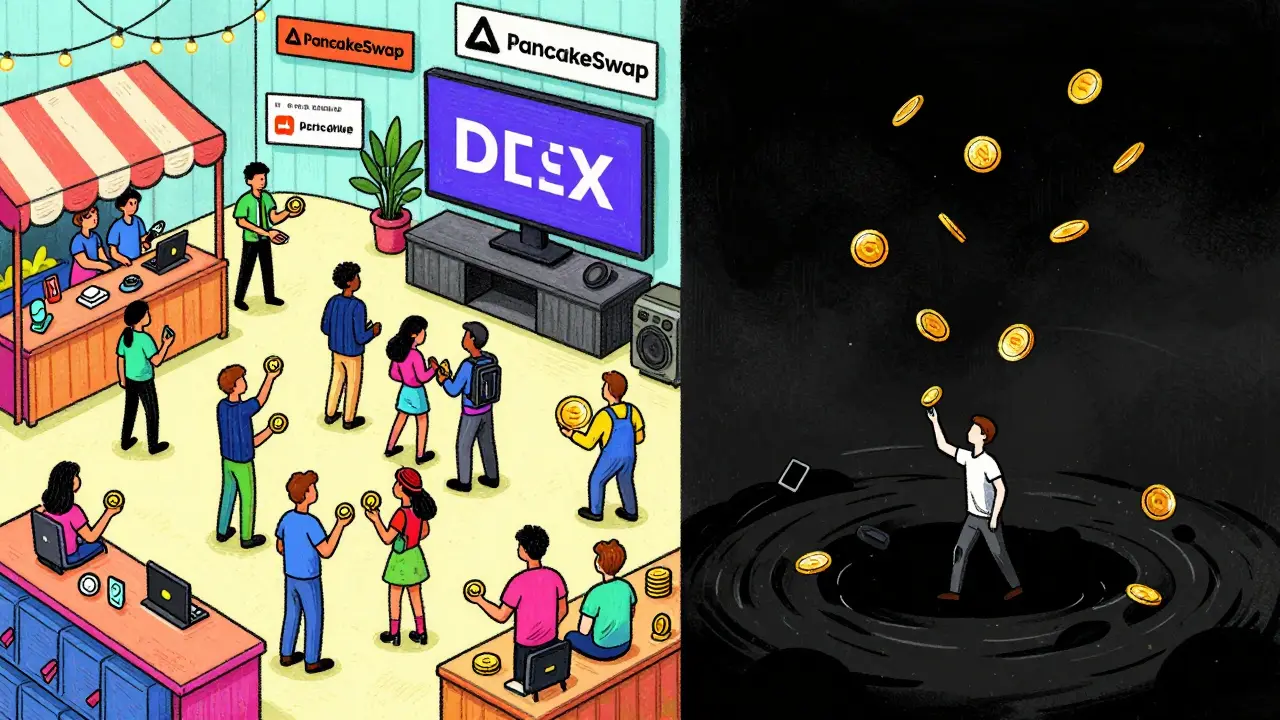
The table above highlights the stark contrast. While PancakeSwap and Uniswap battle for dominance with robust infrastructure and active communities, AmpleSwap sits idle. The claim that it is "cheaper and faster than Uniswap" is technically true regarding base layer costs on BSC versus Ethereum, but practically irrelevant if there is no one to trade with. Speed means nothing if you can't execute a trade without losing half your value to slippage.
Security Risks and the Lack of Social Proof
In decentralized finance, trust is established through transparency and community verification. We usually look for audits, bug bounties, and user testimonials. AmpleSwap fails on multiple fronts here. First, let's talk about social proof. Platforms like FxVerify, which aggregate user ratings for financial services, show AmpleSwap with a rating of 0 out of 5 stars based on 0 reviews. This absence of feedback is concerning. It doesn't necessarily mean users hate it, but it strongly suggests that very few people are using it, or those who did have left long ago due to poor experiences.
Security is another critical pillar. Industry best practices demand that exchanges demonstrate robust security histories, clear regulatory compliance, and transparent operations. Established players like Coinbase and Kraken invest heavily in Know Your Customer (KYC) procedures and banking integrations to meet regulatory standards. AmpleSwap’s regulatory status remains unclear. There is no public evidence of strong compliance frameworks or recent security audits that would give a cautious investor peace of mind. In the wake of numerous DeFi hacks over the years, operating without visible security credentials is a gamble most traders are unwilling to take.
Moreover, the existence of both "AmpleSwap (old)" and "AmpleSwap (new)" tokens indicates a history of migration or relaunch. While migrations happen in DeFi, they often confuse users and fragment liquidity. The fact that the "new" token also shows zero volume suggests that the relaunch did not successfully revive interest or restore confidence. Instead, it may indicate a project that struggled to maintain momentum and eventually faded into obscurity.
Why Liquidity Matters More Than Promises
You might wonder, "If it's on Binance Smart Chain, shouldn't it be cheap?" Yes, BSC transactions are generally cheaper than Ethereum mainnet transactions. However, low gas fees do not equal low trading costs. Trading costs include slippage-the difference between the expected price of a trade and the price at which the trade is executed. Slippage occurs when there is insufficient liquidity in the pool.
On a platform with zero volume, liquidity is shallow. If you attempt to swap even a modest amount of stablecoins for AMPLE tokens, you could experience extreme slippage. You might send $100 worth of USDT and receive only $80 worth of AMPLE because the pool couldn't absorb the trade size. This is a silent killer of capital. Experienced DeFi users prioritize liquidity depth over marginal fee savings. They know that being able to enter and exit positions quickly and at fair prices is more valuable than saving a fraction of a cent on gas.
Additionally, decentralized exchanges rely on smart contracts. If a contract has a bug or a vulnerability, and there is no active development team monitoring it, funds can be drained. With no active community and no visible updates, who is maintaining the code? Who is patching vulnerabilities? These are questions that remain unanswered for AmpleSwap, adding another layer of risk.

Better Alternatives for BSC Traders
If you are attracted to the idea of trading on Binance Smart Chain for lower fees, you have excellent, proven alternatives. PancakeSwap is the undisputed leader on BSC, offering deep liquidity, a wide variety of trading pairs, and additional features like yield farming and lotteries. It has survived multiple market cycles and maintains a strong developer presence. For those willing to explore other chains, Uniswap remains the gold standard for decentralized trading, now supporting multiple networks including Arbitrum, Optimism, and Polygon, providing a balance of security and accessibility.
For centralized exchange options, platforms like Binance offers extensive listings and high liquidity, while Kraken and Coinbase provide strong regulatory compliance and customer support for less adventurous traders. These platforms have established track records, active communities, and transparent operations. Choosing them reduces the risk of interacting with abandoned or vulnerable protocols.
Conclusion: Proceed with Extreme Caution
Based on the available data from mid-2026, AmpleSwap does not present a viable option for cryptocurrency trading. The combination of zero trading volume, absent user reviews, unclear regulatory standing, and lack of industry recognition paints a picture of a dormant project. While the initial promise of a cheaper, faster alternative to Uniswap was appealing, the reality is that the platform failed to capture and retain market share. In the high-stakes world of crypto, silence is rarely a good sign. It usually means the party is over, and the lights have been turned off.
For your safety and financial well-being, stick to platforms with proven liquidity, active development, and transparent security practices. Don't let the allure of a forgotten name lure you into a dead end. The crypto market is full of opportunities, but they exist where the activity is, not where the ghosts reside.
Is AmpleSwap safe to use in 2026?
Based on current data, AmpleSwap poses significant risks. It has zero trading volume, no user reviews, and an unclear regulatory status. The lack of activity suggests the platform may be inactive or abandoned, increasing the risk of smart contract vulnerabilities and inability to withdraw funds. It is recommended to avoid using it for substantial trades.
Why does AmpleSwap have zero trading volume?
Zero trading volume typically indicates a lack of user adoption, technical issues, or discontinuation of operations. For a decentralized exchange, liquidity is essential for functioning. The absence of volume on AmpleSwap suggests that users have migrated to more active platforms like PancakeSwap or Uniswap, leaving AmpleSwap without the necessary market participants to facilitate trades.
What is the difference between AmpleSwap old and new tokens?
The existence of "old" and "new" AmpleSwap tokens suggests a migration or relaunch event in the project's history. Such events often occur when a protocol upgrades its technology or attempts to reset its economic model. However, the fact that the "new" token also shows negligible activity indicates that the relaunch did not successfully revive the platform's popularity or utility.
Are there better decentralized exchanges on Binance Smart Chain?
Yes, PancakeSwap is the dominant decentralized exchange on Binance Smart Chain. It offers deep liquidity, a wide range of trading pairs, and additional DeFi features. Other multi-chain options like Uniswap also support BSC or similar low-fee networks, providing safer and more liquid environments for trading compared to inactive platforms like AmpleSwap.
Does AmpleSwap have regulatory compliance?
There is no publicly available information indicating that AmpleSwap has established strong regulatory compliance frameworks. Unlike major exchanges such as Coinbase or Kraken, which implement KYC procedures and adhere to regional regulations, AmpleSwap's status remains unclear. This lack of transparency adds to the overall risk profile of the platform.