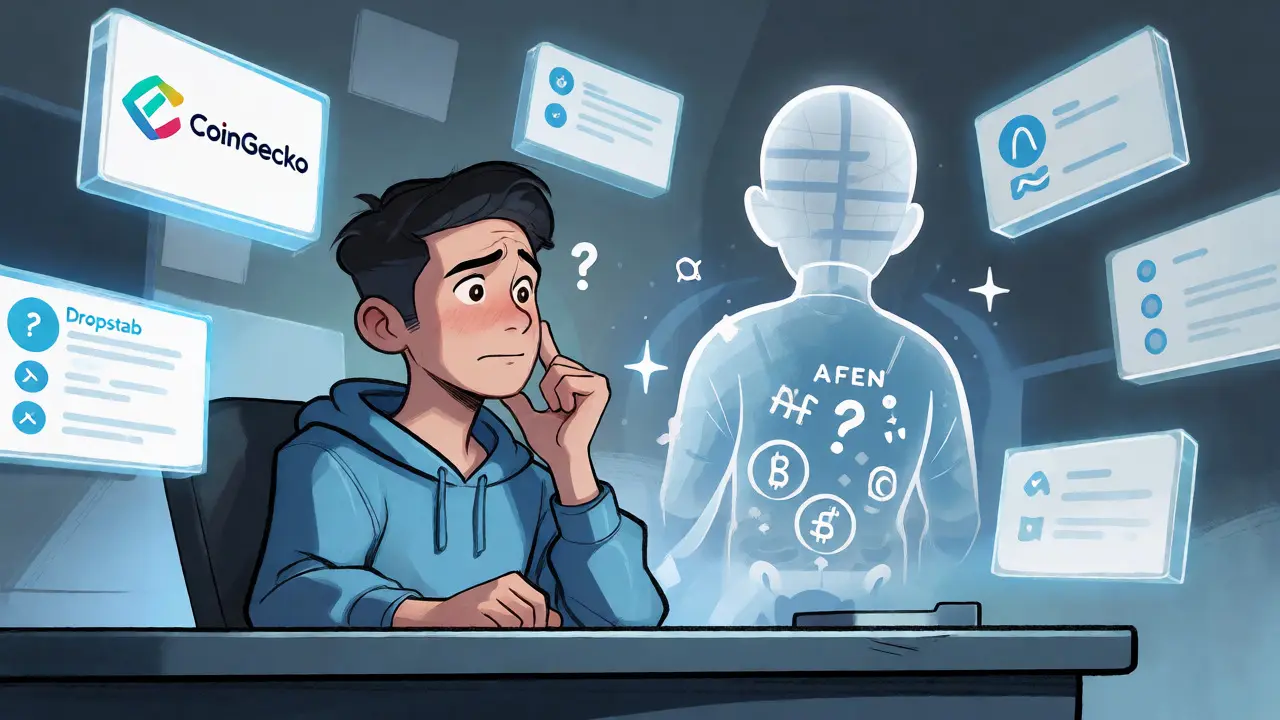
You probably saw it pop up in your Telegram groups or Twitter feed: AFEN Marketplace is offering a massive airdrop by the AFEN Blockchain Network. The promise? Free tokens for doing simple tasks. But before you connect your wallet and start hoping for a moonshot, pause. As of October 2026, major industry trackers like CoinGecko, WeEX, and Dropstab have zero record of this project. That silence is loud. If a legitimate blockchain network were launching a significant token distribution event, it wouldn't just be whispered about in niche chats; it would be all over the news.
The Ghost in the Machine: Why AFEN Is Missing from Major Lists
Think about how we verify almost everything else in crypto. When EigenLayer launched its staking rewards, or when Magic Eden dropped its ME tokens, the data was everywhere. Tokenomics were published, smart contracts were audited, and community sentiment was measurable across multiple platforms. Now, look at AFEN. Despite comprehensive coverage of over 30 potential airdrops in recent reports, AFEN Blockchain Network is absent. It’s not listed among the "rare opportunities" or the confirmed TGEs (Token Generation Events).
This absence isn't just an oversight. Platforms that track airdrops are aggressive about finding new projects because they want to capture traffic. If AFEN had a verifiable product-market fit, it would likely appear alongside competitors. Instead, you’re left with a name and a promise. This pattern often signals one of three things: it’s a brand-new project so early it hasn’t been indexed yet, it’s a rumor with no substance, or-and this is the big one-it’s a scam designed to harvest wallet connections.
Red Flags You Can Spot Without Being a Crypto Expert
You don’t need to read whitepapers to spot trouble. Legitimate airdrops follow specific rules of engagement. Here is what is missing from the AFEN narrative:
- No Official Documentation: Serious projects like Hyperliquid publish detailed allocation models. For example, Hyperliquid allocated 31% of supply for Genesis Distribution. AFEN offers vague promises without specifying total supply, vesting schedules, or utility.
- Lack of Community Buzz: Before a real airdrop hits, Reddit threads and Twitter spaces explode with speculation. Users discuss qualification criteria and share screenshots of their dashboard points. Search for "AFEN airdrop discussion" on major forums, and you’ll find crickets. No hype means no organic interest, which is rare for a project claiming to distribute free money.
- Absence from Trusted Aggregators: Sites like Koinly and MEXC curate lists based on verified activity. They warn users about "less than reputable airdrops." If a project doesn’t pass their basic due diligence filters, it’s a huge red flag.
| Feature | Established Project (e.g., Magic Eden) | Unverified/Rumor (e.g., AFEN) |
|---|---|---|
| Tokenomics Transparency | Clear % allocations (e.g., 12.5% for initial drop) | Vague or non-existent details |
| Community Presence | Active discussions on Reddit, X, Discord | Silent or bot-heavy social media |
| Tracker Inclusion | Listed on CoinGecko, Dropstab, etc. | Absent from major aggregators |
| Smart Contract Audit | Publicly available audit reports | Unknown or unaudited |
The Scam Playbook: How Fake Airdrops Work
If AFEN turns out to be a scam, here is exactly how they will try to get you. These schemes rely on FOMO (Fear Of Missing Out). They create a sense of urgency-"Claim now before it’s gone!"-and ask you to perform actions that cost you more than you think.
First, they might ask you to connect your wallet to a dApp (decentralized application) that looks professional but has no history. Once connected, they may prompt you to sign a transaction. Be careful: signing a malicious transaction can drain your funds. Unlike sending money, signing a permission can allow a contract to move your assets indefinitely. Second, some scams require you to pay a small "gas fee" or "claim fee" in ETH or BNB to receive your free tokens. If the fee is higher than the expected value of the airdrop, you’ve already lost. Third, they might ask for personal information or seed phrases. Remember rule number one: never share your private keys or seed phrase with anyone, especially for an "airdrop claim."

How to Verify Any Airdrop Yourself
Don’t take our word for it. Use these steps to check if AFEN-or any other project-is legit. This process takes five minutes and could save you thousands.
- Check the Website Domain: Does it look like a template? Are there typos? Legitimate projects invest in design and copywriting. Also, check the domain age using a WHOIS lookup. If the site was created last week, be skeptical.
- Look for Social Proof: Go to the official Twitter (X) account. Are the followers real people or bots? Do the comments have genuine questions, or are they all generic praise? Check the LinkedIn page of the founders. Do they exist?
- Cross-Reference with Aggregators: Search for the project on CoinGecko, Dropstab, or AirdropBee. If it’s not there, ask why. Sometimes new projects take time to get listed, but a complete absence after weeks of marketing is suspicious.
- Analyze the Tokenomics: Where does the money come from? Real airdrops are funded by investor capital or protocol revenue. If the math doesn’t add up-if they promise $1,000 worth of tokens per user but have no clear funding source-run.
What Should You Do With AFEN?
Given the lack of evidence, treat AFEN Marketplace as high-risk. If you really want to participate, do it with a burner wallet-a fresh wallet containing only a tiny amount of gas fees. Never use your main wallet where your savings sit. And never, ever input your seed phrase into a website asking for it.
The crypto space is littered with projects that promised the moon and delivered dust. While we hope AFEN is simply an under-the-radar gem waiting to be discovered, the current data suggests caution. Wait for confirmation from trusted sources before investing time or money. In the world of airdrops, patience is often the most profitable strategy.
Is the AFEN Marketplace airdrop legit?
As of late 2026, there is no verifiable evidence supporting the legitimacy of the AFEN Marketplace airdrop. Major crypto tracking platforms like CoinGecko and Dropstab do not list it, and there is minimal community discussion compared to established projects. It is highly recommended to treat it with skepticism until official documentation and audits are released.
Why isn't AFEN listed on airdrop trackers?
Trackers usually require a project to have a verified smart contract, active development, and a certain level of community traction before listing them. AFEN's absence suggests it may be too new, unverified, or potentially a scam operation that lacks the transparency required for inclusion in reputable databases.
Can I lose money by participating in the AFEN airdrop?
Yes. Risks include paying unnecessary gas fees, connecting your wallet to a malicious contract that drains funds, or providing personal data to phishing sites. Always use a burner wallet for unknown airdrops and never share your private key or seed phrase.
How do I know if an airdrop is a scam?
Common signs include requests for your seed phrase, pressure to act immediately, lack of a clear whitepaper, and absence from trusted news outlets. If a project asks you to send crypto to "verify" your wallet, it is almost certainly a scam.
Which airdrops are currently considered reliable?
Projects with established ecosystems like EigenLayer, LayerZero, and MetaMask (if they launch a token) are generally considered more reliable due to their transparent operations, large user bases, and consistent communication through official channels.