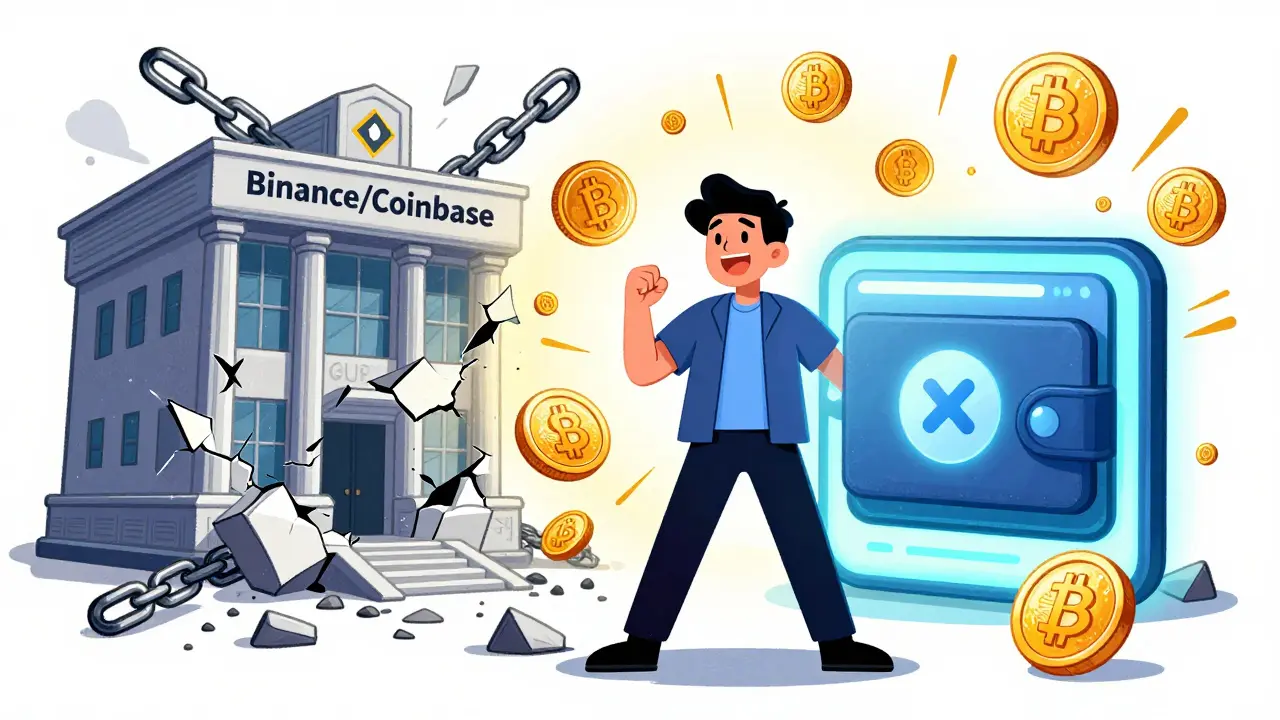
When you trade crypto on a centralized exchange like Binance or Coinbase, you're handing over your keys to someone else. Your coins sit in their wallet. Their servers. Their rules. And if they get hacked, go bankrupt, or freeze your account - your money vanishes. That’s not speculation. It’s happened dozens of times. Decentralized exchanges (DEXs) flip that model entirely. They let you trade directly from your own wallet, with no middleman, no deposits, and no one holding your keys. That’s not just a technical difference - it’s a game-changer for how you control your money.
Full Control Over Your Assets
On a DEX, you never send your crypto to the exchange. You keep it in your own wallet - MetaMask, Phantom, or whatever you use. When you swap ETH for UNI, the trade happens through a smart contract. The contract reads your wallet balance, moves the tokens, and confirms the trade. No one else touches your funds. Not the platform. Not a CEO. Not a hacker who breaks into their database. This is called self-custody. And it’s the biggest advantage most people overlook. If you own your keys, you own your crypto. No one can freeze your account because there’s no account to freeze. No one can seize your funds because they don’t have access to them. This isn’t theoretical. In 2022, when FTX collapsed, users lost over $8 billion because they trusted a centralized platform. On a DEX, that kind of disaster is impossible.No KYC, No Privacy Risks
Centralized exchanges force you to upload your ID, passport, selfie, and sometimes even proof of address. They store all that data. And guess what? That data gets stolen. Constantly. In 2021, KuCoin lost $281 million in a breach, and user personal data was exposed. In 2023, Kraken had a breach that leaked emails and IP addresses. DEXs don’t ask for any of that. You don’t sign up. You don’t verify your identity. You just connect your wallet and start trading. That means no KYC means no data to steal. No government forcing them to freeze your account. No bank blocking your withdrawal because they don’t like crypto. If you want to trade anonymously - and many people do - DEXs are the only way.Access to More Coins - Especially New Ones
Want to trade a new token launched yesterday? On a centralized exchange? Good luck. They have lists. Rules. Fees. Delays. Sometimes, a token has to be on a CEX for months before it’s even listed. On a DEX? As soon as a project deploys its smart contract and adds liquidity, it’s tradable. That’s why you’ll find hundreds of new tokens on Uniswap, SushiSwap, or Pump.fun that you can’t find anywhere else. Many DeFi projects launch directly on DEXs because they can’t afford the listing fees or don’t want the censorship risk of centralized platforms. If you’re into early-stage crypto, DEXs are your only window.Lower Fees and No Hidden Costs
Centralized exchanges charge trading fees - usually 0.1% to 0.4%. But they also charge deposit fees, withdrawal fees, inactivity fees, and sometimes even fees for using their mobile app. Some even charge you to withdraw stablecoins. DEXs? Most only charge the blockchain’s network fee - what’s called gas. On Ethereum, that might be $2 to $10. On Solana? Often less than $0.01. There are no extra fees. No surprise charges. You pay what the network charges, and that’s it. No middleman taking a cut. No hidden fine print.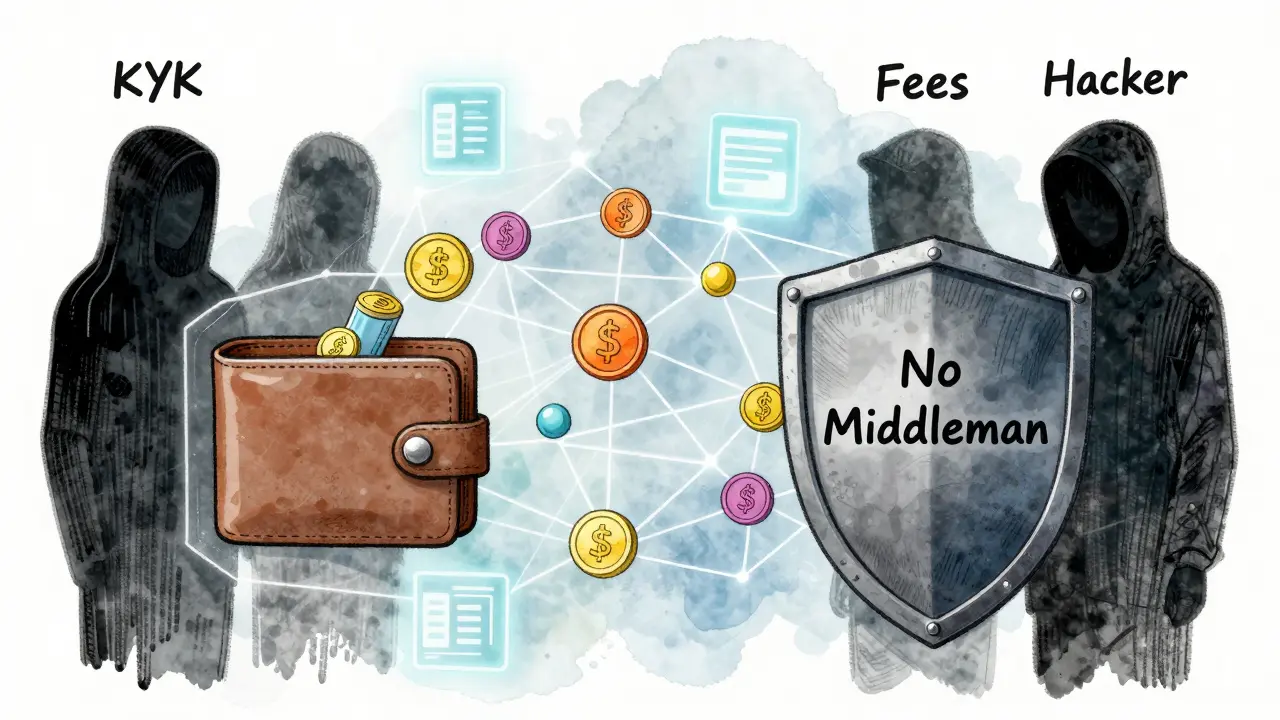
Resistant to Censorship and Regulation
If a government bans crypto trading, centralized exchanges have to comply. They shut down. They freeze accounts. They cut off access. In 2024, several CEXs pulled out of countries like Nigeria and India due to regulatory pressure. DEXs? They’re code running on a blockchain. No headquarters. No CEO to arrest. No bank account to seize. Even if regulators crack down on a DEX’s team, the platform keeps running because it’s decentralized. The smart contracts don’t need anyone to operate. They just work. That’s why DEXs remain active in regions where centralized exchanges are banned or restricted.Integrated with DeFi - More Than Just Trading
A DEX isn’t just a place to swap tokens. It’s a gateway to the whole DeFi world. Once you’re on a DEX, you can instantly access:- Liquidity pools - earn interest by lending your tokens
- Yield farming - get rewards for providing liquidity
- Staking - lock tokens to earn more
- Loans - borrow crypto without selling
- Derivatives - trade futures and options
Less Market Manipulation
On centralized exchanges, fake trading - called wash trading - is common. Bots create fake buy and sell orders to trick people into thinking a coin is popular. Exchanges sometimes even do it themselves to boost volume and attract users. DEXs are transparent. Every trade is on the blockchain. Anyone can see it. There’s no hidden order book. No secret volume. You can check the real liquidity in a pool. If a token has $5 million in liquidity, that’s real. No one can fake it. That’s why serious traders prefer DEXs for accurate price discovery.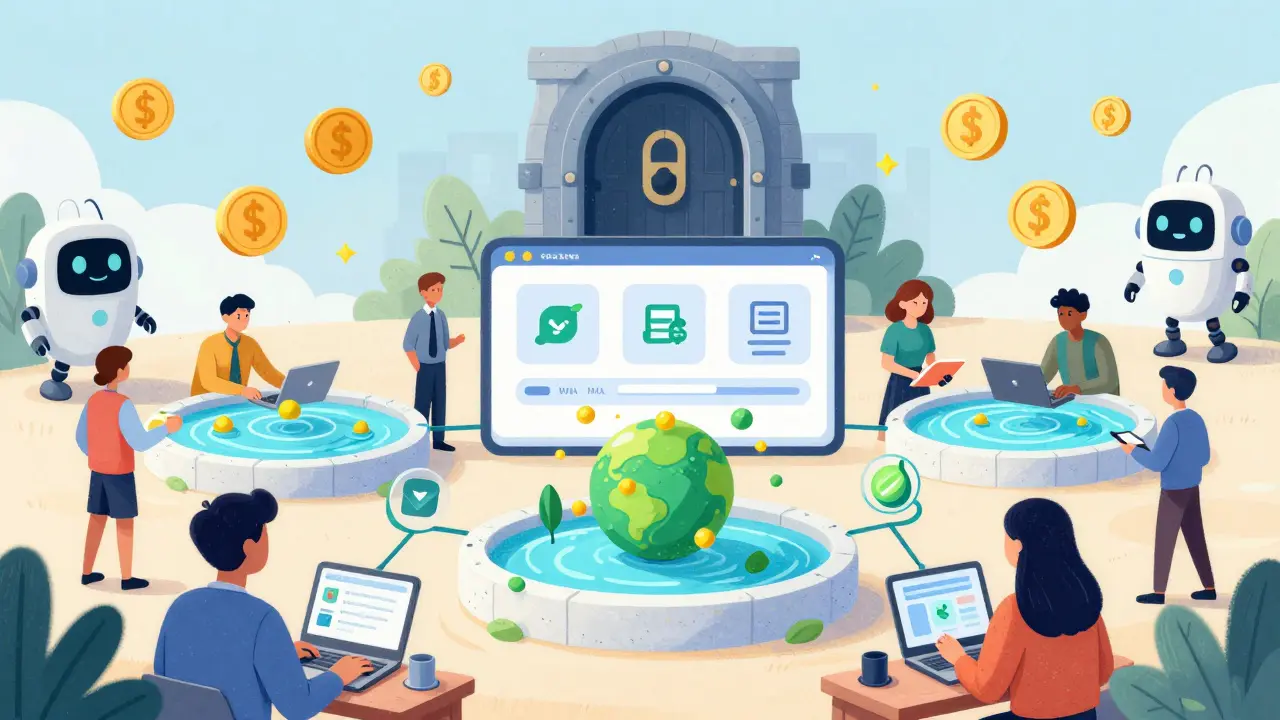
But It’s Not Perfect
Let’s be real - DEXs aren’t magic. They have problems. Slippage can be high on small tokens. You might pay $15 in gas to swap $50 worth of crypto. Interfaces are clunky. If you lose your private key? Your money is gone forever. No customer support. No reset button. And yes - most DEXs don’t accept credit cards or bank transfers. You need crypto already to use them. That’s a barrier for beginners. But none of those issues change the core truth: DEXs give you control, privacy, and freedom that centralized exchanges can’t match. The trade-off isn’t convenience - it’s responsibility. And for many, that’s worth it.Who Should Use a DEX?
You should use a DEX if:- You want full control over your crypto
- You care about privacy and hate KYC
- You trade new or small-cap tokens
- You’re into DeFi and want to earn yield
- You live in a country where centralized exchanges are banned
- You’re tired of platforms freezing your funds
- You’re new and want simple, one-click buys with fiat
- You trade large amounts daily and need deep liquidity
- You rely on customer support when things go wrong
The Future Is Decentralized
DEXs aren’t going away. They’re getting better. New AMM models like concentrated liquidity (used by Uniswap V3) are reducing slippage. Layer-2 networks like Arbitrum and zkSync are slashing gas fees. Fiat on-ramps are starting to integrate - now you can buy crypto with a debit card and swap it directly on a DEX without ever touching a CEX. The movement isn’t about replacing centralized exchanges. It’s about giving people a real alternative. One where you’re not a customer. You’re the owner. If you’ve ever felt like crypto exchanges control you - not the other way around - it’s time to try a DEX. Start small. Learn the flow. Connect your wallet. Do one swap. You’ll see why millions are already making the switch.Are decentralized exchanges safe?
Yes - if you use them correctly. DEXs themselves don’t get hacked like centralized exchanges because they don’t hold your funds. But your wallet can be compromised if you click a phishing link or lose your private key. Always verify contract addresses, never share your seed phrase, and use a hardware wallet for large amounts. Safety comes from your habits, not the platform.
Can I trade fiat on a DEX?
Not directly. DEXs only trade crypto-to-crypto. To get started, you need to buy crypto first on a centralized exchange or via a fiat on-ramp service like MoonPay or Ramp. Then you send that crypto to your wallet and connect it to a DEX. Some newer DEXs now integrate fiat on-ramps directly, but you’re still not depositing dollars into the DEX itself.
What happens if I lose my private key?
Your crypto is gone forever. There is no recovery. No customer service. No reset button. That’s why backing up your seed phrase - and storing it securely offline - is the most important step in using a DEX. Treat it like a bank vault combination. If you lose it, you lose everything.
Are DEXs legal?
Yes, in most countries. Because DEXs don’t have a central company or bank account, regulators struggle to shut them down. However, some jurisdictions restrict access to certain DEXs or require users to report trades. Always check local laws, but unlike centralized exchanges, DEXs aren’t legally required to comply with KYC or freeze accounts.
Do DEXs have lower trading fees than centralized exchanges?
Usually, yes. DEXs charge only the blockchain’s network fee (gas), which can be as low as $0.01 on Solana or $2 on Ethereum. Centralized exchanges charge 0.1%-0.4% per trade, plus withdrawal and deposit fees. For frequent traders, the savings add up fast. But if you’re trading small amounts, high gas fees can make DEXs more expensive - so always check current network conditions.
Think about it - DEXs aren’t just tech. They’re a philosophy. You’re not trading crypto, you’re reclaiming sovereignty. Every swap is a middle finger to banks, regulators, and CEOs who think they own your money. The fact that you can do this anonymously, without begging for approval? That’s revolutionary. Not just better - *liberating*.
And yeah, gas fees suck sometimes. But when your keys are yours and no one can freeze your portfolio because you said ‘no’ to KYC? That’s peace of mind you can’t buy.
I started with $50 on Uniswap. Now I’m in DeFi full-time. No regrets. Just freedom.
OMG YES!! I just did my first swap on SushiSwap yesterday and I’m STILL smiling 😊
Used to be terrified of losing my coins but now I get it - if I lose my seed phrase, THAT’S on me. And honestly? That’s WAY better than some corp freezing my account because ‘regulations’.
Also, the fact I can earn yield while just holding ETH? Magic. 🌟
Just wanted to say thank you for this post. I’ve been lurking for months, scared to touch DEXs because I thought I’d mess up and lose everything.
You made it feel doable. I connected my wallet today. Did a tiny swap. Felt like I’d unlocked a secret level in life.
Still nervous, but now I’m excited too. 💪
It’s wild how much emotional weight this carries, honestly. It’s not just about efficiency or fees - it’s about autonomy. You know how in the 90s people were terrified of email because they thought it’d be hacked? Now we send everything through it. DEXs are like that - the tech isn’t perfect, but the principle is undeniable.
I’ve watched people lose millions on centralized exchanges because they trusted a brand. But I’ve never seen someone lose funds because a DEX got hacked. The contract doesn’t have feelings. It doesn’t care about your ID. It just executes.
And honestly? That’s kind of beautiful. Cold, logical, fair. No CEO can flip a switch and say ‘oops, your money’s gone’. The blockchain doesn’t apologize. It just works.
Yeah, the UIs are ugly. Yeah, slippage sucks. But the underlying architecture? It’s the first time crypto actually delivered on its promise. Not as a meme. Not as a gamble. As a system where you’re not a customer - you’re the owner.
And that changes everything.
While the advantages of decentralized exchanges are compelling, one must not overlook the responsibility they entail. The absence of customer support is not a feature - it is a fundamental shift in user accountability. One must become their own bank, their own auditor, their own security team.
This is not inherently superior, merely different. For those with technical literacy and risk tolerance, DEXs offer unparalleled control. For the average user seeking simplicity and recourse, centralized platforms still serve a vital function.
The future may be decentralized, but adoption requires education - not just evangelism.
DEXs are just a hype cycle built on gas fees and delusional degens. You think you’re sovereign? Bro you just paid $12 in gas to swap $20 of a token that’s 90% rug. Real traders use CEXs for liquidity and order depth. DEXs are for gamblers with too much time and no risk management. And don’t even get me started on ‘no KYC’ - that’s just a backdoor for money laundering and pump and dumps. You’re not free. You’re just reckless.
Agreed with the core points. One thing I’d add: DEXs aren’t just for traders. They’re for people who want to own their financial identity.
I use them to earn yield on stablecoins. I don’t touch my main wallet. Just a small portion. But it’s passive income with zero counterparty risk. No bank can take it. No government can freeze it. No CEO can disappear with it.
It’s not magic. But it’s real. And it’s working.
For anyone new: start with a tiny amount. Like $5. Just to see how it feels.
Connect your wallet. Swap ETH for DAI. See the transaction go through. Feel that chill? That’s the feeling of being in control.
It’s not about being a crypto expert. It’s about taking one small step away from being someone’s customer.
You’re not late. You’re right on time.
DEXs good for techies. But most people want to buy crypto with credit card. Not with seed phrase. CEXs still dominate because they solve real problems. DEXs are niche. Not better. Just different. And gas fees on Ethereum still kill small trades. Solana helps but not everywhere. So don’t oversell it.
Ugh. Another ‘freedom’ post. You know what’s really freedom? Not having to think about private keys or slippage or contract addresses. I just want to buy Bitcoin with my debit card and forget about it. Why does everyone act like DEXs are the answer to everything? They’re just a pain in the ass with more risks.
And don’t even get me started on ‘no KYC’ - yeah, that’s great until the IRS comes knocking and you have no paper trail. You’re not a revolutionary. You’re just irresponsible.
Y’all are killing me with the ‘freedom’ talk 😭
I just started using a DEX last week after my CEX got hacked. Lost $800. Not fun. But then I tried Uniswap… and it felt like… I didn’t lose anything because I never gave it away.
Still scared. Still mess up the UI. But now I back up my seed phrase on paper. Like, actual paper. In a safe. And I’m not embarrassed to say I cried when my first swap went through.
It’s not perfect. But it’s mine. And that’s enough for now.
Oh, so now we’re all libertarians who think blockchain solves everything? How charming.
Let’s not pretend DEXs are immune to manipulation. Liquidity mining? Pump-and-dump tokens with fake volume? Slippage traps? The anonymity doesn’t make it fair - it makes it wild west.
And ‘no KYC’? That’s not freedom. That’s regulatory evasion. And yes, it’s why governments are cracking down.
Maybe the future isn’t ‘no middleman’ - maybe it’s better middlemen.
I live in India. CEXs got banned last year. DEXs saved my portfolio. No one shut them down. No one froze my wallet. I trade daily. Gas is $0.03 on Polygon. I earn yield on USDC. I don’t need a bank. I don’t need approval. Just my phone and a seed phrase. This isn’t theory. This is life.
One thing I wish more people understood: DEXs don’t require you to be a coder. You just need to be careful.
I use MetaMask. I verify contract addresses with DeFiLlama. I never click random links. I use a hardware wallet for anything over $500.
It’s not about being a genius. It’s about building habits. Small ones. Consistent ones.
And honestly? That’s the real win. You’re not just trading crypto. You’re building discipline.
The paradigm shift is undeniable. Decentralized exchanges represent a structural evolution in financial architecture, where trust is algorithmically enforced rather than institutionally delegated. The elimination of counterparty risk - particularly in the context of systemic failures such as FTX - underscores the resilience of permissionless systems. Furthermore, the composability of DeFi primitives enables atomic, non-custodial interactions that are mathematically verifiable and immutable. This is not merely a technological upgrade - it is a foundational reconstitution of monetary sovereignty.
Bro you think DEXs are the future? Nah. They’re the *now*. CEXs are dinosaurs with HR departments and legal teams. Meanwhile, I’m swapping a new memecoin at 3 AM on zkSync with $0.001 gas while my friend in Nigeria buys ETH with his phone balance.
Regulators? They can’t shut down code. Banks? They can’t freeze a wallet they don’t control.
You wanna be free? Stop begging for permission. Connect your wallet. Do the swap. Own it.
And if you lose it? Then you learned. That’s the price of real freedom.
No customer service. No refunds. No excuses. Just you. And the blockchain.
That’s not a bug. That’s the point.